For about 430,000 people worldwide who use cochlear implants, all devices currently on the market share one obvious characteristic: the processor is worn on the outside of the head. It either hooks over the ear or fastens to the skull using a magnet, thereby signalling its presence to anyone who looks aside. This is about to be altered. The first fully implanted cochlear implant, Envoy Medical’s Acclaim device, is now available to patients as part of a clinical trial, with no external hardware.
The Acclaim is completely beneath the skin; there is no microphone positioned behind the ear or a magnetic disc sticking to the scalp, nothing at all that can be seen. Among the 56 people who took part in the trial, three have now reached the twelve-month mark; the experience is one of hearing without advertisements.
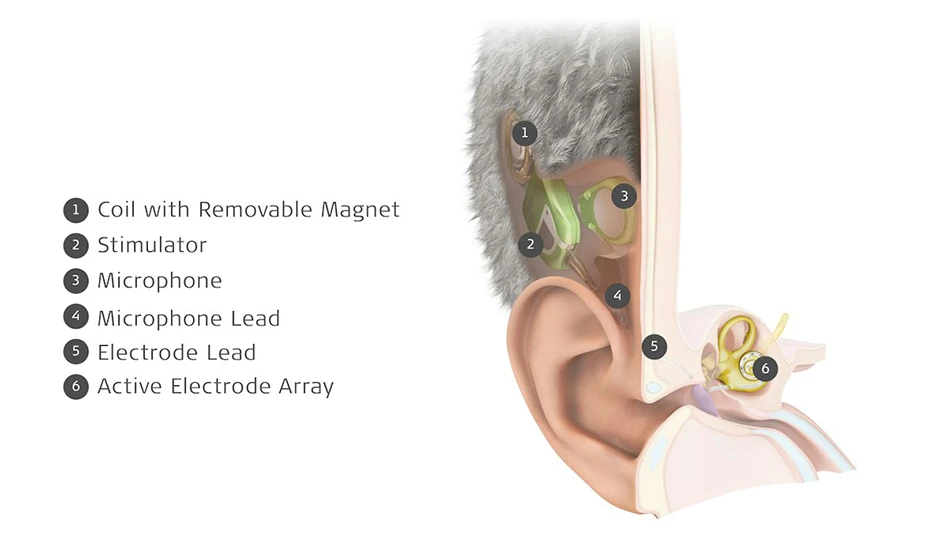
If you remove a conventional cochlear implant, you will see an external microphone that picks up sound, a processor that converts it into electrical signals, and an electrode array threaded into the cochlea to transmit small currents to the auditory nerve. The Acclaim retains the electrode array but modifies all upstream components.
Rather than using an external microphone, Envoy Medical created a proprietary piezoelectric sensor which is placed against the ossicular chain - the three small bones in the middle ear that vibrate when sound waves reach the eardrum. The sensor converts these mechanical vibrations directly into electrical signals, so the patient’s own ear canal and eardrum serve as the microphone. It is an elegant example of engineering that leverages millions of years of evolutionary acoustic design.
The power is supplied by a built-in rechargeable battery, with charging occurring wirelessly through the skin via electromagnetic induction, just as with charging a phone on a pad, the only difference being that the coils are only millimetres apart rather than centimetres.
The signal-processing chip, having been shrunk so as to fit into the titanium case, performs a type of spectral analysis similar to that carried out by external processors; it breaks down the incoming sound into frequency bands, assigns these bands to the positions of the electrodes along the spiral of the cochlea, and sends out current pulses at a rate which exceeds one thousand per second.
Engineering Deep Dive: From Electricity to Light, the Next Frontier in Cochlear Stimulation
The Acclaim is one philosophical approach to the problem: retain the electrical stimulation model but miniaturise all the components so that they will fit under the skin. In contrast, a team at the University Medical Centre Göttingen in Germany is pursuing a much more radical solution; they wish to substitute electricity with light.
Typical cochlear implants use between 12 and 24 electrode contacts to stimulate the auditory nerve. That may seem like a reasonable figure when one takes into account that a normal human cochlea has about 3,500 inner hair cells distributed along a 35mm spiral, each of them responding to a slightly different frequency. It is a bit as if one were trying to perform a symphony on a piano having only a dozen keys.
The issue lies in the way physics works. When electrical current passes through tissue, it does so in wide, overlapping fields. Even if you increase the number of electrodes, their signals still bleed into each other. That is why many people with cochlear implants have difficulty understanding music and speech in noisy situations. There isn’t sufficient frequency resolution.
Light does not diffuse in the same manner; a concentrated beam of light could act on a much smaller number of neurons, perhaps just a few hundred micrometres in extent as opposed to several millimetres with electrical stimulation. The team from Göttingen is employing a technique known as optogenetics, adapted from neuroscience research, to make auditory neurons respond to light.
The spiral ganglion neurons are genetically modified to express channelrhodopsins, light-sensitive proteins originally found in algae. Upon exposure to blue light, the modified neurons open their ion channels; the cell depolarises, and a nerve impulse is generated. This achieves the same final result as electrical stimulation but with greatly improved spatial precision.
The hardware challenge lies in creating an array of micro-LEDs small enough to be inserted into the cochlea. The group is using flexible substrates that carry between 64 and 128 individually addressable LEDs, each smaller than a grain of sand. This provides five to ten times as many stimulation channels as any existing electrical implant.
There are still major obstacles to overcome: the gene therapy approach uses viral vectors to deliver the channelrhodopsin genes, and long-term safety data from human trials are currently unavailable. There is also concern about power consumption given the large number of LEDs involved, although the team has advanced their ultra-efficient micro-LED designs, which now require only microwatts per pulse.
The optical method may not be available for clinical use for about ten years, but if it doesworkr going from channelss to 128 could be what makes the difference between understanding speech in quiet rooms and actually enjoying a concert.
The reason why both of these approaches are so convincing is that they address the same basic problem from different angles. According to the Acclaim, the electrical model is valid; therefore, we should make it unseen. The optical implant, on the other hand, argues that the model is what limits things, and so it should be reimagined. As a result, progress in cochlear engineering is now advancing at a pace not seen since the first commercial implant was fitted in 1982. This rapid progress is of great importance to the 34 million children worldwide with hearing loss.