For 25 years, biomedical engineers have been making more advanced organs-on-chips.
These tiny devices imitate how human tissues work using small pieces of plastic and glass. They can model organs like the lung, gut, and even the blood-brain barrier. But until now, none could truly copy how blood flows through arteries. The new accordion blood flow pump from Texas A&M University finally solves this problem, and its story starts with a student playing music on campus.
Dr Abhishek Jain, an associate professor at Texas A&M, faced a tough engineering challenge. His lab creates micro-physiological systems, or organ-on-a-chip devices, which grow living human cells inside channels thinner than a hair. These systems could help reduce animal testing, speed up drug development, and let researchers study disease in more realistic conditions. But the pumps were a problem.
Blood does not flow steadily through human arteries. Each heartbeat creates a pressure wave that moves out from the heart, changing the flow every 50 milliseconds or so. Syringe and peristaltic pumps, which are common in labs, cannot adjust direction and speed fast enough. They are either too slow, not accurate enough, or both. Because of this, most organ-on-a-chip experiments use constant, even flow, which is not how blood moves in the body.
One afternoon, Jain saw a student playing an accordion. The instrument’s bellows squeeze and stretch to move air quickly and in a controlled way. He realized this idea could be used to move fluid through a microfluidic chip much better than current pumps. Dr Ankit Kumar, a PhD student in Jain’s group, started testing the idea using cheap, accordion-shaped glue bottles instead of expensive prototypes.
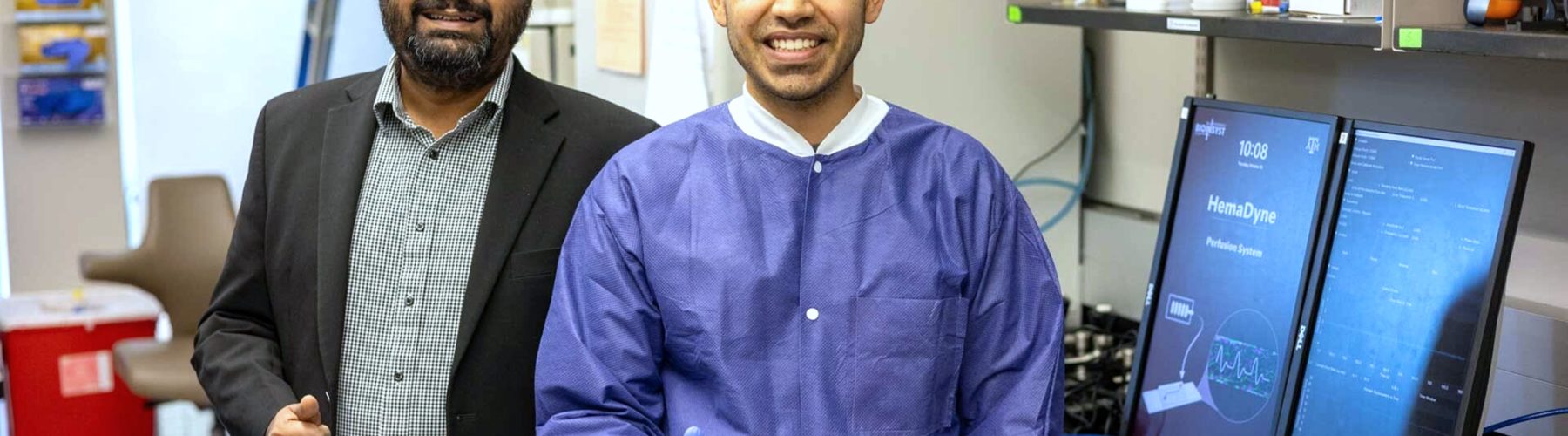
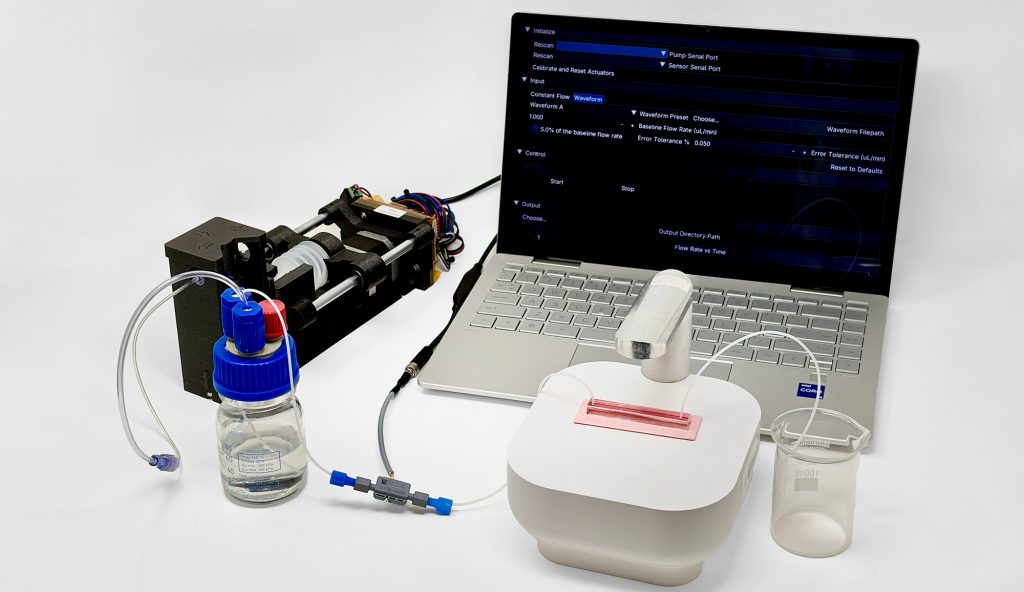
The device they created, called HemaDyne, is a microfluidic system that uses small bellows shaped like an accordion. A stepper motor squeezes and releases each bellows in a set pattern. Since the bellows walls are flexible and easy to move, the system can change the flow rate in just milliseconds, much faster than regular pumps.
The control software is what makes the accordion blood flow pump especially smart. The team used G-code, the same open-source language used in most 3D printers, to turn real patient blood flow data into exact motor commands. For example, a doctor records an arterial waveform from a patient, and that data is turned into a G-code script that tells HemaDyne how to move. This lets the chip experience flow patterns that match the patient’s own blood flow, down to the millisecond.
The team published their results in Nature Communications in July 2026. They showed that HemaDyne can copy patient-specific blood flow patterns with enough detail to capture even the fastest parts of a human pulse. The device can also run for months at a time, which is important for long-term studies of chronic diseases.
The uses for this device go beyond heart research. Jain’s group has received NASA funding to study how microgravity and cosmic radiation affect blood vessels during long space missions. NASA sees the accordion blood flow pump as a valuable tool for learning about the heart risks astronauts might face on a trip to Mars.
Engineering deep dive: how the accordion blood flow pump works
Microfluidics and lab-on-a-chip technology
Microfluidics is the study of moving very small amounts of fluid, usually microlitres or nanolitres, through tiny channels in chips made from materials like PDMS or glass. A lab-on-a-chip combines several lab functions on a chip just a few centimetres wide. In medicine, scientists grow living human cells inside these channels to see how tissues develop, react to drugs, or respond to disease. Because the channels are so small, the fluid moves smoothly and predictably, not chaotically.
If you have studied A-level physics, you might recognize some of these ideas. A difference in pressure pushes fluid through a channel, similar to how voltage pushes current through a resistor. The Hagen-Poiseuille equation explains how the flow rate in a tube depends on the pressure drop, the tube’s radius, the fluid’s thickness, and the tube’s length.
Why bellows create better pressure waveforms
Traditional syringe pumps push a plunger into a stiff barrel at a set speed. To change direction, the motor has to slow down, stop, and then go the other way, which takes time because of the moving parts. Peristaltic pumps squeeze soft tubing with rollers to create pulses, but the shape of these pulses is set by the rollers and does not match the way the heart pumps blood.
The HemaDyne bellows solve both of these problems. An accordion bellows is a thin, folded chamber that can quickly collapse and expand. Since the walls are flexible and light, the system can respond very fast. This means the pump can go from no flow to full flow and back in just a few milliseconds, matching the quick changes in blood pressure waves.
G-code control systems
G-code is a simple text language first made for CNC machines in the 1950s and now used in most 3D printers. Each line tells a motor where to go and how fast. The HemaDyne team used open-source 3D printer software, so the electronics and software are cheap and easy to find. They turn a recorded blood flow pattern into a list of flow rates, and a script changes each one into a G-code command for the motor that moves the bellows.
Endothelial cells and shear stress
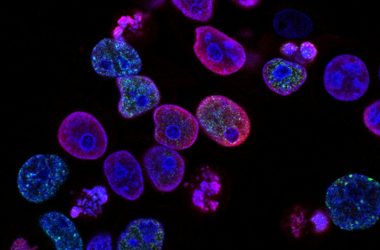
The cells that line blood vessels, called endothelial cells, are active and responsive. They feel the force of blood flowing over them, known as wall shear stress. In areas where this force is low or uneven, like the inside curve of a branching artery, these cells can become inflamed and more likely to develop atherosclerosis. When the force is steady and high, they line up with the flow and protect the vessel. HemaDyne lets engineers apply the full range of blood flow forces, so the cells on the chip feel what they would inside a real artery.
Why millisecond precision matters
The systolic upstroke, which is the quick rise in blood flow when the heart contracts, happens in about 50 to 100 milliseconds. If a pump cannot keep up, it blurs the flow pattern, and the cells on the chip do not get the sharp signals they would in the body. Millisecond-level control is not just a fancy feature; it is the basic requirement for studying how blood flow affects blood vessels.
Most people do not think of the accordion when they hear about biomedical engineering. But its folding bellows, perfected over hundreds of years of music, have now given engineers the missing piece for a technology that could change how we study disease, test new drugs, and get astronauts ready for space. Sometimes, the best engineering ideas are right in front of us, just waiting to be noticed.
- Texas A&M engineers built HemaDyne, an accordion blood flow pump that replicates human arterial waveforms on lab-on-a-chip systems with millisecond precision
- The device uses cheap accordion-shaped bellows and open-source 3D printer G-code to convert patient-specific blood flow data into pump instructions
- It solves a 25-year limitation: existing pumps were too slow to recreate the rapid pressure changes of a human heartbeat
- Applications include studying vascular disease, drug testing, ageing research, and NASA-funded spaceflight health studies for missions to Mars