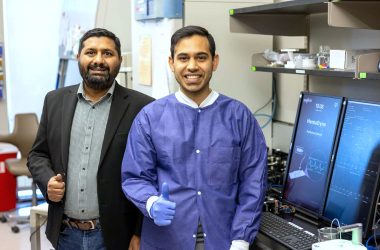
Alessandro Grattoni holds up an object about the size of a grain of rice between his gloved fingers. At first glance, it seems ordinary - a small, pale fibre that could easily be overlooked on a lab bench. But once placed inside a tumour, it gradually dissolves from the inside out over several weeks, releasing a precise dose of cancer drugs right where they are needed.
The device, created by Grattoni’s team at Houston Methodist, is a biodegradable cancer implant called a biodegradable nanofibrous drug-eluting seed, or b-NDES. It addresses a long-standing challenge for oncologists. When chemotherapy and immunotherapy drugs are given through the bloodstream, most of the medicine ends up in other parts of the body, like the liver or kidneys, causing healthy tissues to suffer the same toxic effects as the cancer. Grattoni’s implant avoids the bloodstream completely. It stays inside the tumour and slowly releases the drugs over several weeks instead of just hours.
In a study published in the Journal of Controlled Release, researchers tested the implant in preclinical models of triple-negative breast cancer. This aggressive type of cancer does not respond to hormone therapies and is known for being difficult to treat. The team used the b-NDES along with radiation and two immunotherapy drugs that help the immune system find and attack cancer cells. As a result, tumours disappeared completely in 60% of the treated models, and there were no major side effects elsewhere in the body.
The implant is made from nanofibers, which are threads much thinner than a human hair. The fibres are spun into a scaffold that holds the drug and controls how quickly it is released. According to a report on phys.org, the fibrous structure is designed so the material breaks down at a steady, predictable rate. This allows the drug release to be carefully adjusted. If the release is too fast, it can cause local toxicity; if it is too slow, it may not affect the tumour enough. Grattoni’s team aimed for a balance: the b-NDES releases the drug slowly enough to keep the immune response going, but quickly enough to leave the body once its work is finished.
Combining radiation with local immunotherapy is important because tumours are skilled at hiding from the immune system. Radiation harms cancer cells and reveals markers that immune cells can detect. At the same time, the released drugs remove the signals that tumours use to tell immune cells not to attack. Delivering all three treatments together, directly at the tumour site, creates a much stronger effect than using them separately, according to the team’s findings.
Triple-negative breast cancer was chosen deliberately. It accounts for around 15% of breast cancer diagnoses, disproportionately affects younger women, and lacks the three receptors, oestrogen, progesterone and HER2, that other treatments target. A biodegradable cancer implant that works locally, without relying on those receptors, opens a route to treating a form of the disease that has few good options.
So far, this work has only been done in preclinical models, and Gratton emphasises that point. If human trials go ahead, they will need to confirm safe dosing, consistent manufacturing, and how the implant breaks down over time in real patients. Still, the main engineering challenge - creating an implant that breaks down on a set schedule while carrying the right amount of drug - has been solved well enough to take the next steps.
Engineering Deep Dive: How a Biodegradable Cancer Implant Controls Its Own Breakdown
At its heart, designing a biodegradable cancer implant is a materials engineering challenge that looks like a medical problem. The b-NDES is made using a process called electrospinning. In this method, a polymer solution is pushed through a tiny nozzle with high voltage, creating a jet that stretches and thins as it moves. By the time it lands on a collector, it has turned into a fibre less than a micrometre wide - about one hundredth the width of a human hair. When many of these fibres are layered together, they form a nonwoven mesh with a huge surface area compared to its volume, much like how a sponge fits a large surface into a small space.
The large surface area is key. If the drug were inside a solid block of polymer, it would be released slowly and unevenly, only from the surface. But with a fibrous mesh, fluids can move between the fibres, letting the drug inside the polymer spread out from a much bigger internal surface. Engineers mainly control how fast the drug is released by changing the thickness of the fibres and the type of polymer used. Thicker fibres and slower-degrading polymers make the release last for weeks, while thinner fibres and faster-degrading polymers release the drug more quickly.
Students who have studied polymer chemistry and reaction rates will recognise the basic idea. Here, biodegradation is a hydrolysis reaction, where water molecules break the polymer’s chemical bonds, turning long chains into shorter, water-soluble pieces that the body can remove. The speed of this reaction depends on how much surface area is exposed to body fluids, similar to how powdered substances react faster than lumps in science experiments. Grattoni’s team uses the same principle that explains why a crushed antacid tablet dissolves faster than a whole one, but with much more precision and on a much smaller scale.
Deciding where to put the drug inside the fibre involved its own set of choices. If the drug is near the surface, it comes out quickly in a burst, which can help start an early immune response but might be risky if the concentration gets too high near healthy tissue. If the drug is deeper inside the fibre, it is released more slowly and steadily, which is better for keeping the immune response going over weeks but slower to start working. The team’s method, using radiation and two immunotherapy drugs, suggests a layered or blended design: a quick initial release to activate the immune system, followed by a longer, steady release to keep fighting the tumour.
Making the implant biodegradable is not automatic. The polymers used are usually polyesters like polylactic-co-glycolic acid, chosen because their ester bonds can be made to break down at different rates by changing the ratio of their two main parts. If the ratio is off, the implant might last too long and trigger an immune response, or dissolve too soon before treatment is finished. The implant also needs to be stiff enough to be inserted with a needle without breaking, but soft enough not to harm nearby tissue as it breaks down.
The next big engineering challenge is moving from making these implants one by one in the lab to producing thousands of them with the same fibre thickness, drug amount, and breakdown timing. Even small changes in electrospinning conditions - like humidity, voltage, or flow rate - can affect the fibre size and change how the drug is released. Fixing this consistency issue, more than any single advance in drug chemistry, will decide if implants like the b-NDES can go from lab models to real clinical use.
If future tests confirm these results, the b-NDES could change how cancer drugs are given. Instead of treating the whole body, doctors could place a carefully designed device right where it is needed. While triple-negative breast cancer was the first test case, this fibre-based platform could also deliver different drug combinations to other solid tumours. For now, this work is as much a step forward in materials engineering as it is in medicine.
- Houston Methodist researchers built a biodegradable cancer implant the size of a grain of rice
- The b-NDES device releases immunotherapy drugs directly inside a tumour rather than through the bloodstream
- Combined with radiation, it eliminated tumours completely in 60% of preclinical triple-negative breast cancer models
- No significant side effects were recorded elsewhere in the body
- The research, led by Alessandro Grattoni, is published in the Journal of Controlled Release