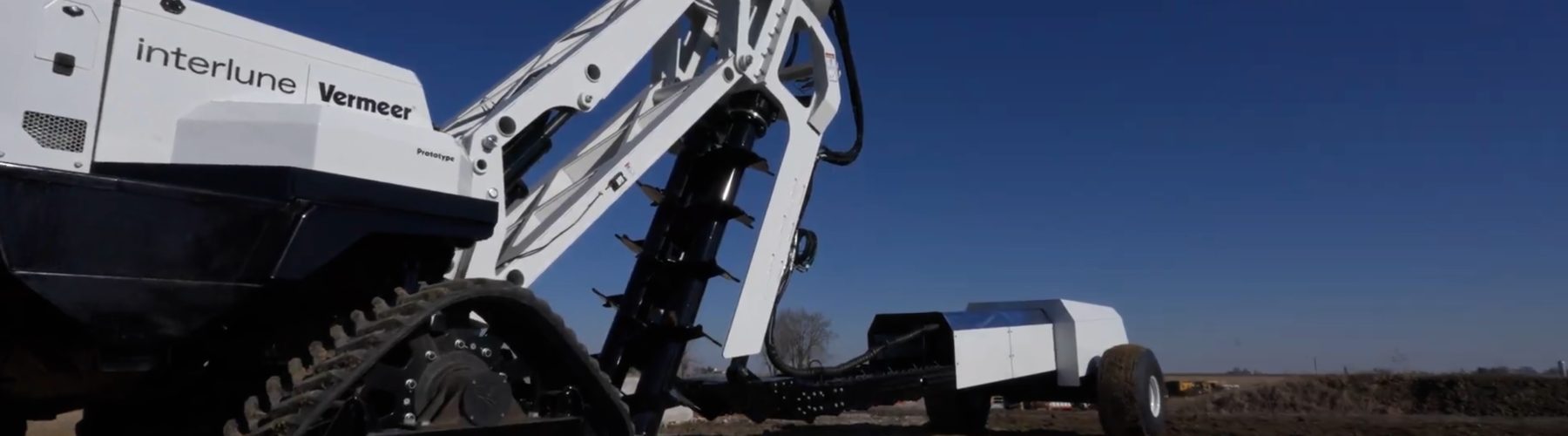
For 75 years, Vermeer Corporation has built trenchers and ploughs for farmland in Pella, Iowa. Their machines dig irrigation channels, lay fibre optic cable, and work the prairie soil. Now, that same engineering is being adapted for a new challenge: working with lunar regolith, far from any cornfield.
On July 30, 2026, Vermeer and Houston-based Interlune announced they were expanding their partnership. The two companies have already built a full-scale prototype of a lunar excavator, a continuous trencher that can process 100 metric tons of lunar regolith per hour. They aim to deliver a mission-ready version by 2028.
Interlune is not mainly focused on building habitats on the Moon. Instead, the company is interested in helium-3, a rare isotope found in the lunar surface after billions of years of solar wind. Helium-3 could be useful for future fusion power and quantum computing. Interlune's business depends on being able to dig, sort, and process large amounts of regolith efficiently. This need, along with NASA's requirements for lunar site-preparation equipment, calls for similar types of machinery.
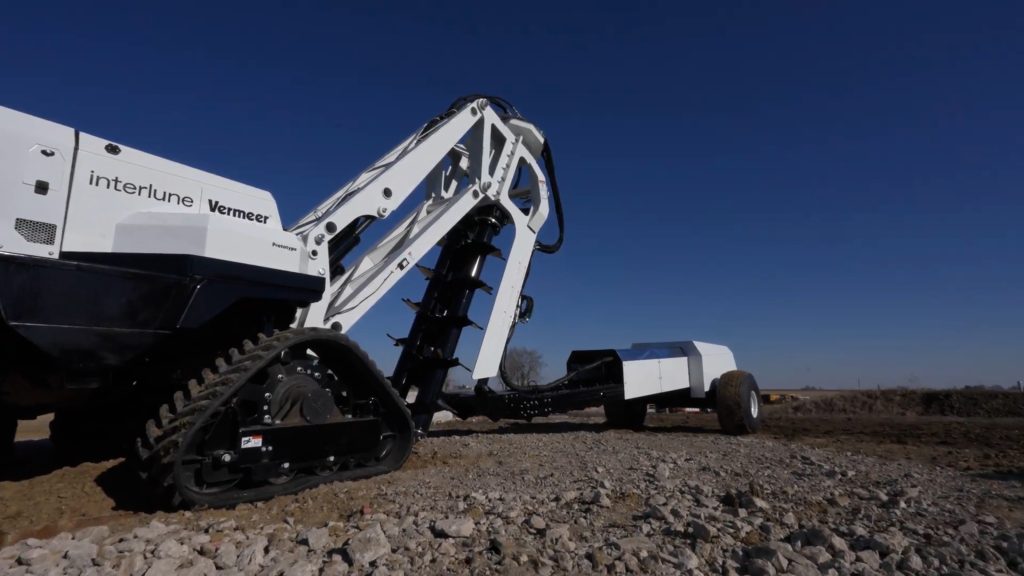
The trencher moves forward, constantly scooping up regolith and feeding it into an onboard system. There, a cryogenic process separates helium-3 gas from the rest of the material. According to Interesting Engineering, the continuous-feed design is key to reaching the 100-metric-ton-per-hour rate because it avoids the delays of lifting and dumping with a traditional excavator arm.
Before sending anything to the Moon, the excavator will be tested on Earth in terrain chosen to mimic the loose, abrasive, and low-gravity conditions of lunar soil as closely as possible. Only after this Earth-based test proves the design meets NASA's requirements will the hardware be adapted for a real lunar mission. This step is part of the larger Moon Base program, which needs prepared ground for habitats, landing pads, or solar arrays.
Vermeer offers something many space contractors do not have: decades of experience with how heavy digging equipment can fail. Bearings can seize, hydraulic seals wear out, and cutting teeth dull at different rates depending on the soil. This knowledge of how trenchers break down on Earth is exactly the kind of expertise NASA needs for equipment that will be far from any mechanic.
Getting the lunar excavator right is important for more than just Interlune's helium-3 goals. NASA's Moon Base plans rely on moving and processing regolith at a large scale, whether for resource extraction, building landing pads, or shielding structures from radiation with compacted lunar soil. If a machine can reliably process 100 metric tons an hour and make the jump from Earth prototype to lunar system, it would be among the first true industrial machines to work off-world.
Engineering Deep Dive: Adapting Earthmoving Machinery for One-Sixth Gravity
Moving a ton of soil is easy on Earth, but moving a ton of lunar regolith is a much different challenge, even though the basic actions are the same. The main difference is gravity. The Moon's gravity is about one-sixth of Earth's. While this means it takes less force to lift things, it also makes it harder for machines to get traction. On Earth, a trencher can dig into loose soil because its weight helps it grip the ground. On the Moon, with much less weight, the machine might just spin its tracks without getting a good hold.
Lunar regolith acts very differently from most soils on Earth. Because there has been no wind or water erosion for billions of years, lunar particles are sharp and angular, more like broken glass than smooth sand. This makes them much more abrasive, wearing down cutting edges, seals, and bearings much faster than Earth soil would. Vermeer's experience with these kinds of problems is valuable here. Engineers choose materials and designs for cutting teeth based on how quickly the soil wears down metal, which ties into material science topics like hardness, wear resistance, and the balance between toughness and resistance to abrasion.
Interlune and Vermeer chose a continuous-trencher design instead of a bucket-wheel or scoop excavator because it is more efficient. A scoop excavator has to slow down, dump its load, and start again each time, which wastes energy and time. A continuous trencher keeps moving and cutting without stopping, much like a conveyor belt in a factory. To keep up the 100 metric tons per hour rate, the system that moves material from the cutting edge to the processor must match the cutting speed and avoid jams. This requires careful control of how fast the particles move and the speed of the conveyor.
After the regolith reaches the processing system, helium-3 is extracted using a cryogenic process. This means cooling the material until the gases inside separate at their different boiling points, similar to how gas plants on Earth separate nitrogen, oxygen, and argon from air. Running this system reliably on the Moon, with its vacuum and extreme temperature changes - from about 120 degrees Celsius in sunlight to minus 130 degrees in shadow - creates a big thermal management challenge in addition to the mechanical ones.
Testing the equipment on Earth first allows engineers to check the mechanical and thermal systems in controlled, repeatable conditions. This helps them find problems that would be much more expensive to fix after launch. It follows a basic rule in aerospace engineering: make sure the system works where you can repair it before sending it somewhere you cannot.
A working lunar excavator would be one of the first pieces of true industrial equipment designed for long-term use off Earth, not just a scientific tool or a one-time sample return. Whether Interlune and Vermeer meet their 2028 goal depends on how successful the Earth tests are over the next two years, and how much of Vermeer's engineering can be used without changes on the Moon.
- Interlune and Vermeer expanded their partnership on 30 July 2026 to build lunar construction equipment
- A full-scale prototype excavator processes 100 metric tons of lunar regolith per hour
- The continuous trencher separates helium-3 gas from regolith using a cryogenic process
- The tool will be demonstrated on Earth before being adapted for the Moon
- A mission-ready version is targeted for delivery by 2028 to support NASA’s Moon Base programme