In the Mojave Desert, at Northrop Grumman’s Scaled Composites facility, engineers are building an aircraft unlike any other. JetZero’s Jet1, a full-scale blended wing body demonstrator, is now in final assembly. If successful, it could reduce airline fuel use by half.
This idea isn’t new - NASA tested blended wing body shapes in wind tunnels years ago. But no one has built one for commercial use or certified it for passengers. JetZero aims to do both. Their design merges the fuselage and wings into one smooth lifting surface. Imagine a manta ray, flattened and stretched to a 185-foot (56-metre) wingspan. The entire underside of the aircraft generates lift, not just the wings, so it can carry the same payload with much less thrust.
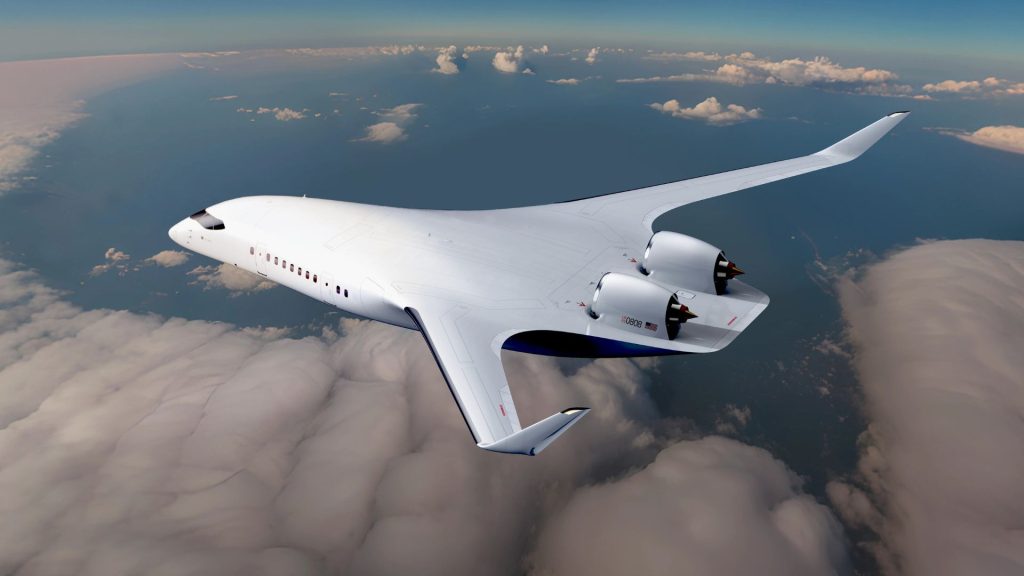
The Jet1 demonstrator is made almost entirely from carbon fibre reinforced polymer (CFRP). Composites are common in modern planes - Boeing’s 787, for example, is about half composite by weight. But blended-wing-body aircraft are harder to build because their large, unusual shape does not fit inside a standard autoclave, the pressurised oven used to cure composite parts.
JetZero solves this by building the autoclave around the aircraft itself. Instead of moving large composite sections to a curing facility, engineers assemble the carbon fibre parts in place and cure them right there. This co-curing method bonds the parts into one solid structure in a single heating cycle. With fewer joints, there are fewer fasteners, less weight, and fewer places where problems could develop.
From desert prototype to production line
JetZero has a clear plan to move from prototype to airline service. Jet1 is set for its first flight in late 2027. At the same time, JetZero is working on a production model called the Z4, which will have a 213-foot wingspan and seat about 250 passengers. Serial production will take place at a new campus in Greensboro, North Carolina.
Money is not the constraint it once was. In January 2026, JetZero raised $175 million from a roster that includes B Capital, United Airlines Ventures, Northrop Grumman, and RTX Ventures. United Airlines has gone further, securing the option to purchase up to 100 blended-wing-body aircraft. The US Air Force, which funded early development, remains closely involved. And the FAA has transferred the design to its normal transport aircraft certification office, a quiet but significant signal that regulators consider this a real commercial programme, not a research curiosity.
Engineering deep dive: why blended wing body aircraft burn less fuel
To see how JetZero could save 50 per cent on fuel, it’s important to consider three aerodynamic factors that work together.
First is the lift distribution. In a regular plane, most lift comes from the wings, while the fuselage is just extra weight the wings have to support. In a blended wing body, the whole shape helps generate lift. The fuselage is part of the wing, not just a tube underneath. This spreads the load over a larger area, so each part has to work less hard, reducing drag.
Second is wetted area. Drag depends on how much of the aircraft’s surface is exposed to the air. Blended wing body planes have a much lower ratio of surface area to internal volume than traditional designs. There is no wing-fuselage junction, which usually creates a lot of drag. The smooth, continuous surface helps reduce drag everywhere.
Third is structural efficiency. Regular planes have round fuselages because circles handle internal pressure well. Blended wing body cabins are wider and flatter, so they need to handle pressure differently. This could be a problem, but carbon fibre composites are much better than aluminium at handling loads from different directions. JetZero’s co-curing process eliminates the need for bolted joints, creating a strong shell in which the outer surface carries the load. The weight saved by skipping thousands of fasteners offsets the extra material required for the new shape.
The co-curing process is interesting on its own. Normally, making composite parts means laying carbon fibre prepreg onto a mould, sealing it in a vacuum bag, and putting it in an autoclave. For Jet1, the mould stays in place. Instead, a portable autoclave, like a big heated pressure bag, wraps around the structure. The temperature rises to about 180 degrees Celsius, and the pressure increases to around 6 bar, which bonds the resin and fuses the parts together. This method removes the usual size limits. It’s been used for boat hulls and wind turbine blades, but never before at this scale for a pressurised aircraft.
Getting certified is another challenge. The FAA’s safety rules were made for traditional tube-and-wing planes. Blended wing body aircraft behave differently in areas like flutter, cabin evacuation, and structural loads. JetZero has to demonstrate compliance with Part 25 transport standards, likely through a mix of analysis, ground tests, and flight tests. The fact that the FAA moved the project to its regular certification office suggests they believe the current rules can work for this design, perhaps with some special conditions, rather than rewriting everything.
Aviation is responsible for about 2.5 percent of global carbon dioxide emissions, and that number is rising as more people fly and other industries cut their emissions faster. Sustainable aviation fuel helps, but there isn’t enough of it yet. Electric planes work for short trips, but can’t match jet fuel for long flights. Cutting fuel use by 50 percent just by changing the shape of the plane would be the biggest efficiency jump in commercial aviation since turbofan engines arrived in the 1960s. JetZero’s assembly floor in the Mojave could be where this new chapter starts.
- JetZero is assembling Jet1, a full-scale blended wing body aircraft demonstrator, at Scaled Composites’ facility in Mojave, California
- The design merges fuselage and wings into a single lifting surface, claiming up to 50% lower fuel consumption than conventional jets
- Built from carbon fibre using a novel co-curing process where the autoclave is built around the aircraft
- First flight is targeted for late 2027, with United Airlines holding options for up to 100 production aircraft
- Raised $175M in January 2026 from B Capital, United Airlines Ventures, Northrop Grumman, and RTX Ventures