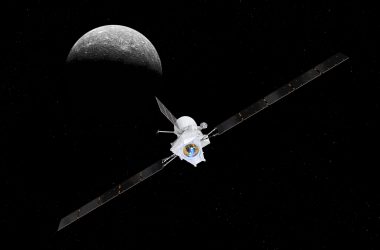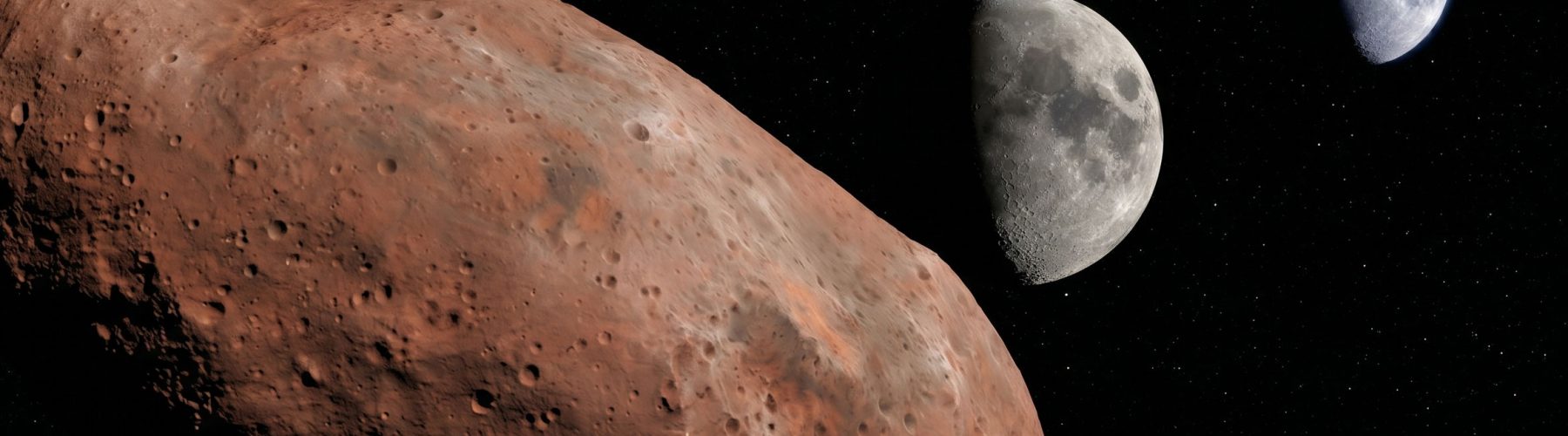
On 7 June 2026, a spacecraft the size of a large car fired its thrusters and slipped into orbit around a rock no wider than a football pitch. That rock, called Kamoʻoalewa, circles the Sun on a path so close to Earth’s own that astronomers call it a quasi-satellite. And the spacecraft, Tianwen-2, has one job over the next year: get close enough to grab a handful of dust and bring it home. The Tianwen-2 asteroid sample return is now officially underway, and it could answer a question that has nagged planetary scientists for decades. Where did this strange little object come from?
Kamoʻoalewa was spotted in 2016 by the Pan-STARRS telescope at the University of Hawaii’s Haleakala Observatory on Maui. It is small, somewhere between 40 and 100 metres across, and its orbit weaves around Earth’s in a curious corkscrew pattern. It never strays far from us, yet it is not gravitationally bound to our planet. It belongs to the Sun.
What makes Kamoʻoalewa genuinely odd is its colour. Spectral measurements taken from ground-based telescopes show it reflects light in a way that closely matches that of lunar silicate rock, rather than the carbon-rich material typical of near-Earth asteroids. One leading hypothesis, published by a team at the University of Arizona, suggests it is a fragment of the Moon blasted free by a large impact millions of years ago. If Tianwen-2 can return even a few grams of surface material, laboratory analysis will settle the debate.

The spacecraft launched in May 2025 and spent roughly a year in transit. Amateur radio operators tracked its telemetry during the final approach, decoding signals that revealed thruster firings and navigation updates in near real time. Orbit insertion placed Tianwen-2 about 20 kilometres from Kamoʻoalewa’s surface. Over the coming months, mission controllers at the Beijing Aerospace Control Centre will lower that altitude in stages, first to a few kilometres, then to just 600 metres, mapping the asteroid in extraordinary detail before the collection phase begins.
Sample collection is scheduled to start on 4 July 2026. The Tianwen-2 asteroid sample return mechanism will use a touch-and-go approach, similar in concept to the technique JAXA’s Hayabusa2 used at asteroid Ryugu in 2019. The 2,100-kilogram spacecraft carries 11 science instruments, including a visible-infrared imaging spectrometer, a thermal radiation spectrometer, a multispectral camera, and a detection radar capable of probing below the surface: a magnetometer, charged and neutral particle analysers, and an ejecta analyser round out the payload. Two dedicated navigation sensors, one narrow-field optical and one laser-based, will guide the final descent.
Once the sample is secured, Tianwen-2 faces an 18-month cruise back to Earth. The return capsule is due to separate from the mothership on 29 November 2027 and descend under a parachute to a landing zone in the Gobi Desert. But that is not the end of the mission. After releasing its precious cargo, the spacecraft will use an Earth gravity slingshot to redirect itself toward the main asteroid belt. Its target there is 311P/PanSTARRS, an active asteroid that periodically ejects dust tails like a comet. Arrival is pencilled in for 24 January 2035. If it gets there, the Tianwen-2 asteroid sample return mission will have become one of the longest and most ambitious deep-space campaigns ever flown.
Engineering Deep Dive: How Do You Orbit a Rock That Barely Has Gravity?
Kamoʻoalewa is tiny. At perhaps 60 metres across (splitting the estimated range), it has a mass of roughly a few hundred thousand tonnes, depending on its density. That gives it a surface gravitational acceleration many thousands of times weaker than Earth’s. Standing on it, you would weigh less than a grain of sand does on your kitchen scales. Orbiting such an object is not like orbiting a planet. It is more like formation flying with a pebble.

The Problem of Staying Close
Around Earth or Mars, orbital mechanics follow a comfortable script. A spacecraft fires its engine to reach the right altitude and velocity, and the planet’s gravity does the rest, holding it in a stable ellipse described by Kepler’s laws. Around Kamoʻoalewa, the gravitational pull is so feeble that even gentle disturbances, such as solar radiation pressure on the spacecraft’s panels, tiny outgassing events, and the gravitational tug of the Sun, can push Tianwen-2 off course in hours.
The solution is what engineers call a “quasi-orbit” or station-keeping trajectory. Rather than relying on the asteroid’s gravity alone, the spacecraft uses its thrusters in frequent, small pulses to maintain a controlled path around the body. Navigation sensors continuously measure the distance and relative velocity between the spacecraft and the asteroid. Onboard software computes correction burns autonomously because the 20-second light-time delay to Earth makes real-time joystick control impossible at the required precision.
Sensing the Surface
The 11 instruments aboard Tianwen-2 exploit different parts of the electromagnetic spectrum, a concept A-level physics students will recognise from the study of waves and photons. The visible-infrared imaging spectrometer splits reflected sunlight into its component wavelengths, revealing which minerals are present on the surface. The thermal radiation spectrometer measures infrared emissions from the asteroid itself, providing data on surface temperature and thermal inertia (how quickly the surface heats up and cools down, which tells engineers whether they are looking at bare rock or loose dust). The multispectral camera captures images at several specific wavelength bands simultaneously, building up a colour-coded mineral map.
Below the surface, the detection radar sends radio pulses into the ground and listens for echoes bouncing off buried layers or voids. This is the same principle behind ground-penetrating radar used in archaeology and civil engineering on Earth, scaled for a body with no atmosphere and almost no gravity.
Touch and Go: Momentum on a Micro Scale
A-level students studying Newton’s third law and conservation of momentum can see both principles at work during the sample collection. When the spacecraft’s sampling arm contacts the surface, it must do so gently enough to avoid bouncing off into space (remember, the escape velocity from Kamoʻoalewa is probably less than walking pace). The reaction force from touching the surface pushes back on the spacecraft, so thrusters must fire simultaneously to keep the probe in contact long enough to collect material. Every gram of sample picked up changes the spacecraft’s mass and, therefore, its momentum. Navigation software accounts for this shift in real time.
Getting Home: The Gravity Slingshot
The return journey offers a textbook example of gravitational slingshot mechanics. After dropping the sample capsule at Earth, Tianwen-2 will pass close to our planet and gain velocity from Earth’s gravitational field without burning fuel, trading orbital energy with the planet itself. This free speed boost is what makes the extended mission to 311P/PanSTARRS feasible. Without it, the fuel budget would fall far short of reaching the main belt. The same physics applies whenever a spacecraft swings past Jupiter or Venus. It is Newton’s law of gravitation and conservation of energy working together across millions of kilometres.
Why It Matters for Engineering Careers
The Tianwen-2 asteroid sample return demands expertise spanning guidance, navigation and control (GNC) engineering, RF and optical sensor design, thermal management in deep space, materials science for the sample containment system, and parachute recovery engineering for the Gobi Desert landing. Each of those fields connects directly to modules in aerospace, mechanical, electronic, and physics degrees at UK universities. If asteroid mining ever becomes commercially viable, missions like this one will have written the engineering playbook.
China’s Tianwen-2 asteroid sample return mission sits alongside JAXA’s Hayabusa2 and NASA’s OSIRIS-REx as one of only a handful of missions ever to collect material from a small body and return it to Earth. For students weighing up A-level choices or university applications, the engineering behind it spans from Newtonian mechanics and electromagnetic wave theory to autonomous software and precision manufacturing. These are not abstract textbook topics. They are the tools that, right now, are steering a spacecraft around a sliver of rock 40 metres wide, half a million kilometres from home.
- China’s Tianwen-2 spacecraft entered orbit around asteroid Kamoʻoalewa on 7 June 2026
- Kamoʻoalewa is a quasi-satellite of Earth, possibly a fragment of the Moon ejected by an ancient impact
- The spacecraft carries 11 instruments and will study the asteroid from altitudes down to 600 metres before collecting a surface sample
- Sample return to Earth’s Gobi Desert is scheduled for November 2027
- An extended mission will take the spacecraft to active asteroid 311P/PanSTARRS in the main belt, arriving 2035