Designing a hypersonic engine used to take months of painstaking layout work before a single component could be analysed in detail. GE Aerospace has just done it in seconds.
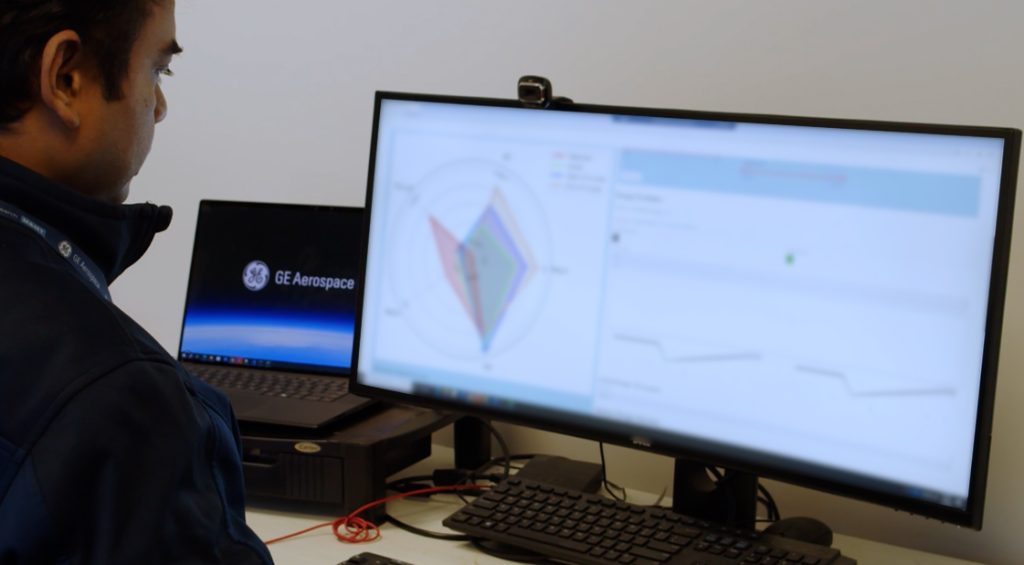
The company announced on 19 May 2026 that it had completed preliminary design studies for a hypersonic dual-mode ramjet engine using an in-house-built generative AI application. The app did not produce a single optimised layout. It returned hundreds of candidate configurations in a single session, each satisfying the geometric, thermal, and performance constraints specified by engineers.
Joe Vinciquerra, General Manager and Senior Executive Director at GE Aerospace Research, put it plainly: the company is “all-in on AI.” That phrase gets thrown around in corporate announcements so often that it has lost most of its force, but in this case, the engineering backs it up. Preliminary design is the phase where engineers define the basic architecture of an engine: where the inlet sits relative to the combustor, how the flow path contracts and expands, where fuel is injected, and how the structure supports it all. Getting this phase right determines whether a design is worth pursuing into detailed engineering. Getting it wrong wastes months or years.
A dual-mode ramjet operates in two distinct regimes. At speeds below roughly Mach 5, it functions as a conventional ramjet, decelerating incoming air to subsonic speeds before combustion. Above Mach 5, the engine transitions to scramjet mode, where air passes through the combustor at supersonic speeds. Designing for both modes in a single engine is one of the hardest problems in propulsion engineering, because the flow conditions, temperatures, and pressures are radically different in each regime. The geometry that works well at Mach 3 may be catastrophic at Mach 7.
This is precisely the kind of problem where generative AI shows its value. A human engineer might explore a dozen layout variations over several months, using experience and intuition to guide the search. The AI application explored hundreds of variations in the time it takes to drink a cup of coffee. Each candidate layout was checked against the specified constraints before being presented to the engineering team, allowing the humans to focus on evaluationand selection rather than on generating and filtering.
The distinction matters. Generative AI in this context is not replacing engineers. It removes the bottleneck of manual layout generation, allowing engineers to spend their time on decisions that require judgment, experience, and physical intuition. The AI does not know which layout will be easiest to manufacture, or which will behave best under off-design conditions, or which will be cheapest to maintain. Those questions still belong to people.
GE Aerospace is not confining its AI tools to experimental hypersonic engines. The company is expanding the same generative design application to the CFM International RISE programme, a joint venture with Safran to develop the next-generation narrowbody aircraft engines. RISE, which stands for Revolutionary Innovation for Sustainable Engines, is based on an open-fan architecture that promises a step change in fuel efficiency compared to current turbofan designs. The aerodynamic complexity of an open fan, with its exposed, counter-rotating blade rows, makes it a natural candidate for AI-assisted layout exploration.
Separately, GE Aerospace has recently been awarded a US Air Force contract for the GE426 engine, which will power autonomous combat aircraft. The preliminary design review for that engine is forthcoming. And the company’s XA102 adaptive-cycle engine, designed for the new F-47 fighter jet, has been cleared for the next phase of development. The XA102 is an adaptive cycle design, meaning it can switch between high-thrust and high-efficiency modes in flight, a capability that no production engine has achieved before.
Taken together, these programmes paint a picture of an aerospace propulsion company that is investing simultaneously in near-term production engines and long-term experimental technologies, using AI as a common thread to accelerate them all. The risk, of course, is that AI-generated designs may converge on local optima or miss unconventional solutions that a creative human engineer might discover. GE’s approach, which generates many candidates and then applies human judgment, is designed to mitigate that risk. Still, it will take several design cycles to determine whether it consistently produces better engines or merely faster preliminary layouts.
Engineering Deep Dive: Dual-Mode Ramjets and the Physics of Hypersonic Combustion
A ramjet is conceptually the simplest type of jet engine. It has no moving parts. Air enters the inlet at high speed, is compressed by the intake duct, mixed with fuel, burned, and then expelled through a nozzle. The compression comes entirely from the ram effect of forward motion, which is why ramjets cannot operate from a standing start and need a booster or another engine to accelerate them to working speed.
At speeds between Mach 2 and Mach 5, the incoming air is decelerated to subsonic speeds in the inlet before reaching the combustor. This subsonic combustion ramjet mode is well understood and has been used in missiles since the 1950s. The air temperatures after deceleration are high but manageable, and combustion proceeds in much the same way as in a conventional afterburner.
Above Mach 5, decelerating the air to subsonic speeds generates temperatures so extreme that they dissociate nitrogen and oxygen molecules, wasting energy and potentially destroying the combustor. The solution is to maintain supersonic airflow through the combustor, a mode known as a supersonic combustion ramjet (scramjet). Burning fuel in a supersonic airstream is enormously difficult because the air passes through the combustor in milliseconds, leaving almost no time for fuel to mix, ignite, and release its energy.
A dual-mode ramjet must handle both regimes, transitioning smoothly between subsonic and supersonic combustion as the vehicle accelerates through the Mach 4-6 range. The geometry of the flow path must accommodate the different shock structures, pressure distributions, and heat loads of each mode. The inlet must capture air efficiently across a wide Mach range. The fuel injection system must distribute fuel in patterns that work for both subsonic mixing and supersonic penetration. These competing requirements make the layout problem exceptionally constrained.
Generative AI addresses the layout problem by framing it as a constrained optimisation problem over a high-dimensional design space. Each candidate layout is defined by dozens of parameters: inlet geometry, isolator length, combustor shape, fuel injector positions, nozzle profile, and structural supports. The AI explores this space using algorithms that can navigate many dimensions simultaneously, generating layouts that satisfy all constraints and then clustering them by performance characteristics for human review.
The thermal management challenge deserves particular attention. At Mach 6, the stagnation temperature of the incoming air exceeds 1,800°C. The engine structure must either withstand these temperatures using ceramic matrix composites or actively cool itself using the fuel as a heat sink before it enters the combustor. This regenerative cooling approach is standard in liquid rocket engines. Still, it adds complexity to a ramjet because the fuel flow rate is set by the thrust requirement rather than the cooling requirement. If the two do not match, the engine either overheats or wastes fuel. AI-generated layouts can incorporate cooling channel geometries alongside the flow path, evaluating thermal performance as part of the constraint set rather than as an afterthought.
The age of AI-designed jet engines has not arrived. What has arrived is the age of AI-assisted preliminary design, where the slow, manual process of generating candidate layouts gives way to rapid, constraint-driven exploration. Whether that acceleration translates into better engines will depend on the engineers who evaluate the candidates and the test programmes that validate them. GE Aerospace is betting that faster exploration leads to better starting points. The hypersonic ramjet engine design study is the first evidence for that bet.