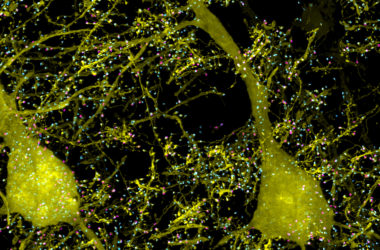
A neuron fires. Nothing unusual about that, except this particular neuron was printed on a flexible polymer sheet using specialist electronic inks in a lab at Northwestern University. And the brain cell it just activated, a real one, sitting in a slice of mouse brain tissue in a dish, responded as though the signal had come from a neighbour rather than a machine.
Published in Nature Nanotechnology in April 2026, the work represents something engineers and neuroscientists have been chasing for years: an artificial device that communicates with biological neural tissue in the brain’s own language. Not simple electrical pulses, the kind that existing implants already deliver, but the complex, varied signalling patterns that real neurons use to encode information. Single spikes. Continuous firing. Bursting patterns. The full repertoire.
The team, led by researchers at Northwestern’s McCormick School of Engineering, used a printing technique called aerosol jet printing to deposit nanoscale flakes of two materials onto flexible substrates. Molybdenum disulfide (MoS₂) acts as the semiconductor, the component that generates the electrical spiking behaviour. Graphene serves as the conductor, carrying signals between components. Together, these printed artificial neurons produce outputs that, to a biological neuron receiving them, look convincingly real.
Existing neural implants, like cochlear implants for hearing or deep-brain stimulators for Parkinson’s disease, work by delivering relatively simple electrical pulses. They are effective, but blunt. A cochlear implant does not replicate the full richness of natural hearing. It provides enough signal for the brain to interpret speech, but music often sounds flat and noisy environments remain difficult.
The limitation is partly one of signalling complexity. Real neurons do not just fire on-off pulses. They modulate their firing rate, their timing, their burst patterns. Different patterns encode different information. By capturing this diversity, each printed artificial neuron can encode more information and perform more sophisticated functions, as the Northwestern team explained. That means fewer components needed in a device, and a closer match to how the brain actually processes information.
The practical applications are some distance away, but the direction is clear. Brain-machine interfaces that could restore movement to paralysed patients, retinal prosthetics that deliver more natural vision, and hearing implants with richer sound quality all depend on this signalling fidelity. Beyond medicine, the same printed neurons could form the basis of neuromorphic computing systems, processors that mimic the brain’s architecture rather than following the traditional transistor-based approach, potentially slashing the energy consumption of artificial intelligence systems.
Engineering Deep Dive: How Printed Artificial Neurons Work
To understand why this advance matters, you need to understand what a biological neuron actually does when it fires. A neuron at rest maintains a voltage difference across its cell membrane of about -70 millivolts, the resting potential. When stimulated, ion channels in the membrane open, allowing sodium ions to rush in and rapidly depolarise the cell. The voltage spikes to about +40 mV, then potassium channels open, repolarising the cell. This spike, called an action potential, lasts about 1 millisecond and propagates along the axon to the synapse, where it triggers neurotransmitter release to the next neuron.
Replicating this electronically requires a device capable of producing sharp voltage spikes with the right amplitude, duration, and timing. Previous artificial neurons, typically built from silicon transistors, could produce single spikes but struggled with the full range of biological firing patterns. The Northwestern team’s innovation lies in the material: molybdenum disulfide, a two-dimensional semiconductor whose properties naturally produce the nonlinear, threshold-dependent behaviour seen in biological neurons.
MoS₂ is a transition metal dichalcogenide, a class of materials that exist as atomically thin layers. At the nanoscale, these flakes exhibit memristive behaviour, meaning their electrical resistance changes depending on the history of voltage applied to them. This memory effect allows printed devices to produce complex firing patterns rather than simple on-off responses. Apply a steady input, and the device might fire continuously. Apply a pulsed input,t, and it bursts. The material’s physics performs the computation, rather than requiring complex external circuitry.
Aerosol jet printing is the fabrication method. Unlike inkjet printing, which deposits relatively large droplets, aerosol jet printing aerosolises the ink into a fine mist and focuses it through a nozzle using a sheath gas. This allows features as small as 10 micrometres to be printed onto flexible substrates. The MoS₂ and graphene inks are formulated by dispersing nanoscale flakes in solvents, then printing them in specific patterns to create the transistor-like structures that form each artificial neuron.
The team placed their printed neurons adjacent to slices of living mouse brain tissue and measured whether the artificial signals could trigger responses in biological neurons. They could. This is a higher bar than simply showing the device produces neuron-like waveforms. It demonstrates functional communication across the electronic-biological interface.
For A-level students, this work bridges several subjects. The mechanisms of the resting potential and action potential are core A-level Biology content. The semiconductor physics of MoS₂ connects to A-level Physics (energy bands, conductors, semiconductors, insulators). The printing fabrication process relates to Design and Technology concepts around manufacturing and materials processing. And the broader question of brain-machine interfaces sits at the intersection of engineering, medicine, and ethics.
The energy argument is worth noting. A human brain operates on roughly 20 watts. A modern AI training run can consume megawatts of power. If neuromorphic systems built from printed artificial neurons can approach the brain’s efficiency, the implications for sustainable computing are substantial.
The gap between a proof-of-concept on mouse brain slices and a working human implant remains wide. Biocompatibility over years, not hours, needs to be demonstrated. The printing process needs scaling. Regulatory approval for any neural interface is a lengthy process. But the fundamental question, can an artificial device speak a language that biological neurons understand, now has a clearer answer than it did a year ago.
- Northwestern University engineers printed artificial neurons using molybdenum disulfide and graphene electronic inks
- The printed neurons generate complex signalling patterns (single spikes, continuous firing, bursting) that mimic real neural activity
- When tested on mouse brain tissue slices, the artificial neurons successfully triggered responses from living neurons
- Applications include brain-machine interfaces, neuroprosthetics for hearing and vision, and energy-efficient computing
- The research was published in Nature Nanotechnology in April 2026