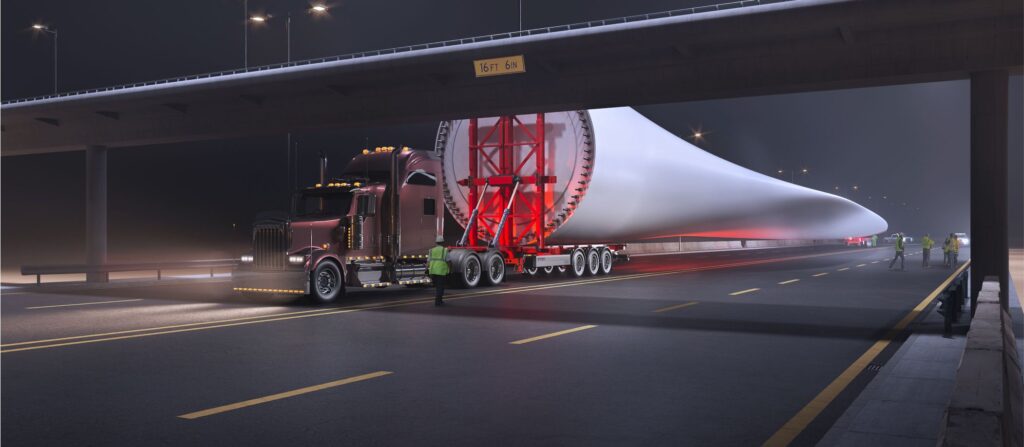
The wind energy industry faces a fundamental engineering constraint that has nothing to do with turbine technology or wind physics. Modern onshore wind turbines are limited to 70-meter blade lengths, not because of manufacturing limitations, but due to constraints on transportation infrastructure. Highway overpasses, tunnel clearances, and road curvatures create rigid physical boundaries that prevent larger blades from reaching installation sites.
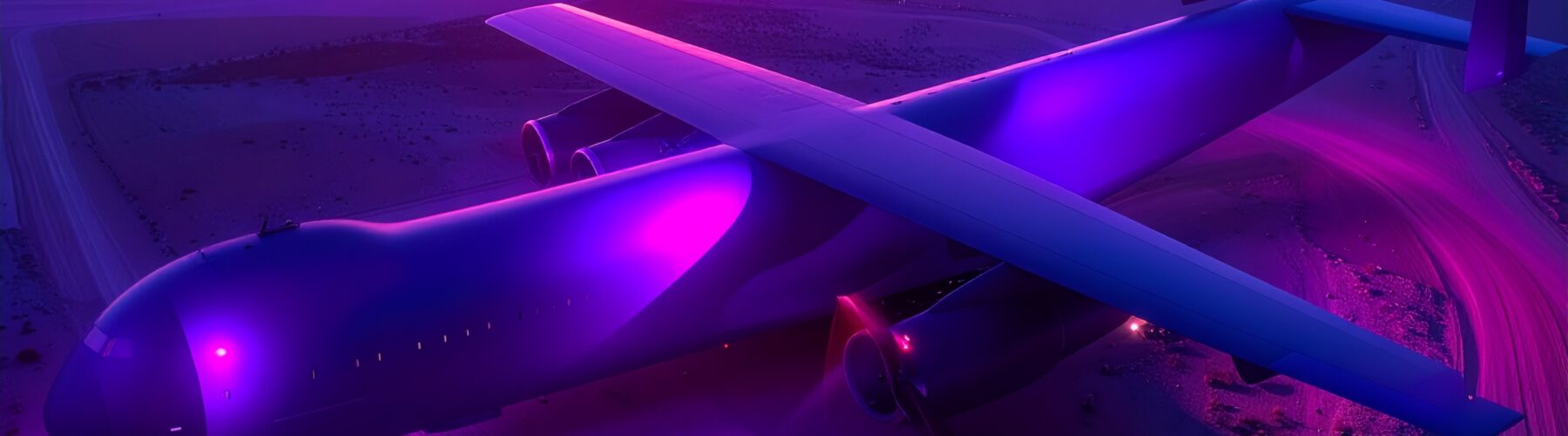
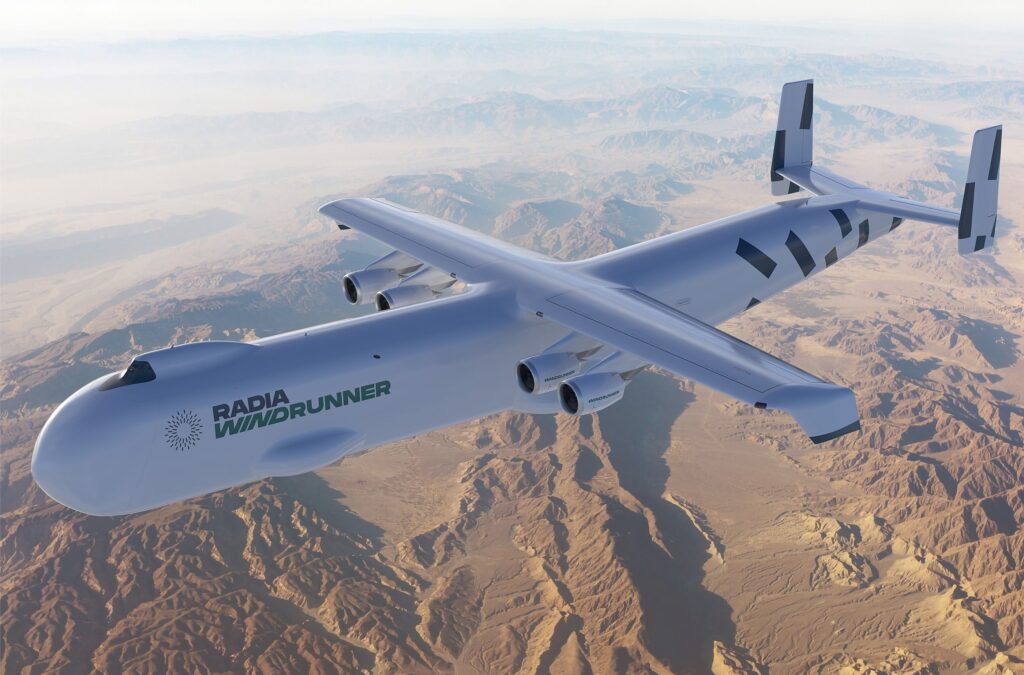
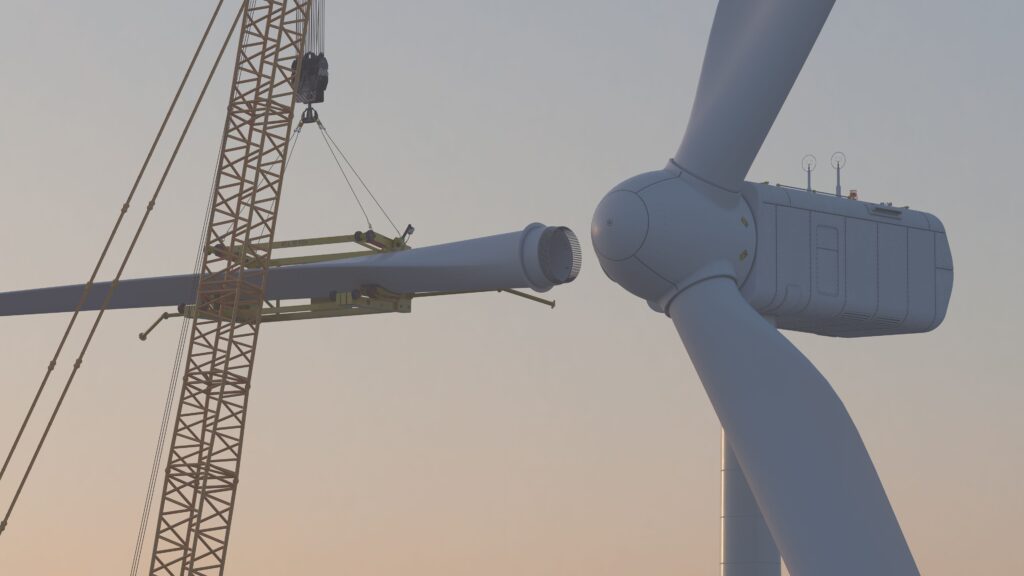
Radia, a Boulder, Colorado-based aerospace company, has proposed an unconventional solution: build the world’s largest aircraft specifically to transport wind turbine blades. The WindRunner, if successfully developed, would measure 108 meters in length with an 80-meter wingspan, creating a cargo bay volume nine times larger than a Boeing 747-400.
The WindRunner’s design prioritises volume over mass, a critical distinction in aerospace engineering. While the aircraft can carry 72,575 kilograms of payload-relatively modest compared to existing heavy-lift aircraft-its cavernous 7,702 cubic meter cargo bay addresses the specific challenge of blade transportation. The aircraft would accommodate three 80-meter blades, two 95-meter blades, or a single 105-meter blade.
The engineering team has incorporated several key design features to enable operations on semi-prepared airstrips. Twenty landing gear tires distribute the aircraft’s weight across a larger surface area, reducing ground pressure to levels compatible with dirt runways. The aircraft’s broad, stubby wings provide nearly 1,000 square meters of surface area, enabling deceleration within 1,080 meters-approximately 10 aircraft lengths.
A distinctive H-tail configuration replaces a conventional single vertical stabiliser. This design choice stems from airport height restrictions of 24 meters. The split tail provides necessary stability while maintaining compatibility with existing infrastructure. The nose-loading cargo door, borrowed from the Antonov An-124 design, enables direct blade loading without requiring complex manoeuvring.
Engineering Deep Dive: Aerodynamics, Structures, and Wind Turbine Physics
Short Takeoff and Landing Aerodynamics
The WindRunner’s aerodynamic design centres on achieving short takeoff and landing (STOL) capabilities on unpaved surfaces. The straight, high-aspect-ratio wing generates substantial lift at relatively low speeds through several mechanisms. The wing’s 80-meter span creates a large lifting surface while maintaining structural efficiency through the application of beam theory principles.
Wing loading-the ratio of aircraft weight to wing area-determines takeoff and landing speeds. With approximately 1,000 square meters of wing area and an estimated maximum takeoff weight of 350,000 kilograms (based on payload and fuel requirements), the WindRunner would achieve a wing loading of 350 kg/m². This relatively low wing loading enables operation at slower speeds, critical for short-field performance.
The four turbofan engines provide a thrust-to-weight ratio comparable to that of early fighter jets when the aircraft is operating empty. This excess thrust enables steep climb angles immediately after takeoff, essential for clearing obstacles near improvised runways. During landing, the engines can provide reverse thrust to supplement wheel braking on loose surfaces.
Structural Engineering Challenges
Designing an aircraft fuselage to accommodate 105-meter-long rigid structures presents unique structural challenges. The cargo bay must resist both bending moments and torsional loads while maintaining minimal weight. The solution involves a semi-monocoque structure, where the skin carries significant loads and is reinforced by frames and longerons.
The cargo hold pressurisation strategy reflects another engineering optimisation. Rather than full pressurisation to sea level, the hold maintains pressure equivalent to an altitude of 8,800 meters-approximately the summit of Mount Everest. This reduces structural requirements by 65 per cent compared to full pressurisation while preventing damage to composite blade materials from pressure differentials.
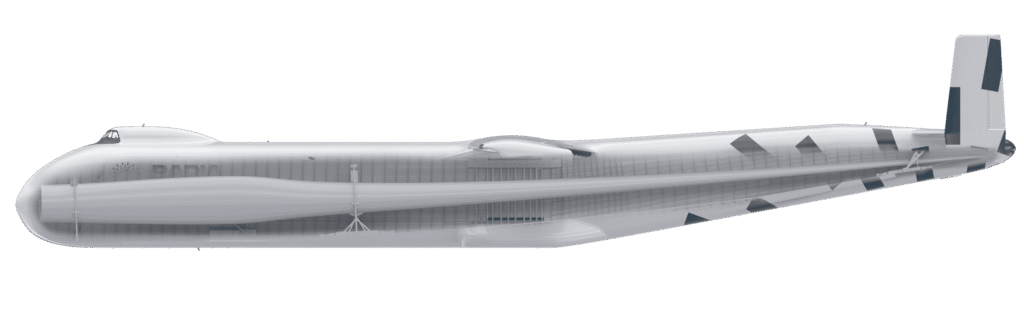
The nose door mechanism must support a 7.3-meter-high opening while maintaining structural integrity during flight. This requires a complex system of hinges, actuators, and load-transfer structures that redirect forces around the opening. Similar designs on the An-124 use multiple locking points and pressure seals to maintain aerodynamic efficiency.
Wind Turbine Scaling Physics
Understanding why larger blades necessitate such elaborate transportation solutions requires examining the physics of wind turbines. Power generation follows the equation P = 0.5 × ρ × A × V³ × Cp, where ρ represents air density, A is swept area, V is wind velocity, and Cp is the power coefficient.
The swept area increases with the square of the blade radius. A turbine with 105-meter blades sweeps 34,636 square meters, compared to 15,394 square meters for 70-meter blades-a 2.25-fold increase. This larger area captures more kinetic energy from the wind stream.
Additionally, longer blades reach higher altitudes where wind speeds typically increase due to reduced surface friction. The wind velocity’s cubic relationship to power means even small speed increases yield substantial power gains. If wind speed increases from 7 to 8.5 meters per second at greater heights, power output increases by 79 per cent.
The combined effects of a larger swept area and higher wind speeds enable a single large turbine to generate equivalent power to multiple smaller units. This consolidation reduces foundation costs, maintenance requirements, and the need for transmission infrastructure. Economic modelling suggests these benefits could reduce the levelized cost of energy by 20-35 per cent, if the transportation challenge can be solved.
The WindRunner’s operational concept requires establishing regional hub airports near blade manufacturing facilities. From these hubs, the aircraft would shuttle blades to temporary airstrips constructed adjacent to wind farms. These strips need only 1,800 meters of graded dirt road, significantly less infrastructure than conventional airports require.
Flight operations present unique challenges. The aircraft’s massive cross-section creates substantial parasitic drag, limiting its range to 2,000 kilometres with a maximum payload. This constraint limits operations to continental regions, preventing the delivery of blades across intercontinental distances. Multiple aircraft would service a single wind farm, potentially requiring dozens of flights over several months to deliver all components.
The carbon footprint of these operations raises environmental concerns. The consumption of jet fuel for hundreds of flights could offset some of the environmental benefits of wind power. However, if larger turbines reduce the total number of units by 50 per cent, the reduction in concrete and steel for foundations and towers could compensate for aviation emissions. The net carbon calculation depends on turbine capacity factors, grid emissions intensity, and operational lifespan.
The WindRunner faces competition from alternative transportation concepts. Hybrid airships could carry similar payloads without requiring prepared runways. However, airships struggle with wind loads during ground operations-particularly problematic at sites with high wind speeds, which are often ideal for turbines. Their slow speeds would also limit delivery rates, potentially extending project timelines.
The U.S. Department of Defence’s interest in WindRunner for military cargo applications could provide additional revenue streams if the design proves successful. Military logistics often require delivering outsized cargo to austere locations, aligning with WindRunner’s capabilities. This dual-use potential might justify development costs even if wind turbine transportation proves less profitable than projected.
Boeing’s potential restart of C-17 production represents another competitive threat. While the C-17 cannot match WindRunner’s cargo volume, its proven design and existing support infrastructure offer lower technical risk. The C-17’s 77,500-kilogram payload capacity exceeds WindRunner’s, though its cargo bay cannot accommodate 100-meter blades without segmentation.
If Radia successfully develops and certifies the WindRunner, the aircraft could enable a new generation of onshore wind installations. Sites previously considered uneconomical due to moderate wind speeds might become viable with larger, more efficient turbines. This expansion could particularly benefit inland regions lacking offshore wind resources.
The engineering challenges remain substantial. No company has previously certified a clean-sheet commercial aircraft of this scale without prior experience in aviation. The certification process typically requires five to seven years for conventional designs; an unprecedented configuration might face additional delays. Radia’s strategy of using certified components and existing systems could accelerate approval, though the novel integration still presents regulatory uncertainties.
The WindRunner represents an intersection of aerospace and renewable energy engineering. If the technical, regulatory, and economic challenges can be overcome, the aircraft might enable onshore wind farms to achieve cost parity with fossil fuel generation across broader geographical areas. The success or failure of this venture will likely influence future approaches to renewable energy infrastructure development.
- Radia is developing a 108-meter aircraft specifically designed to transport wind turbine blades up to 105 meters long
- The WindRunner would be the world’s largest aircraft by volume, with cargo space nine times larger than a 747
- Current road infrastructure limits onshore wind turbine blades to 70 meters due to overpass and tunnel clearances
- The aircraft can land on 1,800-meter dirt runways near wind farms using 20 tires and a specialised wing design
- Larger turbines could reduce wind energy costs by 20–35 percent and double economically viable wind farm locations
- Technical challenges include certifying an unprecedented design and managing carbon emissions from transport flights