A single raindrop hitting a treated surface at terminal velocity. A brief flash of charge, 110 volts, enough to light an LED. Now imagine millions of drops hitting a rooftop covered in solar panels that are already generating electricity from the overcast sky above them. That is the premise behind a new hybrid energy-harvesting device developed by researchers at the Institute of Materials Science of Seville (ICMS), and it works because of a coating thinner than a human red blood cell.
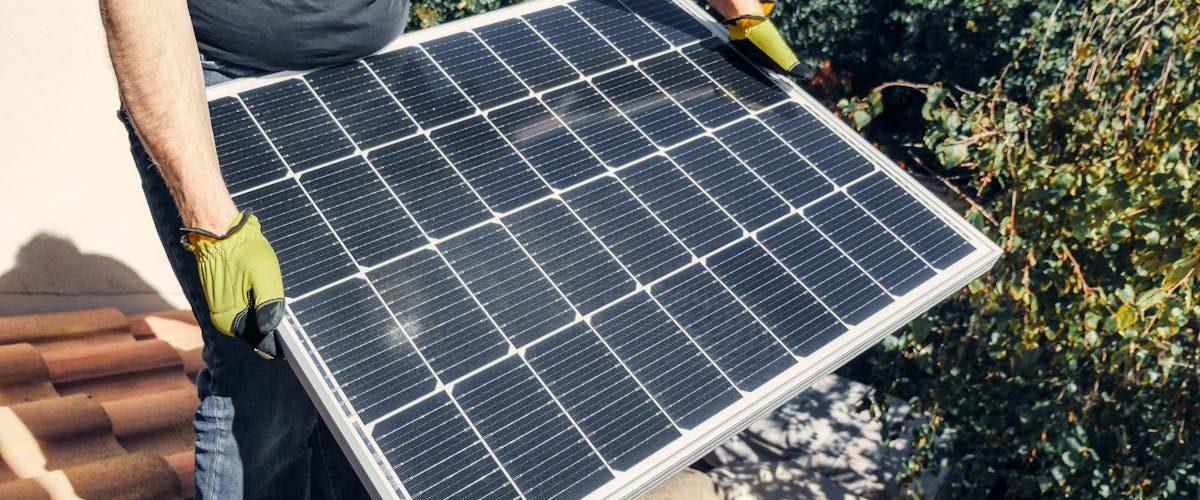
The team, a joint effort between the Spanish National Research Council (CSIC) and the University of Seville, has created a thin film just 100 nanometres thick that can be deposited directly onto perovskite solar cells. The coating does three things at once: it shields the sensitive perovskite layer from moisture, it improves light absorption by reducing reflection, and it generates electrical charge from the mechanical impact of raindrops through the triboelectric effect.
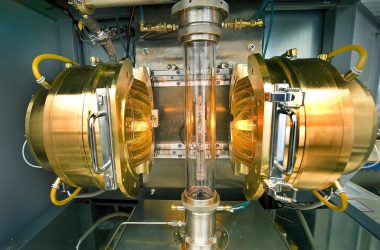
The key to the coating’s performance lies in how it is made. The ICMS team used Plasma-Enhanced Chemical Vapour Deposition (PECVD) to grow a fluorinated polymer layer at room temperature, without solvents. The process is gentle enough not to damage the perovskite crystal structure beneath it, which is significant because perovskites are notoriously fragile. Heat, moisture, and mechanical stress can all cause them to degrade.
The fluorinated surface is hydrophobic, pushing the water contact angle to 110 degrees. Drops bead up and roll off rather than spreading and soaking in. This alone would extend the cell’s operational life. But the same surface chemistry that repels water also generates a charge when struck by it. The triboelectric effect, the same phenomenon that makes your hair stand up when you rub a balloon against it, produces a measurable voltage pulse each time a raindrop lands and lifts off.
In laboratory tests, the coating increased light transparency to above 90 per cent, meaning the solar cell beneath it actually absorbs more photons than it would if left bare and exposed. The researchers also subjected the coated cells to full water immersion and humidity-temperature stress cycles. The cells survived, suggesting that the coating could protect panels in the kind of sustained wet weather that, until now, has been dead time for solar generation.
Carmen López, a researcher at ICMS, explained: “Our work proposes an advanced solution that combines perovskite solar cell photovoltaic technology with triboelectric nanogenerators in a thin-film configuration, thus demonstrating the feasibility of implementing both energy harvesting systems.” Fernando Núñez, another member of the team, pointed to applications in smart cities, from autonomous signage and auxiliary lighting to environmental monitoring stations in remote areas.
Engineering Deep Dive: Triboelectric Nanogenerators and Perovskite Solar Cells
Two separate energy-harvesting technologies underpin this device, and understanding each one individually makes it easier to see why combining them is clever.
Perovskite solar cells take their name from their crystal structure, which matches that of the mineral perovskite (calcium titanium oxide). The synthetic versions used in solar cells are typically halide perovskites, compounds with the general formula ABX₃, where A is a large cation (often methylammonium or caesium), B is a metal (usually lead), and X is a halide (iodine, bromine, or chlorine). This structure absorbs sunlight across a broad spectrum. It converts it into electricity through the photovoltaic effect, the same principle behind silicon solar cells, but using a material that can be deposited as a thin film at much lower temperatures.
The problem with perovskites has always been durability. The crystal structure breaks down when exposed to moisture, oxygen, or prolonged UV radiation. Commercial silicon panels last 25 years. Early perovskite cells degraded within weeks. A protective coating that simultaneously improves performance and blocks moisture addresses the single biggest barrier to perovskite commercialisation.
Triboelectric nanogenerators (TENGs) convert mechanical energy into electricity using the triboelectric effect, the same charge transfer that occurs when two different materials come into contact and then separate. When a raindrop strikes the fluorinated polymer surface, electrons transfer between the water and the polymer. As the drop deforms, spreads, and then recoils or rolls away, the changing contact area drives an alternating current through an external circuit. The voltage from a single drop can exceed 100 volts, though the current is extremely small, typically in the microampere range. The useful power per drop is measured in microwatts.
A-level Physics students will recognise several concepts at work here. The photovoltaic effect is related to the photoelectric effect, which Einstein explained in 1905 and appears in the quantum physics module. Triboelectric charging relates to electrostatics and charge transfer. The idea of combining two energy sources into a single device is an example of hybrid systems engineering, a growing field that appears in first-year university courses.
The PECVD deposition method itself is worth understanding. A plasma, an ionised gas, is generated inside a vacuum chamber. Precursor gases (in this case, fluorocarbon compounds) are introduced, and the plasma energy breaks them into reactive fragments that bond to the substrate surface, building the polymer film atom by atom. Because the substrate (the perovskite cell) remains at room temperature throughout, the process avoids the thermal damage that would destroy the delicate crystal structure.
The 100-nanometre thickness is not arbitrary. It represents an optimised balance between three competing requirements: thick enough to provide meaningful moisture protection, thin enough to maintain optical transparency above 90 per cent, and with the right surface texture to maximise triboelectric charge generation. Thicker films would block more light. Thinner films would offer less protection. The team arrived at 100 nanometres through systematic experimental variation.
This is still laboratory-scale work. The cells tested were small, and the power generated by raindrop impacts is orders of magnitude below what the solar function provides in sunshine. But in regions where it rains frequently, even a modest contribution from raindrop harvesting extends the useful operating window of a solar installation. The real value may lie less in the triboelectric output itself and more in what the coating does for perovskite durability, potentially unlocking a cheaper, more versatile solar technology that has been held back for a decade by its inability to survive outdoors.
- A 100-nanometre thin film generates electricity from both sunlight and raindrop impacts
- Single raindrop produces over 110 volts via the triboelectric effect
- Coating protects perovskite solar cells from moisture and improves light absorption to above 90%
- Made using Plasma Enhanced Chemical Vapour Deposition at room temperature
- Potential applications in IoT sensors, smart cities, and remote monitoring stations