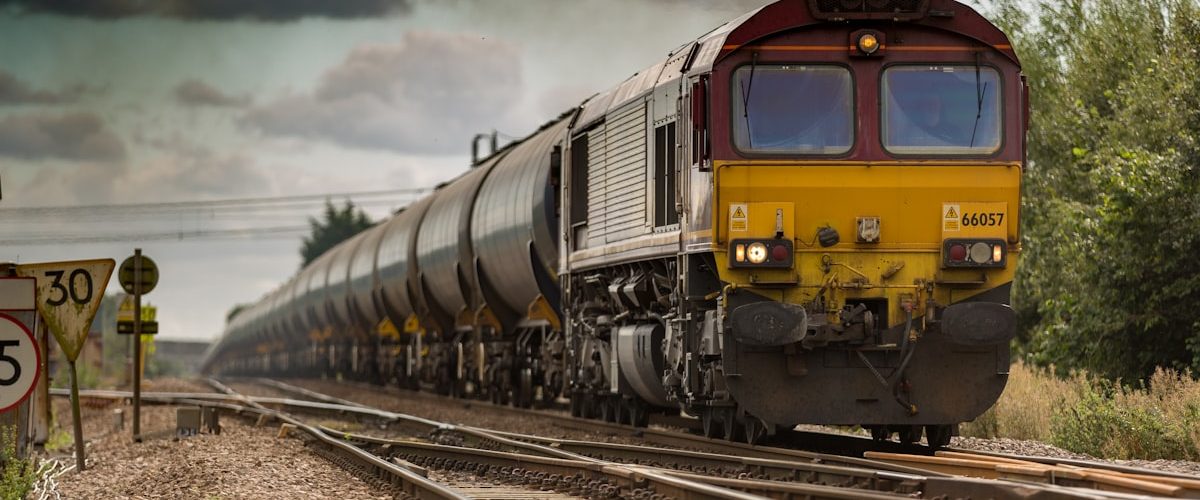
On 3 March 2026, a Great Northern train left London for Welwyn Garden City carrying something unusual in its luggage. Bolted inside the carriage was a prototype quantum navigation system, the first of its kind to operate on any mainline railway in the world. The train ran its normal service. Passengers probably did not notice. But the device was quietly doing something that no railway system has done before: tracking the train’s exact position without a single satellite signal.
The Railway Quantum Inertial Navigation System, or RQINS, uses quantum sensors to detect tiny changes in motion and rotation as the train moves. By continuously measuring these changes, it calculates position from first principles, a method known as dead reckoning. GPS, by contrast, relies on signals from orbiting satellites, and those signals vanish the moment a train enters a tunnel, passes between tall buildings, or runs through a cutting with steep walls. In a country where a significant proportion of the rail network passes through exactly those environments, the limitations of satellite positioning are not theoretical. They are a daily operational headache, as Interesting Engineering reported.
Why quantum sensors change the equation for railway navigation
Inertial navigation is not a new idea. Submarines and aircraft have used it for decades, relying on accelerometers and gyroscopes to track movement. The problem is drift. Conventional inertial sensors accumulate small errors over time. After a few minutes, those errors become large enough to render the position estimate useless without external correction, usually from GPS. Quantum sensors promise to break this cycle. By exploiting the wave-like behaviour of atoms cooled to near absolute zero, they can measure acceleration and rotation with far greater precision than their mechanical or fibre-optic predecessors. The slower drift means the system stays accurate for longer without external help.
The consortium behind RQINS brings together an unusual mix of expertise. MoniRail, a rail technology firm, leads the project. Imperial College London and the University of Sussex provide quantum physics research. The National Physical Laboratory contributes measurement science. PA Consulting handles systems integration, and QinetiQ, the defence technology company, brings experience in navigation systems for military platforms. Funding comes from Innovate UK and the Department for Science, Innovation and Technology, with coordination from GBRX, the innovation arm of Great British Railways.
Lord Peter Hendy, the UK Minister of State for Transport, framed the trial in practical terms. “With these new capabilities, we’re preventing equipment failures, helping to boost our railway’s reliability,” he said. The immediate benefit is not about replacing GPS entirely but about filling the gaps where GPS fails, and reducing dependence on expensive fixed trackside equipment such as balises, the transponder tags embedded between rails that current signalling systems use to confirm a train’s location.
The Welwyn Garden City route was chosen because it includes a mix of open track, cuttings, and the approaches to London’s King’s Cross, where satellite visibility is patchy. Data from the trial will be compared against known track geometry to assess the system’s accuracy under real operating conditions.
Engineering Deep Dive: How quantum navigation tracks a train without GPS
At the core of RQINS is a quantum accelerometer. Unlike a conventional accelerometer, which measures force on a small mass suspended by springs, a quantum accelerometer measures the interference pattern of atoms held in a superposition of states. The physics is rooted in matter-wave interferometry, a concept that extends the wave-particle duality covered in A-level Physics into a practical measurement tool.
The principle works like this. A cloud of atoms, typically rubidium, is cooled using laser beams to microkelvin temperatures, a few millionths of a degree above absolute zero. At these temperatures, the atoms behave as quantum waves rather than classical particles. A sequence of precisely timed laser pulses then splits each atom’s wavefunction into two paths, allows them to travel along different trajectories, and recombines them. The phase difference between the two paths depends on the acceleration the atom experienced during the sequence. By measuring that phase difference, the system extracts an acceleration value with extraordinary precision.
Gyroscopes based on similar principles measure rotation. Together, a quantum accelerometer and a quantum gyroscope form a quantum inertial measurement unit (IMU). The train’s position is calculated by integrating acceleration twice with respect to time to obtain displacement and integrating angular rate to obtain orientation. This is pure Newtonian mechanics: F = ma gives acceleration, and double integration of acceleration gives position. Students studying A-level Maths will recognise this as successive integration of a function, the same technique used in kinematics problems involving variable acceleration.
The practical challenge is that any IMU, quantum or otherwise, produces drift. Errors in the acceleration measurement, however small, accumulate through the double integration. A bias of just one micro-g (one millionth of gravitational acceleration) leads to a position error of about 0.5 metres after 30 seconds. Quantum sensors reduce this bias by orders of magnitude compared to conventional MEMS (micro-electro-mechanical systems) accelerometers, but they do not eliminate it. The engineering trick is to combine the quantum IMU with other onboard data, such as wheel speed sensors and track maps, using a Kalman filter. This statistical algorithm continuously estimates the most likely position by weighting inputs according to their known error characteristics.
The military heritage of this technology is worth noting. QinetiQ, one of the consortium partners, has developed inertial navigation systems for submarines and autonomous underwater vehicles, environments where GPS is equally unavailable. The miniaturisation challenge is moving from a laboratory-scale cold-atom system that might fill a large desk to a ruggedised unit that fits inside a train carriage and withstands vibration, temperature swings, and the electromagnetic noise of a railway environment.
For the railway industry, the long-term prize is significant. Current European Train Control System (ETCS) signalling relies heavily on balises, passive transponders mounted between the rails every few hundred metres. Each one must be installed, maintained, and replaced when it fails. A train-borne positioning system that does not require rackside infrastructure could dramatically reduce installation and maintenance costs, particularly on routes being upgraded from older signalling.
There are still open questions. How long can the quantum IMU maintain useful accuracy before it needs a correction? Can the system be manufactured at a price the railway industry will accept? And can it meet the safety integrity levels required for signalling, where a positioning error could have consequences measured in lives? The Welwyn Garden City trial is a first step, not a final answer.
Quantum sensing is moving out of the laboratory and onto infrastructure that millions of people rely on daily. Whether RQINS becomes a standard part of railway signalling or remains a research curiosity depends on how well it handles the gap between physics-lab precision and the grime, vibration, and unpredictability of a working railway. The data from March’s trial will start to answer that question.
• Britain has become the first country to test quantum navigation technology on a mainline railway, trialled on 3 March 2026
• The Railway Quantum Inertial Navigation System (RQINS) uses ultra-sensitive quantum sensors to determine a train’s exact position without GPS
• The system works in tunnels and urban canyons where satellite signals fail
• A consortium led by MoniRail, including Imperial College London and QinetiQ, developed the prototype with Innovate UK funding