Automotive & Transport
Britain's first electrified rail testing loop opened at Long Marston in Warwickshire, a 3.5 km closed track backed by £75 million in investment.
Until last week, if a British train manufacturer wanted to test a new electric locomotive on a closed loop of overhead-wired track, the options were limited: book time on the live network (expensive, disruptive, and hedged with restrictions) or ship the train abroad. That gap has now closed.
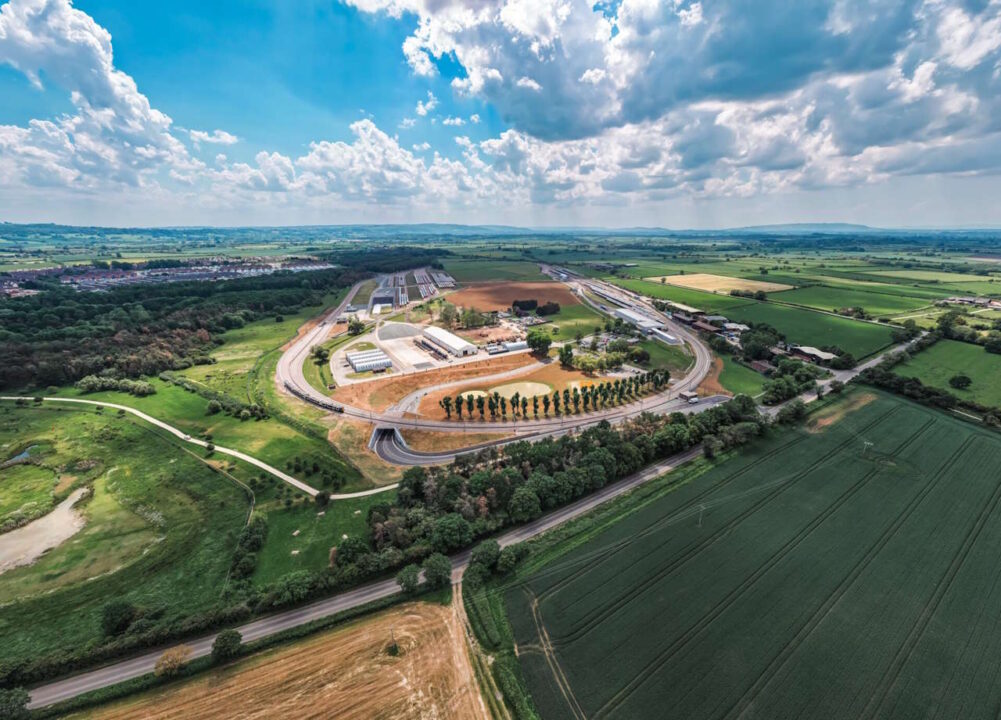
On 4 June 2026, Rail Minister Lord Hendy cut a ribbon at Long Marston Rail Innovation Centre in Warwickshire, officially opening Britain’s first electrified rail testing loop. Standing beside him were Porterbrook CEO Mary Grant and Francis Bourgeois, the social media content creator whose unrestrained enthusiasm for trains has made him one of the railway’s most unlikely ambassadors.
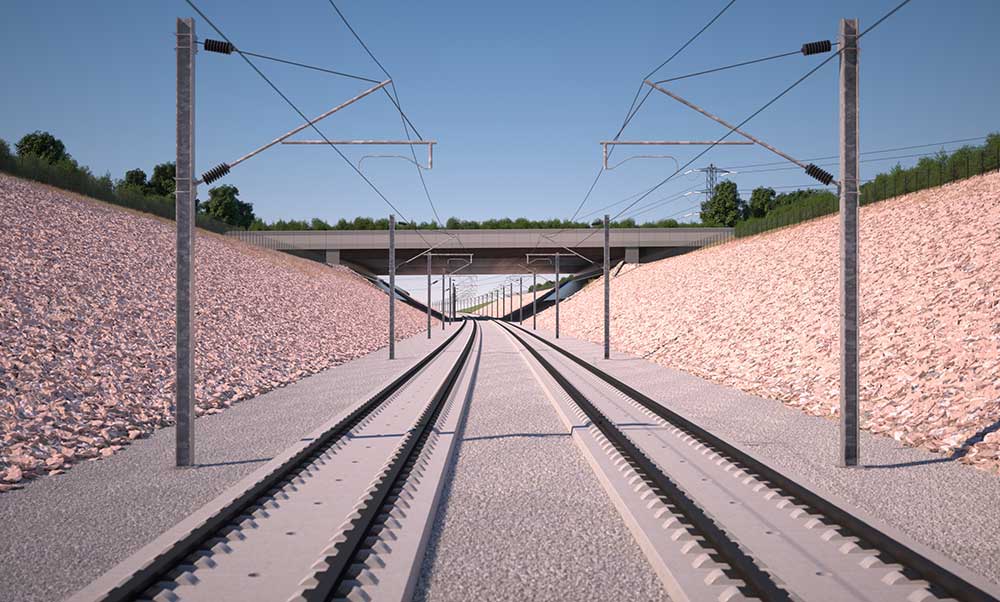
The numbers are straightforward. The loop runs 3.5 kilometres around a 135-acre former military depot that Porterbrook has spent more than £75 million converting into a rail innovation hub. Overhead line equipment, identical to what you’d find on the West Coast Main Line, hangs above the track, supplying 25 kV AC power. The closed circuit means testing can run continuously without timetable conflicts, signal restrictions, or the need to clear a path through passenger services.
Porterbrook is the UK’s largest rolling stock financing company. Over the past five years, it has invested more than £1 billion in new trains, fleet upgrades, and traction innovation, including £14 million to build and test HydroFLEX, the country’s first hydrogen-powered passenger train. The Long Marston facility is the physical infrastructure that underpins that kind of work.
The loop allows controlled testing of overhead line equipment performance, traction power systems, braking behaviour, and pantograph-catenary interaction, all under conditions that mirror the real network but without the consequences of getting it wrong at 125 mph past a platform full of commuters.
Lord Hendy, who spent decades running Transport for London before joining the Department for Transport, called it “exactly what we want to see as we move towards Great British Railways.” That reference matters. The Government is in the process of unifying Britain’s fragmented rail network under a single public body, and Long Marston positions itself as a shared industry resource rather than a private testing ground.
Hundreds of spectators attended the opening, including Network Rail apprentices and primary school children from Warwickshire who had visited the site as part of an earlier educational programme. It was a deliberate choice: the facility is as much about demonstrating engineering careers as it is about testing bogies.
Engineering deep dive
Railway electrification is one of the oldest and most mature engineering systems in daily use, but testing new rolling stock against it is surprisingly difficult. The Long Marston loop addresses several specific technical challenges.
The 25 kV AC overhead catenary system is the standard for Britain's electrified main lines. Power is fed from the national grid through trackside substations, stepped down and supplied to the overhead contact wire at 25,000 volts, 50 Hz single-phase AC. A pantograph on the train's roof presses upward against the contact wire, drawing current that passes through a transformer and rectifier on board the train to supply the traction motors.
The pantograph-catenary interface is one of the most mechanically demanding contact systems in engineering. The contact wire is kept under approximately 12 kilonewtons of tension and held at a nominal height of 4.7 metres above rail level. It zigzags slightly from side to side (a feature called stagger) to distribute wear across the full width of the pantograph's carbon contact strip. At speed, the pantograph must maintain consistent contact pressure despite wind loading, track geometry variations, and the catenary's own dynamic response: too little pressure and the pantograph arcs, damaging both surfaces. Too much and it lifts the wire, risking a disconnection that can bring down hundreds of metres of overhead equipment.
A-level Physics students will recognise the electromagnetic principles at work. The traction motors in modern electric trains are three-phase AC induction motors or permanent magnet synchronous motors, both of which rely on rotating magnetic fields to produce torque. The single-phase 25 kV supply must be converted to three-phase power on board, typically using insulated-gate bipolar transistor (IGBT) inverters, the same power electronics found in electric vehicles and industrial drives.
The closed-loop geometry of the Long Marston track allows engineers to test these systems under repeatable conditions. A train can accelerate, run at a steady speed, brake, and repeat the cycle indefinitely, building up the statistical dataset needed to validate performance claims. On the live network, testing windows are short, conditions vary with weather and traffic, and any fault triggers an immediate shutdown with knock-on delays for thousands of passengers.
Braking is another focus. Regenerative braking, where the traction motors act as generators to feed energy back into the overhead line, is standard on modern electric trains. But the amount of energy returned depends on the network's receptivity at that point, which varies with other trains' power demands. On a closed loop with instrumented power supplies, engineers can measure regenerative braking efficiency precisely and optimise control algorithms accordingly.
The facility also matters for digital signalling trials. The UK is progressively introducing the European Train Control System (ETCS), which replaces lineside signals with in-cab displays and continuous radio communication between train and track. Testing ETCS on a closed loop eliminates interference from legacy signalling systems. It allows engineers to simulate edge cases, emergency braking scenarios, degraded-mode operation, and communication dropouts that would be dangerous to test on the operational network.
Links to the curriculum: A level, GCSE
Only 38 per cent of Britain’s rail network is electrified, compared with more than 75 per cent in the Netherlands and Switzerland. The Government has committed to extending electrification, but progress is slow and expensive. Long Marston will not solve that political problem. Still, it does give engineers somewhere to develop and prove the technology that electrification demands, without borrowing time on a railway that already struggles to keep its timetable.
Credit via newcivilengineer.com
Automotive & Transport
Construction & Infrastructure
Automotive & TransportBreakthroughs
Construction & Infrastructure