British clean technology company Altilium has partnered with Jaguar Land Rover to produce the UK’s first electric vehicle battery cells manufactured using recycled cathode active materials. The collaboration, demonstrated at the 2025 Cenex Expo, represents a significant advancement in battery circular economy technology.
The project, supported by the Advanced Propulsion Centre UK through its Advanced Route to Market Demonstrator initiative, focuses on validating the use of recycled materials in high-performance automotive applications. If successful validation studies confirm long-term performance, this technology could establish the foundation for a resilient domestic battery supply chain.
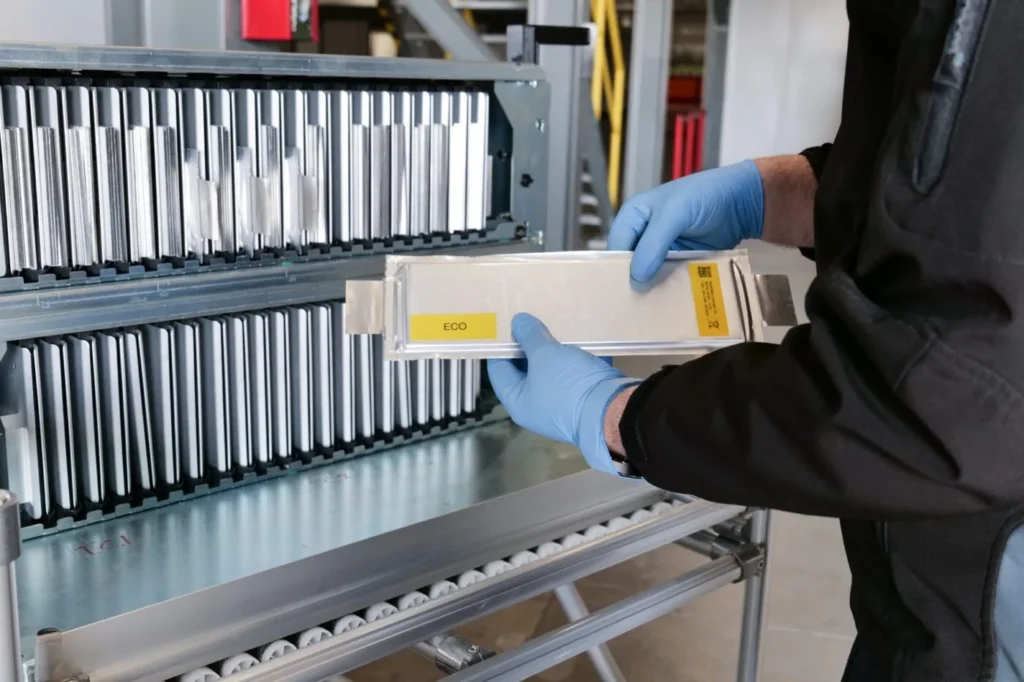
Altilium’s EcoCathode process recovered cathode active materials from end-of-life EV batteries to manufacture automotive-grade NMC 811 multilayer pouch cells. The concentration of recovered materials meets the European Union’s 2030 minimum recycled content targets of 26% cobalt, 1% lithium, and 1% nickel.
Initial electrochemical testing demonstrated performance characteristics comparable to cells manufactured with conventional primary materials. The recycled battery cells are currently undergoing comprehensive validation studies at JLR’s battery testing facilities to assess long-term performance metrics and reliability parameters.
The manufacturing process utilised both multilayer and single-layer pouch cell configurations. The multilayer cells incorporated recycled cathode active materials, whereas the single-layer variants achieved complete circularity by using 100% recycled cathode and graphite anode materials. This dual approach enables assessment of varying recycled content levels and their impact on cell performance.
Testing protocols evaluate key performance indicators, including: * Energy density and capacity retention * Charge-discharge cycle durability
- Thermal stability characteristics * Internal resistance measurements * Calendar aging performance
If validation studies confirm sustained performance over automotive duty cycles, the technology could enable the scaled production of recycled battery cells for commercial applications.
Engineering Deep Dive: Battery Recycling Technology and NMC Chemistry
The successful creation of functional EV battery cells from recycled materials requires a sophisticated understanding of lithium-ion battery chemistry and advanced materials recovery processes. This breakthrough demonstrates the technical feasibility of circular battery manufacturing through several key engineering principles.
NMC 811 Battery Chemistry
NMC 811 refers to a specific lithium-ion battery cathode chemistry with a composition ratio of 80 per cent nickel, 10 per cent manganese, and 10 per cent cobalt in the cathode active material. This high-nickel formulation offers superior energy density compared to earlier NMC variants, such as NMC 532 or NMC 622, making it particularly suitable for automotive applications where energy density directly impacts vehicle range.
The cathode active material forms the positive electrode in lithium-ion cells, where lithium ions intercalate during discharge and deintercalate during charging. The specific crystal structure of NMC 811 materials enables high-voltage operation and excellent electrochemical reversibility, but requires precise material purity and a narrow particle size distribution for optimal performance.
EcoCathode Recovery Process
Altilium’s EcoCathode process employs hydrometallurgical techniques to recover cathode metals from spent battery cells. The process begins with mechanical shredding to separate battery components, followed by selective dissolution of cathode materials using targeted chemical solutions.
Critical metals, including nickel, cobalt, manganese, and lithium, are extracted through precipitation and purification steps that achieve recovery rates of greater than 95 per cent for cathode metals and 99 per cent for graphite materials. The recovered materials undergo refinement to meet battery-grade specifications, ensuring purity levels equivalent to those of primary mining sources.
Recovered cathode metals are processed into precursor materials through controlled precipitation reactions. These precursors are then calcined at precise temperatures to form the final NMC 811 cathode active material with appropriate crystalline structure and morphology.
Quality control parameters include particle size distribution analysis, surface area measurements, electrochemical performance testing, and analysis for trace impurities. The synthesised materials must meet stringent automotive specifications for moisture content, particle density, and electrochemical properties to ensure consistent cell performance
The integration of recycled cathode active materials into battery cell manufacturing requires careful process control during electrode preparation. The recycled materials are combined with conductive additives and polymer binders to form cathode slurries, which are coated onto aluminium current collectors.
Electrode calendering, electrolyte filling, and formation cycling processes must be optimised for recycled materials to achieve performance parity with conventional cells. Variations in material properties between recycled and virgin materials can affect coating uniformity, adhesion characteristics, and initial capacity formation.
Electrochemical testing protocols evaluate recycled battery cells across multiple performance dimensions. Capacity measurements assess the total energy storage capability, while power testing determines peak discharge rates. Cycle life testing subjects cells to repeated charge-discharge cycles to evaluate capacity retention over time.
Thermal analysis, which includes differential scanning calorimetry and thermal gravimetric analysis, is used to assess thermal stability and safety characteristics. Impedance spectroscopy provides insights into internal resistance and charge transfer kinetics that affect power delivery performance.
Advanced characterisation techniques, such as X-ray diffraction, confirm the integrity of the crystal structure, while scanning electron microscopy evaluates electrode morphology and potential degradation mechanisms. These comprehensive validation procedures ensure recycled materials meet automotive performance and safety requirements.
An independent life cycle assessment conducted by sustainability consultancy Minviro quantified the environmental benefits of recycled cathode materials. For NMC 811 pouch cells produced in the UK, utilising 100 per cent recycled cathode active materials could reduce greenhouse gas emissions by 32 per cent compared to cells manufactured with virgin materials mined and refined in Asia.
The recycled battery cells meet minimum recycled content requirements established in the EU Battery Regulation, which mandates specific recycled material percentages by 2036. Compliance with these regulations reduces regulatory risk for UK automotive manufacturers exporting to European markets.
Dr. Christian Marston, Altilium’s Chief Operating Officer, emphasised the technology’s potential to reduce emissions and decrease reliance on imported raw materials. The EcoCathode process can recover over 95% of cathode metals from battery waste, with the recovered materials suitable for direct reuse in new battery production.
Dr. David Sellick, JLR’s project lead, noted that battery cells represent the most significant contributor to an EV’s carbon footprint. If comprehensive validation studies confirm long-term performance, this recycling technology could enable automotive manufacturers to meet sustainability targets while maintaining performance standards.
The demonstration featured a virtual reality model of the Jaguar I-PACE battery pack, showcasing how recycled cells are integrated into existing vehicle architectures. This compatibility assessment addresses potential concerns regarding the performance of recycled materials in commercial applications.
TLDR
- Altilium and JLR produced UK’s first EV battery cells using recycled cathode materials
- NMC 811 cells manufactured with 26% cobalt, 12% lithium, 15% nickel recycled content
- Performance testing shows comparable results to conventional primary materials
- Life cycle assessment reveals 32% reduction in greenhouse gas emissions
- Technology meets EU 2036 Battery Regulation requirements
- EcoCathode process recovers 95% of cathode metals from battery waste