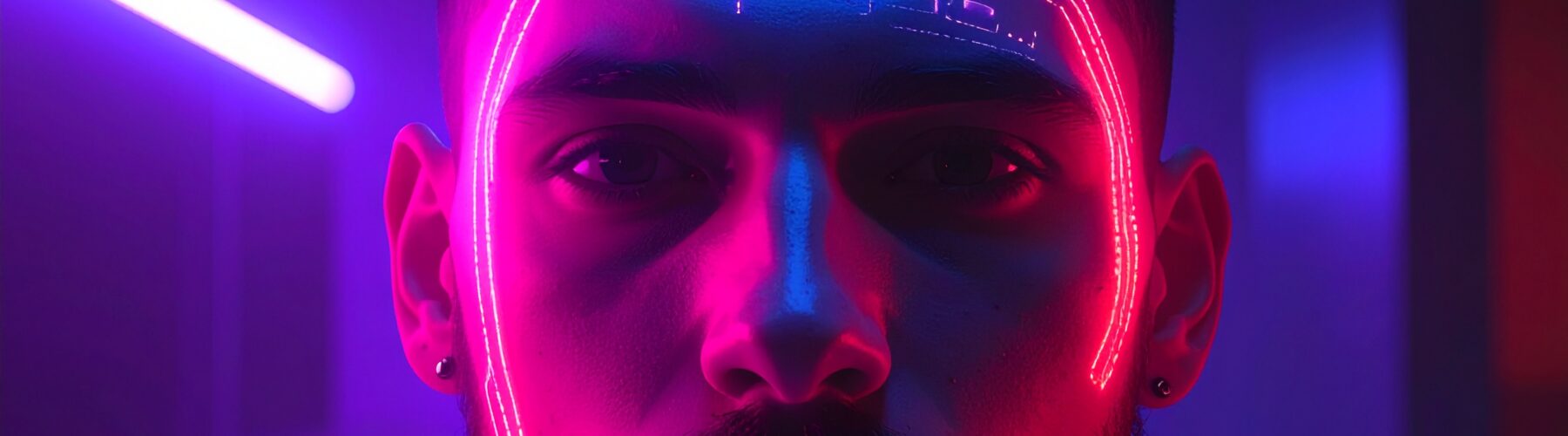
Researchers at the University of Texas at Austin have developed a wireless, skin-adherent electronic device that measures cognitive load in real time. The disposable “e-tattoo” system utilises electroencephalography (EEG) and electrooculography (EOG) sensors positioned on the forehead to detect mental strain without the need for traditional bulky equipment.
The technology addresses critical safety concerns in high-pressure occupations where mental fatigue is a contributing factor to accidents. Recent incidents, including a January collision at Reagan National Airport during understaffed air traffic control operations, highlight the need for objective mental workload assessment systems.
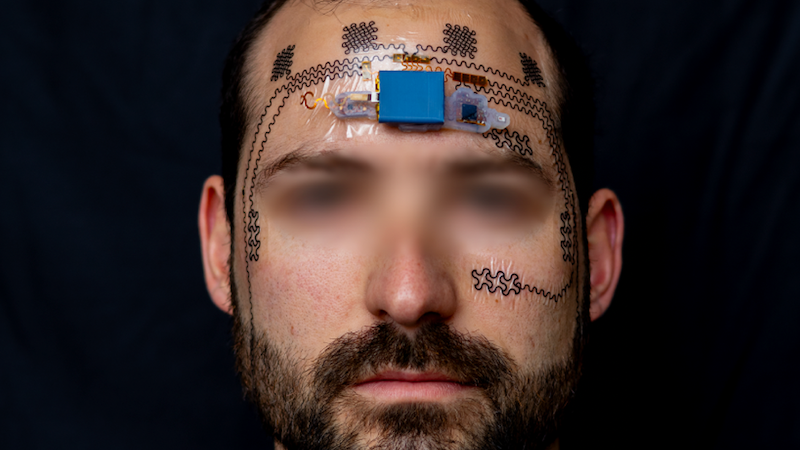
Traditional EEG monitoring requires helmet-like caps with multiple electrodes connected through cables to external processing units. These systems require the application of conductive gel and create stability issues due to variations in head shapes. The new approach eliminates these constraints through custom-fitted adhesive sensors.
The device consists of paper-thin polymer-based sensors manufactured to match individual facial geometry
The system monitors specific brainwave frequencies that correlate with mental effort. During cognitive strain, delta and theta wave activity increase while alpha, beta, and gamma waves decrease. The forehead-mounted sensors capture these electrical patterns alongside eye movement data.
Testing involved six participants completing memory tasks of increasing difficulty. The device successfully differentiated between low and high cognitive load states, with results correlating closely to NASA Task Load Index questionnaire responses. Machine learning algorithms were used to process the combined EEG and EOG data and predict mental workload levels.
Sweat production improved device performance by reducing the electrical impedance between sensors and skin, resulting in more stable signal acquisition over extended wear periods.
Technical Deep Dive: E-Tattoo Sensor Architecture and Signal Processing
Sensor Material Engineering
The e-tattoo employs carbon-doped polyurethane as its base substrate, providing the necessary flexibility for facial conformity while maintaining electrical conductivity. This material choice represents a significant advancement over traditional rigid electrode systems.
The sensor architecture incorporates several key engineering innovations:
Stretchable Circuit Design: The electrodes feature serpentine patterns that allow up to 40% elongation without signal degradation. This wavy geometry distributes mechanical stress across the circuit, preventing conductor fracture during facial movements or expressions.
Adhesive Interface Technology: A proprietary biocompatible adhesive layer bonds the sensors to the skin while maintaining electrical conductivity. The adhesive incorporates conductive particles that create stable electrical pathways even as the material deforms with facial movements.
Electrode Positioning Optimization: Strategic placement targets the prefrontal cortex region, positioning sensors above the eyebrows in the “third eye” configuration. Additional electrodes extend toward temples and cheeks to capture eye movement patterns and provide signal stabilization.
The device captures two distinct types of bioelectrical signals:
EEG Signal Processing: Brain activity generates electrical potentials ranging from 10 to 100 microvolts. The forehead location limits signal acquisition to the prefrontal cortex, which governs executive functions, including working memory and attention control. While this reduces spatial resolution compared to full-cap EEG systems, it targets the brain region most relevant to cognitive load assessment.
EOG Signal Integration: Eye movement detection adds a secondary indicator of cognitive load. Rapid eye movements, blink frequency, and gaze patterns correlate with mental effort levels. The combined EEG-EOG approach offers redundant measurement pathways, thereby enhancing overall system reliability.
The device utilises a trained neural network to classify cognitive states based on incoming sensor data. The algorithm processes multiple signal features:
- Power spectral density across frequency bands (1-50 Hz)
- Signal coherence between electrode pairs
- Eye movement velocity and acceleration
- Blink rate variations
Training data from controlled laboratory studies established baseline patterns for low, moderate, and high cognitive load states. The system achieves approximately 85% accuracy in real-time classification, comparable to laboratory-grade EEG equipment.
Data transmission occurs through a low-power Bluetooth 5.0 module integrated into the central processing unit. The system streams raw sensor data at a 250 Hz sampling rate, with on-device preprocessing reducing bandwidth requirements.
Power consumption averages 15 milliwatts during active monitoring, enabling 8-12 hour operation from the integrated lithium-polymer battery. The charging system uses inductive coupling to avoid exposed electrical contacts that could compromise the device’s water resistance.
Each e-tattoo requires individual facial mapping using 3D scanning technology. The manufacturing process involves:
- Facial Geometry Capture: High-resolution 3D scanning records facial contours and landmark positions
- Sensor Layout Optimization: Software algorithms determine optimal electrode placement for each user’s anatomy
- Substrate Fabrication: Laser cutting creates custom-shaped polyurethane substrates
- Circuit Printing: Conductive inks are deposited using screen printing techniques
- Quality Testing: Each device undergoes electrical characterization before packaging
The entire customisation and manufacturing process takes approximately 48 hours, representing a significant improvement over traditional EEG cap-fitting procedures.
However current design constraints include:
Hair Coverage Limitation: Sensors function only on hairless skin surfaces, which restricts placement options and reduces spatial resolution compared to full-scalp EEG systems.
Signal Artefact Management: Facial muscle activity, jaw movement, and skin stretching generate electrical interference that necessitates advanced filtering algorithms.
Long-term Adhesion: Extended wear beyond 24 hours may compromise adhesive performance, particularly in high-humidity environments or during intense physical activity.
Temperature Sensitivity: Electronic components exhibit performance variations across different temperature ranges, necessitating calibration for varying environmental conditions.
Future development focuses on conductive ink systems that can function through hair, enabling full scalp coverage while maintaining the disposable and low-cost advantages of the current design.
The technology targets occupations where mental fatigue poses safety risks. Air traffic controllers managing complex airspace during peak hours could benefit from real-time monitoring of their cognitive load. Similarly, surgeons performing lengthy procedures, pilots on extended flights, and nuclear facility operators represent potential user groups.
Current workplace mental load assessments rely on self-reporting through questionnaires, such as the NASA Task Load Index. However, individuals often misjudge their cognitive capacity, making objective physiological monitoring valuable for safety-critical roles.
The system’s economic advantage over traditional EEG equipment is substantial. Professional EEG systems cost upward of $15,000, while the e-tattoo hardware totals approximately $200 for the processing unit and battery, plus $20 for each disposable sensor array.
This cost structure makes the technology accessible for widespread workplace implementation, though regulatory approval for occupational use will require extensive validation studies demonstrating reliability across diverse working conditions.
The current design functions only on hairless skin, limiting sensor placement to the forehead region. Researchers are developing conductive ink systems that could enable full scalp coverage through hair, expanding monitoring capabilities while maintaining the disposable advantage.
Integration of on-device neural network processing represents another development target. If successful, this advancement would eliminate the need for external data processing, enabling completely self-contained operation within the tattoo itself.
The technology also faces adoption challenges beyond technical performance. Workplace acceptance of visible facial sensors may vary across industries and organizational cultures, potentially limiting implementation despite proven functionality.
Electronic tattoo systems could fundamentally alter occupational safety protocols by providing objective data on mental fatigue. If validated for commercial use, the technology may enable supervisors to adjust work assignments before cognitive overload leads to errors.
The development represents progress toward comprehensive physiological monitoring in safety-critical industries, complementing existing approaches for tracking physical strain and environmental hazards.
TLDR
- University of Texas researchers developed disposable electronic face tattoos that monitor mental workload through forehead sensors
- The system uses EEG and eye movement tracking to detect cognitive strain without bulky traditional equipment
- Testing showed 85% accuracy in distinguishing between low and high mental load states • Each device costs approximately $220 total versus $15,000+ for conventional EEG systems
- Target applications include air traffic control, surgery, and other safety-critical occupations • Current limitations include hair coverage restrictions and the need for custom facial fitting