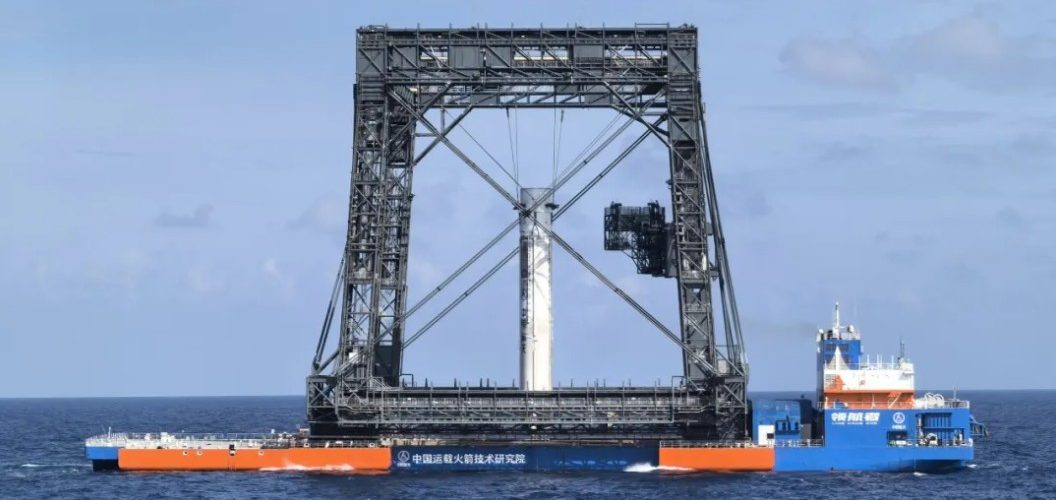
At 0415 UTC on July 10, a 63-metre rocket launched from Hainan Island. Eleven minutes later, after placing a satellite in orbit, its first stage returned through the atmosphere and landed in a net on a floating platform in the South China Sea. This Long March 10B booster recovery marked two world firsts: it was the first time an orbital-class booster was caught in a net, and the first perfect first-stage recovery on a rocket's maiden flight. With this, China became the second country after the United States to recover an orbital booster.
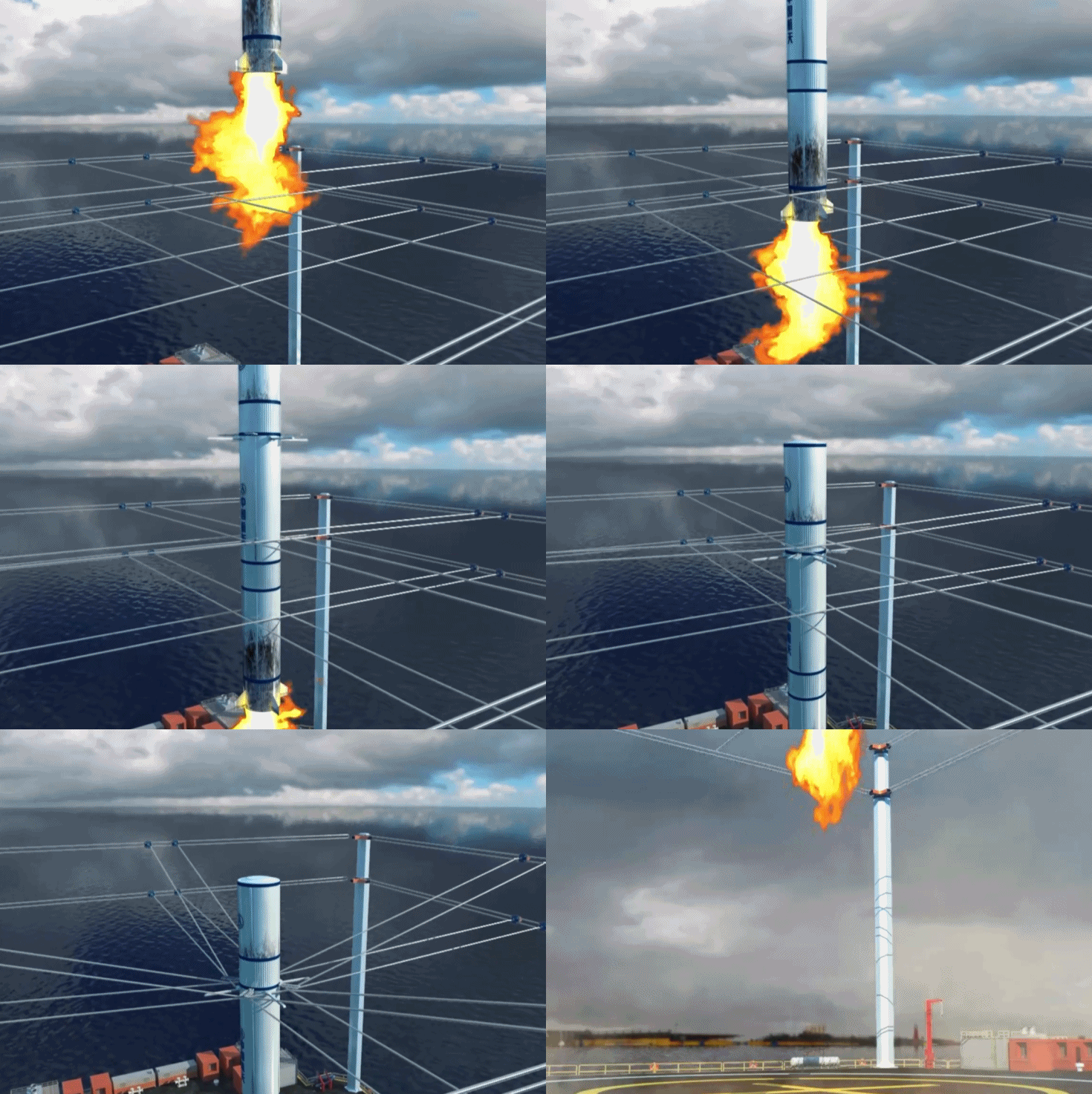
The rocket was built by the China Academy of Launch Vehicle Technology, part of the state-owned China Aerospace Science and Technology Corporation (CASC), and launched from the Wenchang Commercial Space Launch Site on Hainan. After separating from the upper stage, the first stage used a series of engine burns to reverse course and guided itself back to the recovery platform at sea. In the final moments, four lightweight hooks extended from the base and caught the net, absorbing the last of the booster's energy and bringing it to a stop. There were no landing legs or need to balance on engine thrust - just hooks and a net.
If you've seen SpaceX land a Falcon 9 booster on a drone ship, you might think all rocket recoveries work the same way. But that's not the case. Falcon 9 uses a series of engine burns to slow down, then lands upright on four legs, balancing on engine thrust until the last second. Blue Origin's New Glenn uses a similar method. The Long March 10B, however, doesn't use landing legs at all. Instead, its four hooks catch a net, making the system lighter and simpler. Every kilogram saved on the booster means more can be carried as payload, and in rocketry, saving weight is crucial.
Standing 63 metres tall with a 5-metre payload fairing (the protective nose cone that shields satellites during ascent) and a capacity of 16,000 kilograms to low-Earth orbit, the Long March 10B sits in roughly the same weight class as SpaceX’s 70-metre Falcon 9. It is the commercial sibling of the Long March 10A, a vehicle designed to carry crew to China’s Tiangong space station. The broader Long 10 March family is also being developed for crewed lunar missions, with a target date of 2030.
CASC plans to reuse the same booster that flew on July 10 for another mission in 2026. This quick turnaround shows the rocket's main goal: supporting China's planned satellite megaconstellations, which are meant to be a homegrown answer to SpaceX's Starlink network. Building a network of thousands of broadband satellites takes hundreds of launches in a short time, and discarding a first stage after each flight would be extremely costly. Reusing boosters is the only way to make the numbers work.
China isn't relying on just one rocket. The Long March 12A, another partially reusable model, is in development, and the private company Landspace is building Zhuque-3, which aims for vertical landings like Falcon 9. According to Scientific American, the Long March 10B's successful recovery now puts China in the reusable launch race, a field that until recently was limited to American companies.
Engineering deep dive: the physics of the Long March 10B booster recovery
Why rockets have stages (and why we throw them away)
Getting to orbit is, at heart, a speed problem. A satellite in low-Earth orbit travels at roughly 7.8 kilometres per second. The Tsiolkovsky rocket equation, which relates a rocket’s achievable change in velocity to the ratio of its full mass to its empty mass and the speed of its exhaust, shows that a single-stage vehicle would need to be almost entirely propellant, leaving virtually nothing for payload. Staging solves this. Stack two or more rocket stages on top of each other, burn the lowest stage first, then jettison it. Shedding that dead mass mid-flight dramatically improves the mass ratio for the remaining stages, making orbital velocity achievable with a meaningful payload on top.
The catch is cost. The first stage is typically the most expensive part of the rocket, housing the main engines, turbopumps, and propellant tanks. And discarding it after every flight is like scrapping a passenger jet after a single London-to-Sydney trip. Recovery and reuse is the obvious fix, provided you can solve the engineering.
Coming back: burns, loads, and heat
A first-stage booster separates at an altitude of roughly 60 to 80 kilometres, travelling at around 2 kilometres per second. Returning it to a landing site requires a series of engine firings. The “boostback burn” applies Newton’s third law directly: exhaust gases are expelled at high speed in one direction, and the booster accelerates in the opposite direction, redirecting its arc back towards the recovery point. In A-level terms, the momentum of the expelled exhaust is equal and opposite to the momentum gained by the booster.
As the booster descends into the thicker atmosphere, it faces severe aerodynamic heating. Surfaces can exceed 1,000 degrees Celsius, demanding thermal protection such as ablative coatings, materials engineered to char and erode in a controlled way, carrying heat away from the structure. Structural loads during re-entry can surpass those experienced on the way up, so the airframe must be built to survive the round trip. Typically, 10 to 15 per cent of a booster’s total propellant is reserved for the return journey, a direct trade-off between reusability and per-flight payload capacity.
Guidance: hitting a net on a moving platform
Threading a 63-metre booster onto a net at sea demands precision measured in metres. The booster carries inertial measurement units (accelerometers and gyroscopes that continuously track position and orientation), satellite navigation receivers, and grid fins: small, waffle-like aerodynamic surfaces mounted near the top of the stage. These fins can be angled independently to steer the booster through the atmosphere during descent. In the final seconds, onboard computers calculate real-time corrections, adjusting thrust levels and fin positions to align the booster’s hooks with the net.
Why a net beats legs
Landing legs add mass. On Falcon 9, four deployable legs made from carbon-fibre composite and aluminium contribute several hundred kilograms to the booster’s dry weight. They also demand a precision vertical touchdown balanced on engine thrust, which requires extra propellant for hovering and last-moment corrections. A net catch relaxes these requirements. The net offers a larger capture window, the hooks are lighter than a set of legs, and much of the landing hardware sits on the platform rather than on the rocket itself. The trade-off is that you need a dedicated sea-based platform with a net system, but the booster ends up lighter, simpler, and capable of carrying more to orbit.
For students weighing up aerospace engineering, the lesson from Hainan is clear. The industry is no longer about perfecting one launch architecture and leaving it unchanged for decades. It is a live design competition between rival recovery methods, materials, and guidance systems, playing out across multiple continents. Net catch versus propulsive landing is an argument about mass budgets, structural loads, and operational complexity, exactly the sort of trade-off analysis that defines engineering as a discipline.
- China’s Long March 10B caught its first-stage booster in a net at sea on 10 July 2026, on the rocket’s maiden flight
- It is the first net-based recovery of an orbital-class booster and the first perfect booster recovery on an inaugural launch
- Four lightweight hooks replace landing legs, saving mass for payload
- CASC plans to reuse the same booster later in 2026 to support China’s satellite megaconstellation ambitions