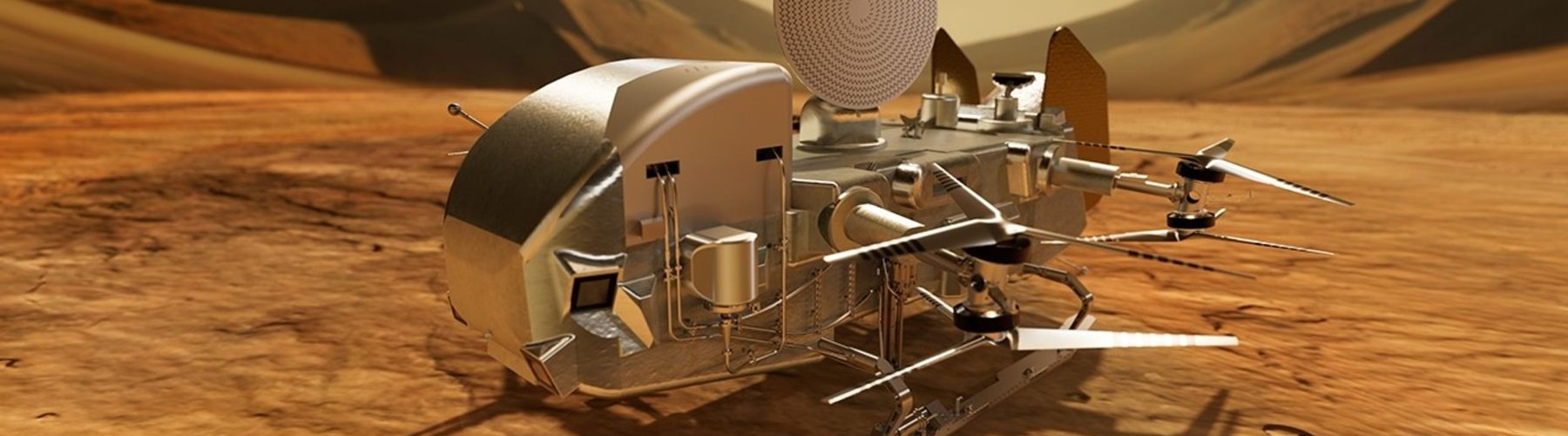
In a clean room at the Johns Hopkins Applied Physics Laboratory in Laurel, Maryland, engineers are assembling something that looks like it belongs in science fiction. Dragonfly is a car-sized, eight-rotor drone powered by a lump of decaying plutonium. It will fly through an atmosphere four times denser than Earth’s, land on dunes made of frozen organic compounds, and search for the chemical building blocks of life. Its destination is Titan, Saturn’s largest moon, a world where methane rains from orange skies and rivers carve valleys through ice as hard as granite. Assembly began on 10 March 2026, and as NASA confirmed, the Dragonfly Titan rotorcraft has now entered its integration and testing phase.

“This milestone essentially marks the birth of our flight system,” said Elizabeth Turtle, Dragonfly’s principal investigator at APL. The first weeks focused on power and functional testing of two components: the Integrated Electronics Module, or IEM, which serves as Dragonfly’s brain, handling navigation, data processing, and communications, and the Power Switching Units, which control how electricity flows to the rotorcraft’s instruments and systems. Both passed their initial checks after being connected to the wiring harness.
Why the Dragonfly Titan rotorcraft flies on another world
Titan’s atmosphere is 1.5 times the surface pressure of Earth’s and composed mainly of nitrogen, with a surface temperature of about minus 179 degrees Celsius. The thick atmosphere and low gravity, roughly one-seventh of Earth’s, make it surprisingly easy to fly there. A rotor on Titan generates far more lift per revolution than it would on Earth or Mars, where the atmosphere is roughly 100 times thinner. NASA’s Ingenuity helicopter proved powered flight was possible on Mars, but it was a technology demonstration weighing just 1.8 kilograms. Dragonfly will weigh several hundred kilograms and carry a full science payload, including a mass spectrometer, a gamma-ray spectrometer, and meteorological sensors.
The launch window opens no earlier than summer 2028 aboard a SpaceX Falcon Heavy. After a six-year transit, Dragonfly will arrive at Titan in the mid-2030s, parachute through the atmosphere inside an aeroshell, and begin a series of powered flights between scientifically interesting sites. Each flight could cover several kilometres. Between flights, the rotorcraft rests on the surface, recharging and running science experiments.
Engineering Deep Dive: Designing the Dragonfly Titan Rotorcraft
Power is the first problem. Titan receives about 1 per cent of the sunlight that reaches Earth, and its thick haze scatters what little arrives. Solar panels are useless. Instead, Dragonfly carries a Multi-Mission Radioisotope Thermoelectric Generator, or MMRTG. This device contains plutonium-238 dioxide, which decays radioactively, producing heat. Thermoelectric couples, devices that convert a temperature difference directly into electrical voltage via the Seebeck effect, surround the plutonium core. The Seebeck effect is a direct application of thermoelectric physics. If you study A-level Physics, you will encounter thermocouple principles in the electricity and thermal units. The MMRTG produces a steady electrical output of around 110 watts at the start of the mission, declining slowly as the plutonium decays with a half-life of 87.7 years.
The power output is modest, far less than a domestic kettle. Dragonfly cannot fly continuously. Instead, it charges a lithium-ion battery during rest periods on the surface, then uses the stored energy for short, intense flights. The energy budget is tight: every watt allocated to heating, communications, or science instruments is a watt not available for rotors. This is systems engineering at its most constrained, balancing competing demands within a fixed power envelope.
Aerodynamically, Dragonfly is an octocopter, with eight rotors arranged in four coaxial pairs. Coaxial rotors, where two rotors spin in opposite directions on the same axis, are more compact than side-by-side arrangements and cancel out each other’s torque, simplifying the flight control system. The thick Titan atmosphere means the rotor blades can be shorter and spin more slowly than they would need to on Earth for the same lift. Lift is governed by the equation L = half rho v squared S Cl, where rho is air density, v is rotor tip speed, S is blade area, and Cl is the lift coefficient. On Titan, rho is about four times Earth’s sea-level value, which roughly quadruples the lift for given rotor dimensions and speed.
Navigation on Titan presents unique challenges. There is no GPS network. Dragonfly will use inertial measurement units, accelerometers and gyroscopes that track the vehicle’s movement relative to its starting point. These are supplemented by cameras for visual odometry, a technique that estimates movement by tracking features in successive images. Radar altimeters measure height above the surface. All of this must work autonomously, because the one-way light travel time between Earth and Saturn is about 80 minutes. A pilot on Earth could not react to a gust of wind or an unexpected obstacle. Dragonfly must make its own decisions.
Thermal protection is another engineering layer. At minus 179 degrees Celsius, lubricants freeze, batteries lose capacity, and electronics slow down. The MMRTG’s waste heat, normally an engineering nuisance, becomes a resource on Titan. Heat pipes and thermal insulation, including specially formulated foam being tested during the current assembly phase, channel warmth from the MMRTG to the rotorcraft’s critical systems. The engineering trade-off is delicate: too much insulation and the electronics overheat during flight, when the rotors generate frictional heat. Too little and they freeze on the surface during charging.
The science payload connects directly to the astrobiology question: does Titan have the chemistry for life? The mass spectrometer will analyse surface samples for complex organic molecules. Titan’s surface is coated in tholins, organic compounds formed when ultraviolet light and charged particles from Saturn’s magnetosphere break apart nitrogen and methane in the upper atmosphere. These fragments recombine into increasingly complex molecules, raining down onto the surface over millions of years. Some planetary scientists think Titan’s subsurface ocean, a layer of liquid water beneath the ice crust, could mix with these surface organics in impact craters, creating conditions where prebiotic chemistry might occur. Dragonfly will visit such a crater.
Assembly will continue at APL through 2026 and into early 2027, when the lander moves to Lockheed Martin in Colorado for system-level testing. Final environmental testing returns it to APL before shipping to Kennedy Space Center in spring 2028. Between now and then, every bolt, wire, and software routine must be proven to survive a six-year journey through space, a violent atmospheric entry, and years of operation on a frozen moon a billion kilometres from the nearest repair shop.
NASA’s Dragonfly has entered assembly at Johns Hopkins APL. The nuclear-powered octocopter will fly on Titan after a 2028 launch. Titan’s dense atmosphere makes flight easier than Mars.