A novel wave energy converter that eliminates the need for permanent seabed structures has demonstrated energy conversion efficiency exceeding 65% in testing, potentially addressing key limitations in ocean energy harvesting. The Kinowave system, developed by researchers from the University of Edinburgh and Imperial College London, has recently secured the UK James Dyson Award for its innovative approach to marine renewable energy.

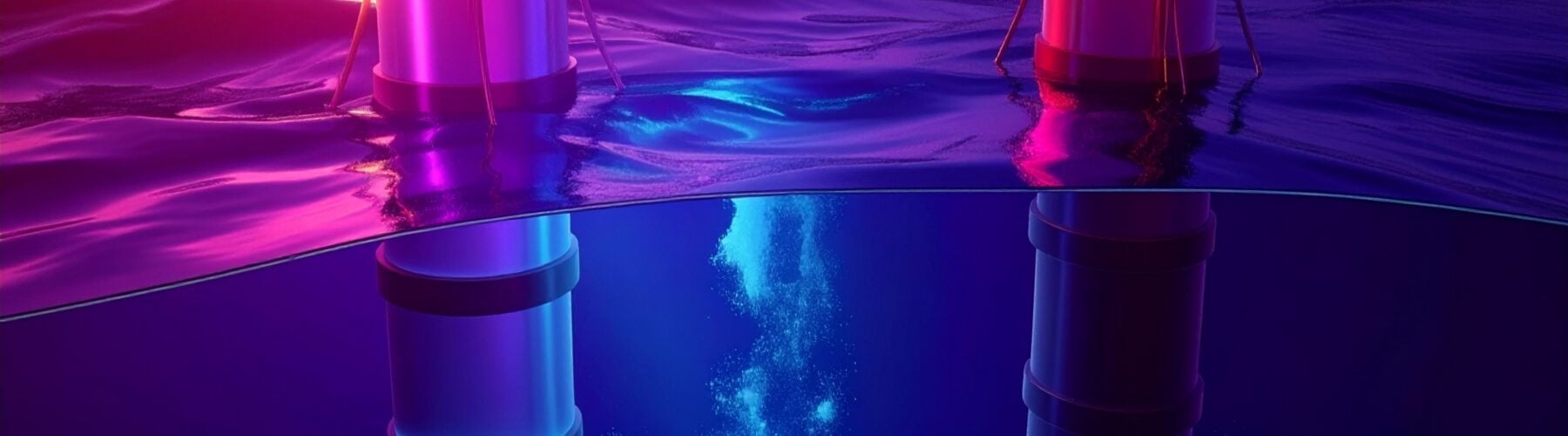
The Kinowave platform operates through interconnected, fluid-filled vertical cylinders that float freely on the ocean surface. Unlike conventional wave energy converters that require fixed anchoring systems, this design harnesses energy from the relative motion between internal fluid and cylinder walls as waves cause the platform to oscillate.
The system’s core innovation lies in applying Pascal’s principle to harness wave energy. As ocean swells move the floating platform, internal fluid levels automatically adjust across connected cylinders, creating differential motion that drives power generation mechanisms. This approach eliminates the need for permanent seabed installations, which typically incur significant deployment costs and have environmental impacts in wave energy projects.
Testing conducted in both controlled pool environments and open ocean conditions near Visakhapatnam has validated the concept’s performance metrics. The prototype demonstrated consistent energy extraction across varying wave conditions, with efficiency measurements substantially exceeding typical wave energy conversion rates.
Engineering Principles Behind Fluid-Coupled Wave Energy Conversion
Pascal’s Law Application in Dynamic Systems
Pascal’s Law states that pressure applied to a confined fluid is transmitted equally in all directions. In static applications, this principle enables hydraulic machinery and water levelling systems. The Kinowave design extends this concept to dynamic wave environments by utilising pressure differentials created through relative motion.
When wave action causes the floating platform to move vertically, fluid within interconnected cylinders experiences pressure variations. The connecting tubes between cylinders allow fluid redistribution to maintain equilibrium. Still, the motion between the liquid mass and cylinder walls creates a phase lag that can be harvested for energy. This differential motion occurs because the fluid responds to gravitational levelling while the cylinders follow wave motion patterns.
Fluid Dynamics and Energy Transfer Mechanisms
The energy transfer efficiency depends on several fluid dynamic parameters. The diameter ratio between connecting tubes and cylinders significantly affects flow rates and response characteristics. Equal-diameter systems, as implemented in Kinowave, minimise flow restrictions and reduce energy losses due to turbulence and friction.
Wave-induced motion creates oscillatory fluid displacement within the cylinder network. The amplitude and frequency of this displacement determine the power that can be extracted. Higher wave energy densities translate to greater fluid motion, providing more mechanical energy for conversion systems.
The platform’s response to wave forcing depends on its buoyancy characteristics and mass distribution. Proper design ensures the platform follows wave motion effectively while maintaining stable operation across varying sea states. The fluid mass within cylinders acts as both the energy transfer medium and a tuning parameter for system resonance.
Wells Turbine Integration and Power Take-Off
Wells turbines represent a specialised power take-off mechanism particularly suited for oscillatory fluid flows. Unlike conventional turbines that require unidirectional flow, Wells turbines maintain consistent rotation direction regardless of airflow direction, making them ideal for wave energy applications.
In the Kinowave system, fluid motion within cylinders can drive air displacement through carefully designed pneumatic chambers. This air movement powers Wells turbines that convert oscillatory motion into rotational mechanical energy for electrical generation. The turbine’s symmetric airfoil design ensures efficient operation across the bidirectional flow cycles typical of wave energy systems.
Alternative power take-off mechanisms include linear generators driven by float systems and direct mechanical coupling through rack-and-pinion arrangements. The choice of power take-off affects overall system efficiency and maintenance requirements, with Wells turbines offering advantages in durability and consistent performance.
Hydrodynamic Optimisation and Wave Interaction
Wave energy absorption efficiency depends on the platform’s interaction with incoming wave fields. The cylinder arrangement and platform dimensions influence how effectively the system captures wave energy across different frequencies and directions.
Optimal energy extraction occurs when the platform’s natural response frequency aligns with the dominant wave periods in the deployment environment. This resonance condition maximises motion amplitude and energy transfer rates. The interconnected cylinder design provides tuning flexibility through fluid mass adjustment and geometric modifications.
Wave diffraction and radiation effects around the platform affect energy absorption patterns. Larger platforms interact more strongly with longer wavelengths, while smaller systems respond better to higher-frequency waves. The Kinowave design aims to balance these factors for broad-spectrum energy capture.
Ocean trials conducted off the Indian coast demonstrated the system’s practical viability under real-world conditions. The prototype successfully maintained stable operation while achieving energy conversion rates exceeding 60% of incoming wave power. This performance level represents a substantial improvement over many existing wave energy technologies, which typically achieve conversion efficiencies between 30 and 45%.
Controlled testing in wave tanks allowed precise measurement of energy transfer mechanisms. Data analysis revealed that the interconnected cylinder configuration effectively captures energy across a range of wave frequencies, resulting in a more consistent power output than single-point absorber systems.
The research team’s iterative development process involved twelve prototype iterations, each addressing specific performance limitations identified through testing. Early versions with different cylinder-to-tube diameter ratios exhibited reduced efficiency due to flow restrictions, resulting in the current equal-diameter design, which optimises fluid movement.
Traditional wave energy converters face significant challenges related to permanent installation requirements. Seabed anchoring systems for projects like the Pelamis wave farm require extensive marine construction and ongoing maintenance in harsh ocean environments. The mooringless Kinowave design eliminates these complications while maintaining energy extraction capability.
Cost analysis suggests substantial savings compared to fixed-installation systems. The absence of permanent structures reduces deployment complexity and the need for environmental permitting. If successful in larger-scale trials, this approach could enable the deployment of wave energy in locations where seabed anchoring proves impractical or environmentally sensitive.
The platform’s mobility offers additional operational advantages. Systems can be relocated based on seasonal wave patterns or removed during extreme weather events. This flexibility could improve capacity factors and extend equipment lifespans compared to permanently installed alternatives.
The development team has entered Imperial College London’s Cleantech Innovation Programme, providing access to advanced testing facilities and technical expertise. Near-term objectives include constructing a 100-watt prototype for detailed performance characterisation, followed by scaling to 10-kilowatt demonstration units within two years.
Collaboration discussions with the Government of Seychelles aim to establish pilot deployment sites for real-world testing and evaluation. These trials would evaluate system performance under sustained ocean conditions, while assessing the benefits of community energy applications and the effectiveness of coastal protection measures.
The modular design philosophy enables scalable deployment approaches. Multiple platforms could operate in arrays to increase total power output, with individual units sized according to specific application requirements and deployment constraints.
Beyond electricity generation, the Kinowave system offers potential benefits for coastal protection by absorbing wave energy before it reaches shorelines. Wave energy dissipation offshore could reduce coastal erosion and storm damage, particularly valuable for vulnerable island communities and low-lying coastal areas.
If the technology proves viable at commercial scale, it could contribute to renewable energy portfolios in coastal regions with significant wave resources. India alone possesses an estimated 41,300 MW of wave energy potential, representing substantial untapped renewable capacity.
The combination of energy generation and coastal protection functions could improve project economics by providing multiple revenue streams and environmental benefits. This dual-purpose approach is essential for the commercialisation of wave energy technology in regions facing both energy needs and coastal vulnerability.
- Kinowave wins 2025 UK James Dyson Award for innovative wave energy conversion system
- Award-winning design achieves 65% efficiency using interconnected fluid-filled cylinders
- System operates without permanent seabed structures or mooring systems
- Pascal’s law application enables energy extraction from relative fluid motion
- Ocean testing validates concept performance, contributing to award recognition
- £30,000 award funding accelerates development toward 10kW demonstration units
- Technology offers combined energy generation and coastal protection benefits