There’s a saying in physics that at first seems contradictory: the quantum vacuum is not empty. Even when space is freed of all matter and radiation, it still shows activity at the quantum level, with virtual particles appearing and disappearing so quickly no instrument can directly observe them. It’s a concept students accept during lectures without fully believing. A group from the Chinese Academy of Sciences has now given a solid reason to take it seriously by using the quantum vacuum - shaped and confined - to boost vacuum enhanced superconductivity in a real material. The result, published in Nature, is both strange and possibly transformative.
The experiment focuses on a crystal of niobium diselenide (NbSe₂), a well-known superconductor. If left unattended, it transitions to its superconducting state at a specific critical temperature. The team, headed by Guanghui Cheng and with Frank Wilczek, a Nobel laureate from MIT, acting as a co-author, put a six-layer-thick NbSe₂ crystal into a carefully designed electromagnetic cavity. As a result, the critical temperature increased by 5.4 per cent.
The material was not altered; no atoms were added nor was it subjected to pressure. Instead, they modified the shape of the empty space around it, causing the superconductor to react.
Why Vacuum Enhanced Superconductivity Sounds Impossible but Is Not
The answer lies in quantum electrodynamics, specifically the Casimir effect and related phenomena. If you confine electromagnetic fields within a cavity, only certain wavelengths can exist inside. Imagine a guitar string: only particular standing waves fit between its fixed ends. In an electromagnetic cavity, only certain vacuum field modes remain; others are suppressed.
This reshaping of the vacuum changes the density of virtual photons, the ghostly particles that quantum field theory predicts are constantly being created and annihilated in empty space. Virtual photons are not a theoretical convenience. They produce measurable forces (the Casimir effect), shift atomic energy levels (the Lamb shift), and alter the electron’s magnetic moment. They are real enough to do physics with.
The team’s insight was that these virtual photons could also modify electron interactions in a superconductor. Superconductivity depends on electrons pairing up into Cooper pairs, bound together by an attractive interaction mediated (in conventional superconductors) by vibrations of the crystal lattice called phonons. If you can add another attractive channel, through virtual photons in a shaped vacuum, you lower the energy of the superconducting state and make it more robust.
Engineering Deep Dive: Terahertz Cavities and the Art of Shaping Nothing
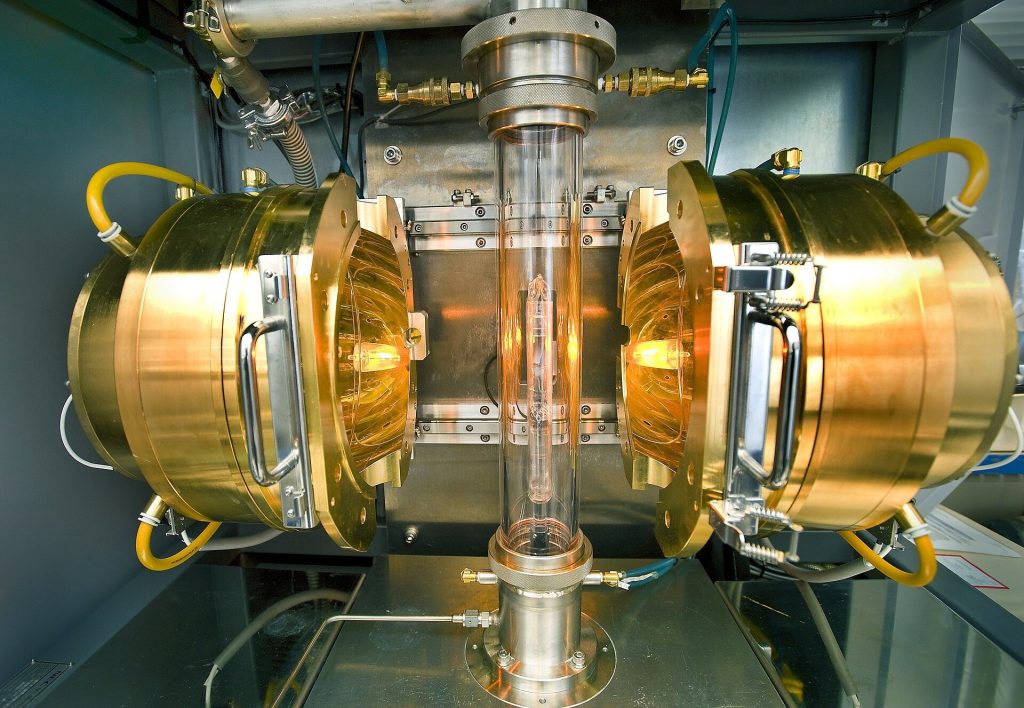
Building a cavity that modifies the quantum vacuum in a useful way is an exercise in precision electromagnetic engineering. The team used a split-ring resonator, a structure borrowed from metamaterials research, operating at terahertz frequencies.
A split-ring resonator is essentially a metallic ring with a gap cut into it. It behaves as an LC circuit: the ring provides inductance, the gap provides capacitance, and the combination resonates at a frequency determined by its geometry. Scale the ring down to micrometre dimensions and the resonant frequency lands in the terahertz band, between microwaves and infrared light.
The resonator performs two tasks. First, it confines the electromagnetic field to a small volume around the NbSe₂ crystal, concentrating vacuum fluctuations where they overlap with superconducting electrons. Second, its resonant frequency matches the energy scale of the superconducting gap, the energy needed to break a Cooper pair. This matching ensures virtual photons couple efficiently to the pairing mechanism rather than irrelevant excitations.
The six-layer thickness of the NbSe₂ crystal is deliberate. If too thick, the cavity fields cannot penetrate the bulk. If too thin, surface effects dominate and obscure the vacuum contribution. Six atomic layers hit a sweet spot where the cavity mode extends through the entire crystal while the material retains bulk-like superconducting behavior.
Measuring a 5.4 per cent change in critical temperature requires extraordinary control over experimental conditions. Temperature stability must be maintained to millikelvin precision. The cavity geometry must be reproduced identically across samples to confirm that the effect is not due to variations in crystal quality. The team ran extensive control experiments with the same NbSe₂ crystals outside the cavity, confirming the temperature shift appeared only when the vacuum was confined.
This approach is exciting from an engineering perspective because it does not require modifying the superconducting material. Doping, applying pressure, or changing composition are permanent changes. Placing a material inside a cavity is reversible and tunable. Adjust the cavity geometry and you adjust the vacuum contribution. In principle, you could sweep through resonant frequencies to optimise enhancement for different materials.
The 5.4 per cent increase is modest in absolute terms. But the concept - that engineering the electromagnetic environment around a material can modify its quantum properties - opens a design space that did not exist before. Researchers are discussing stacked-cavity architectures to amplify the effect and whether this approach might work for unconventional superconductors, where the pairing mechanism is still debated.
A 5.4 per cent bump in critical temperature will not by itself deliver room-temperature superconductors. Nobody involved claims that. It adds a new tool to the materials engineering toolkit. For decades, options for enhancing superconductivity have been chemical (change the material) or mechanical (apply pressure). Now there is a third option: shape the vacuum. This result excites physicists because it suggests there are levers nobody had thought to pull.