The arithmetic of modern naval defence has a problem. An interceptor missile costs hundreds of thousands of pounds. A mass-produced drone costs a few hundred dollars. If your enemy can afford to send fifty drones at your ship, and each one requires a missile to stop it, the maths works in the attacker’s favour long before you run out of threats. The DragonFire laser weapon, now confirmed for deployment on Royal Navy Type 45 destroyers by 2027, rewrites that equation. Each shot costs approximately £10 in electricity.

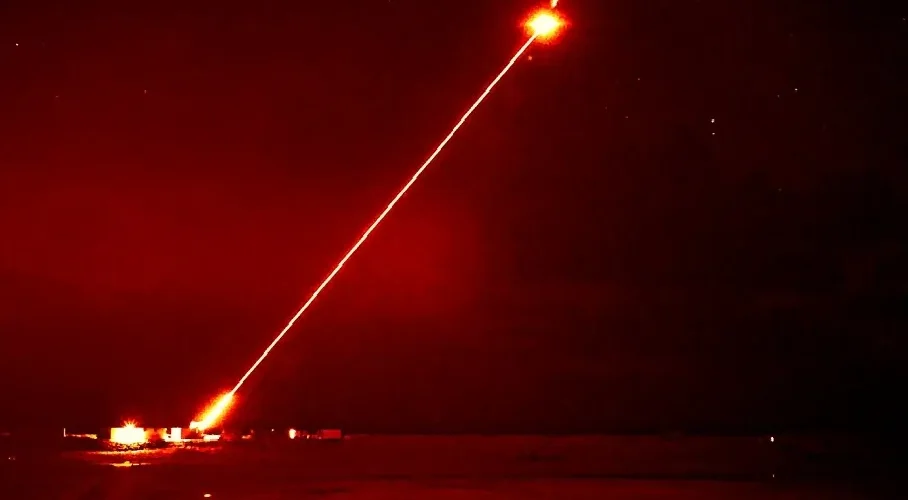
The UK Ministry of Defence announced in March 2026 that the programme had been accelerated by five years, bringing initial deployment forward from the early 2030s to 2027. Successful trials at the MOD Hebrides range in Scotland in November 2025 demonstrated the system’s ability to engage and destroy fast-moving aerial targets, marking the UK’s first above-the-horizon laser engagement. The DragonFire laser weapon delivers a 50 kW beam with sub-centimetre precision at one kilometre, a level of accuracy that the MOD describes as equivalent to hitting a £1 coin at that distance.
From fibre optics to fire control
DragonFire was developed by a consortium of four organisations: MBDA UK, which leads weapons integration; Leonardo UK, which builds the beam director; QinetiQ, which provides the laser source and trial facilities; and the Defence Science and Technology Laboratory (DSTL), the MOD’s in-house research arm. The project was publicly disclosed in 2017 and has since undergone a series of progressively more demanding trials.
The production contract for the first two operational systems was awarded to MBDA in November 2025, with delivery aligned to naval integration milestones on at least two Type 45 destroyers. Vernon Coaker, the Minister of State for Defence, confirmed the accelerated timeline in a March 2026 statement. Britain will become the first European NATO member to field an operational shipborne laser weapon, a distinction that carries both strategic and industrial significance.
The operational concept positions the DragonFire laser weapon as a short-range layer within the Type 45’s existing air defence architecture. The ship’s Sea Viper missile system handles high-altitude, long-range threats. DragonFire fills the gap at close range, dealing with drones, small boats, and incoming projectiles that would otherwise consume expensive missiles. Each engagement preserves a Sea Viper round for a target that justifies the cost. Over a sustained engagement, the savings are not marginal. It is transformative.
The system’s appetite for electrical power is considerable, but the Type 45 destroyers were designed with significant generation capacity. Their integrated electric propulsion system, built around Rolls-Royce WR-21 gas turbines and Converteam electric motors, provides the headroom needed to feed a directed energy weapon alongside the ship’s other systems.
Engineering Deep Dive: How the DragonFire laser weapon puts light on target
The core of DragonFire is a fibre-combined laser architecture. Rather than using a single, monolithic laser source, the system merges the output of multiple glass-fibre lasers into a single beam. Each fibre laser generates a few kilowatts of power. By coherently combining them, phasing each fibre so that its light waves align constructively, the system reaches the 50 kW-class output needed for weapon-grade effects. The physics is interference: when two waves of the same frequency are in phase, their amplitudes add. When they are out of phase, they cancel. The engineering challenge is maintaining phase coherence across multiple fibres simultaneously, in real time, on a moving ship.
Students who have studied wave superposition in A-level Physics will recognise this principle. It is the same constructive interference that produces bright fringes in a Young’s double-slit experiment, scaled up by orders of magnitude and applied to kilowatt-class laser beams.
Fibre combination offers practical advantages over alternative approaches, such as chemical lasers or solid-state slab lasers. Each fibre module is relatively small, efficient, and replaceable. If one fibre fails, the system degrades gracefully rather than shutting down. The electrical-to-optical efficiency of fibre lasers is typically around 30 to 40 per cent, meaning that for every kilowatt of electrical input, roughly 300 to 400 watts of laser light emerge. The remainder is waste heat, which must be managed through the ship’s cooling systems.
Getting a precise beam onto a moving target at range requires a beam director, the turret-mounted optical assembly built by Leonardo UK. The beam director contains a primary mirror that focuses and steers the beam, electro-optical sensors for target tracking, and a secondary tracking laser that illuminates the target to provide precise pointing data. The entire assembly is stabilised against the ship’s motion using gyroscopic and inertial reference systems. On a destroyer pitching and rolling in the North Atlantic, mechanical stabilisation to sub-milliradian accuracy is a formidable engineering problem.
The atmosphere complicates things further. Turbulence, humidity, and thermal gradients distort a laser beam as it travels, causing it to spread and wander. DragonFire addresses this with adaptive optics, a technology borrowed from astronomy. A wavefront sensor measures the distortion in real time, and a deformable mirror adjusts its shape hundreds of times per second to compensate. The corrected beam arrives at the target as a tight spot rather than a diffuse glow. Without adaptive optics, the beam would lose most of its effectiveness beyond a few hundred metres in maritime conditions.
The weapon effect itself is thermal. The beam does not punch through the target like a bullet. Instead, it applies sustained thermal energy to a small area, raising the surface temperature until the material fails structurally or the target’s electronics are disabled. Against a drone made of composite materials, the dwell time needed for destruction can be measured in seconds. Against a hardened metal target, it takes longer, which is why DragonFire is designed for soft targets at close range rather than as a replacement for missiles against armoured threats.
The fire control integration is perhaps the least visible but most complex part of the system. The laser must be slaved to the ship’s combat management system, receiving target tracks from the Type 45’s Sampson radar and other shipboard sensors. It must prioritise targets, calculate engagement windows, assess whether atmospheric conditions permit an effective shot, and hand off to the missile system if the laser cannot achieve the required effect. All of this happens autonomously, with a human operator authorising engagements but not manually aiming the beam.
Directed energy weapons have been promised for decades and have disappointed almost as often. DragonFire’s accelerated deployment suggests the technology has crossed a threshold from demonstration to operational capability. Whether it performs as well in the grey, wet conditions of the North Sea as it did on the Hebrides test range is a question the Royal Navy will answer over the next few years. The engineering, at least, appears ready for the ocean.
- The UK’s DragonFire laser weapon will be deployed on Type 45 destroyers by 2027, five years ahead of original plans
- The 50 kW fibre-combined laser achieves sub-centimetre precision at one kilometre and costs approximately £10 per shot
- Successful trials in 2025 at Scotland’s Hebrides range downed fast-moving drones in the UK’s first above-the-horizon laser engagement
- Britain will become the first European NATO member to field an operational shipborne laser weapon