For more than a decade, solid-state batteries have occupied the same awkward position in engineering as fusion power: always promising, never quite arriving. The technology works beautifully in laboratories. Small cells with ceramic or glass electrolytes demonstrate higher energy densities, faster charging, and better safety than conventional lithium-ion batteries. But scaling from a thumbnail-sized cell to a factory production line has proved stubbornly difficult, and the list of startups that have tried and stumbled is long. This month, a company in Maryland took a step that narrows the gap between laboratory proof and industrial reality.
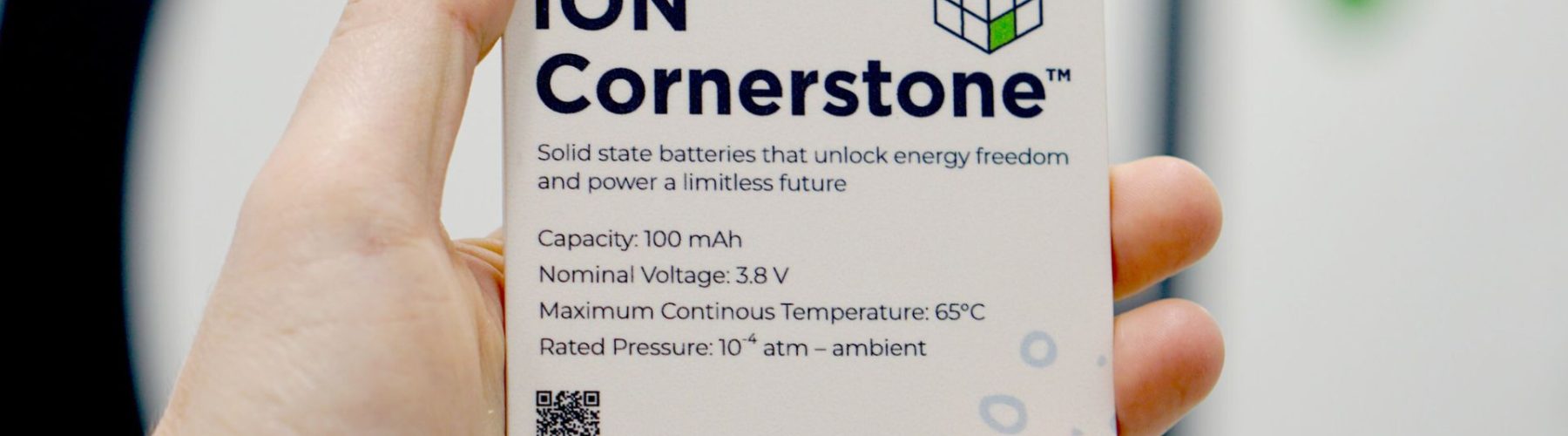
ION Storage Systems, based in Beltsville, announced that its Cornerstone Cell has passed customer performance qualification, making it the first US solid-state battery company to clear this benchmark. Qualification means that an external customer has tested the cell against their own performance specifications, covering capacity, cycle life, charge rate, and operating temperature range, and confirmed it meets their requirements. It is not the same as mass production, but it is the gate that must be passed before production orders can be placed. CTO Dr Greg Hitz described the milestone as a “company-defining moment,” noting that bringing a solid-state, anodeless battery out of the lab and into the real world has been the company’s central objective.
Why solid-state matters
The “solid-state” label refers to the electrolyte, the material that carries lithium ions between the battery’s two electrodes during charging and discharging. In a conventional lithium-ion cell, this electrolyte is a liquid organic solvent. The liquid works well, but it is flammable, which is the root cause of the thermal runaway events that occasionally make headlines when laptop or electric vehicle batteries catch fire. A solid electrolyte, typically a ceramic, glass, or polymer, eliminates this flammability risk. It also opens the door to using a lithium metal anode, or no anode at all in what engineers call an “anodeless” design, which can store more energy per kilogram than the graphite anodes used in today’s cells.
ION’s technology uses a ceramic electrolyte, and the cell is described as anodeless. In this configuration, lithium metal is deposited directly onto a current collector during charging, rather than being intercalated into a graphite host structure. During discharge, the lithium dissolves back into ions and migrates through the ceramic to the cathode. The absence of a graphite anode saves both weight and volume, boosting the cell’s energy density. The company has highlighted the cell’s high-temperature stability as a particular advantage, suggesting applications where conventional lithium-ion cells would degrade or pose safety risks.
The production timeline calls for installation of a new sintering furnace at the Beltsville facility, with manufacturing expected to begin later in 2026. Sintering, the process of heating a ceramic powder to just below its melting point so the particles fuse into a dense solid, is the critical manufacturing step for ceramic electrolytes. The uniformity and density of the sintered layer determine the cell’s ionic conductivity and mechanical strength. Getting this right at scale, producing thousands of identical electrolyte sheets with consistent thickness and no pinholes, is where many solid-state battery efforts have faltered.
ION is not targeting electric vehicles first. Instead, the company is pursuing industrial, defence, and consumer electronics applications where the safety and temperature advantages of solid-state cells command a premium that justifies the higher manufacturing cost. This mirrors the historical path of lithium-ion batteries themselves, which spent years powering camcorders and laptops before the cost curve dropped enough for electric vehicles. CEO Jorge Diaz Schneider has positioned the strategy as deliberate: prove the technology in demanding but lower-volume markets, then scale.
Engineering Deep Dive: How Solid-State Batteries Differ from Lithium-Ion
A lithium-ion battery is, at its core, a device that moves lithium ions back and forth between two electrodes through an electrolyte. During discharge, lithium atoms at the anode lose an electron (oxidation), and the resulting lithium ion migrates through the electrolyte to the cathode, where it is incorporated into the cathode’s crystal structure (reduction). The electron, meanwhile, travels through an external circuit from anode to cathode, producing the electrical current that powers your phone or car. Charging reverses the process. A-level Chemistry students will recognise this as an electrochemical cell operating on redox reactions.
In a conventional cell, the electrolyte is a lithium salt dissolved in an organic solvent, typically a mixture of ethylene carbonate and dimethyl carbonate. This liquid fills the pores of a thin polymer separator that keeps the two electrodes physically apart. The liquid electrolyte conducts lithium ions well, with ionic conductivities around 10 milliSiemens per centimetre (mS/cm), and it wets the electrode surfaces to create good electrical contact. But organic solvents are flammable. If the separator is punctured, perhaps by a manufacturing defect or physical impact, the electrodes can short-circuit, generating heat that decomposes the electrolyte and releases flammable gases. This is thermal runaway, and it can escalate to fire or explosion within seconds.
A solid electrolyte replaces the flammable liquid with a rigid or flexible solid that conducts lithium ions through its crystal lattice or amorphous structure. Ceramic electrolytes, such as lithium lanthanum zirconium oxide (LLZO) or lithium phosphorus sulphide (LPS), achieve ionic conductivities approaching those of liquid electrolytes, some exceeding 10 mS/cm at room temperature. Because the electrolyte is solid and non-flammable, the catastrophic failure mode of thermal runaway is largely eliminated.
The anodeless design used by ION takes this further. In a standard lithium-ion cell, the anode is a layer of graphite particles bound to a copper current collector. During charging, lithium ions from the cathode intercalate between the graphene layers of the graphite, a process that stores the lithium but adds the weight and volume of the graphite host. In an anodeless cell, the copper current collector is bare. During charging, lithium ions arriving from the cathode are reduced to lithium metal directly on the copper surface, forming a thin metallic layer. During discharge, this layer dissolves. The cell effectively builds and destroys its own anode with every cycle.
The engineering challenge is managing the lithium metal deposition. In liquid electrolytes, lithium metal tends to deposit unevenly, forming needle-like structures called dendrites that can pierce the separator and cause short circuits. This is why commercial lithium-ion cells use graphite rather than lithium metal anodes. A dense, defect-free ceramic electrolyte physically blocks dendrite growth because the ceramic is mechanically stronger than the soft lithium metal. This is one of the primary advantages of the solid-state approach: it enables the use of lithium metal (or anodeless) configurations that are unsafe with liquid electrolytes.
Sintering, the manufacturing process ION is scaling up, is a standard technique in ceramics engineering. A fine powder of the electrolyte material is pressed into a sheet and heated in a furnace to a temperature typically between 900°C and 1200°C, depending on the composition. At these temperatures, the powder particles begin to bond at their contact points, and the sheet densifies as pores are eliminated. The goal is a sheet that is thin (typically 10 to 50 micrometres), dense (above 95% of theoretical density), mechanically robust, and free of pinholes. Any pinhole creates a pathway for lithium dendrites to bypass the electrolyte, defeating the purpose of the solid-state design. Achieving this consistently at production speed is the crux of the scaling challenge.
For A-level students, solid-state batteries connect several curriculum areas. The redox chemistry of lithium-ion cells appears in A-level Chemistry. The ionic conductivity of solid electrolytes connects to the physics of charge transport in materials. The energy density advantage of lithium metal over graphite is a straightforward calculation comparing the specific capacities: lithium metal offers 3,860 milliamp-hours per gram, versus graphite’s 372 mAh/g. And the materials science of sintering, where temperature, time, and pressure determine the microstructure of the final product, is a textbook example of engineering process control.
ION is not alone in the solid-state race. QuantumScape, Factorial, and several Asian manufacturers are pursuing parallel approaches. But the qualification milestone matters because it shifts the conversation from “can it work?” to “can it ship?” The next twelve months will reveal whether the sintering process can produce cells at a cost and volume that justify the investment. For the battery industry, and for anyone interested in the engineering of energy storage, it is a space worth watching closely.
• ION Storage Systems, a Maryland-based startup, has become the first US solid-state battery company to achieve customer performance qualification for its Cornerstone Cell.
• The cell uses a ceramic electrolyte and an anodeless design, eliminating the flammable liquid found in conventional lithium-ion batteries.
• Production is expected to begin later in 2026 following installation of a new sintering furnace at the company’s Beltsville facility.
• The company is initially targeting industrial and defence applications rather than electric vehicles, mirroring how lithium-ion batteries first entered the market through consumer electronics.