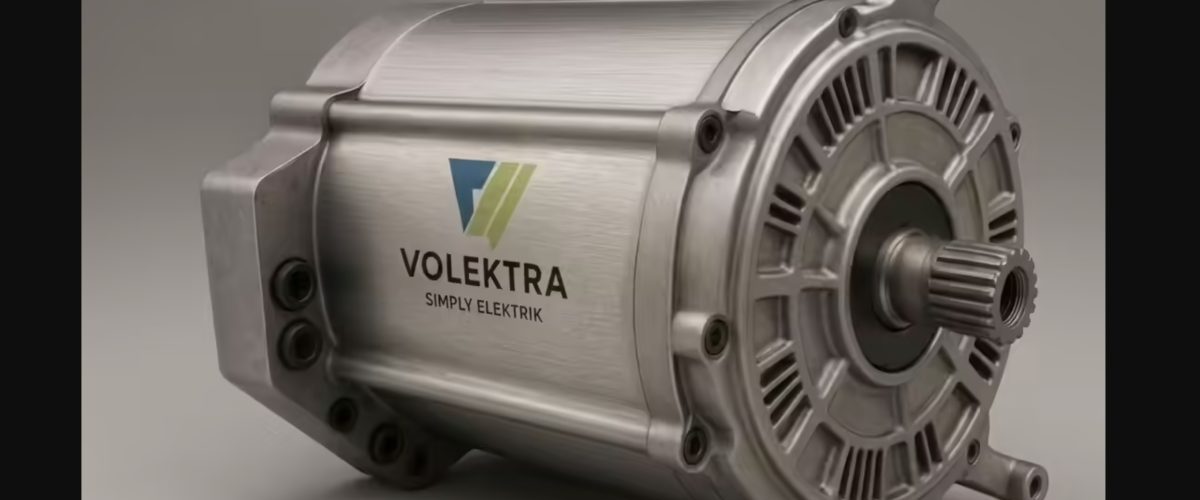
Nearly all electric vehicles rely on permanent magnets within their motors, which are made from rare earth elements refined primarily in China.
Bengaluru-based Vimag Labs aims to eliminate these magnets entirely. In July 2026, the company received its fifth Indian patent for a rare earth free EV motor that generates the rotor magnetic field using power electronics and software algorithms rather than fixed magnets. If successful at production scale, this technology could reshape the automotive industry’s approach to supply chain risk.
The motor, named the Virtual Magnet Synchronous Motor (VMSM), differs from conventional permanent magnet synchronous motors (PMSMs) that use neodymium-iron-boron magnets to create a constant magnetic field. In PMSMs, the stator windings generate a rotating field, and the interaction produces torque. The VMSM replaces rotor magnets with an externally excited system that creates and controls the rotor field in real time. It is brushless and uses no slip rings, resulting in fewer wearing parts, no sparking, and reduced maintenance.
Why a rare earth-free EV motor matters now
The supply chain is highly concentrated. China controls approximately 91 percent of global rare earth refining and 94 percent of sintered permanent magnet production, despite holding only a third of the world’s rare earth reserves. Decades of investment in processing infrastructure ensure that nearly every EV motor magnet passes through a Chinese facility. In April 2025, Beijing imposed export controls on seven heavy rare earth elements and their magnets. Although a further expansion in October 2025 was suspended for one year due to a trade truce, the message remains clear: supply is not guaranteed.
Founded in September 2025 by Manish Seth, Vimag Labs raised a $5 million Series A led by Accel and signed a manufacturing agreement with Jendamark to support scaling. The company is conducting pilot programs with two-wheeler and passenger vehicle manufacturers in India and is targeting industrial applications from 200 kW to 600 kW. Seth described the latest patent, titled “A Robust Rotating Transformer Excited Synchronous Motor and Its Control,” as the result of over 87,600 engineering hours.
Vimag is not the only company addressing this challenge. Tesla announced at its 2023 Investor Day that its next-generation motor would eliminate rare earth elements, though no production date has been set. General Motors and Stellantis have invested in Niron Magnetics, a Minnesota startup developing iron-nitride magnets without rare earths. Valeo’s magnet-free iBEE motor is not expected before 2028. Honda has funded switched-reluctance motor developer Enedym, and Jaguar Land Rover is investing in rare earth magnet recycling.
The common thread is that everyone is spending. Despite significant investment across the industry, no company has yet achieved mass production of a rare earth free drive unit. Vimag’s approach, which uses software to replace hardware, differs from the iron-nitride and ferrite strategies pursued by Western competitors. However, the company’s claim that its motor matches or exceeds permanent magnet performance has not been independently verified at production scale. Efficiency, not just peak power, remains a challenge for magnet-free designs, as lower efficiency directly reduces vehicle range.REE EV motor generates torque
To understand Vimag’s innovation, it is useful to review the motor it seeks to replace. A permanent magnet synchronous motor (PMSM) operates because permanent magnets in the rotor create a constant magnetic flux. The stator, a stationary ring of coils, receives three-phase alternating current, generating a rotating magnetic field. The rotor’s magnets synchronize with this field and spin at the same speed. Torque results from the angular difference (load angle) between the rotor’s magnetic field and the stator’s rotating field.
Neodymium-iron-boron (NdFeB) magnets are highly effective because neodymium exhibits strong magnetic anisotropy, causing its atomic magnetic moments to align in a single direction. This results in a remanent flux density of approximately 1.2 to 1.4 tesla, significantly higher than ferrite magnets (0.3 to 0.4 T). This strong field enables PMSM motors to be compact and efficient, contributing to their dominance in the EV market.
An externally excited synchronous motor (EESM) generates the rotor field using electromagnetic coils wound on the rotor, rather than permanent magnets. Current is supplied to these coils, typically via slip rings and brushes. The magnetic field strength can be adjusted by varying the current, providing a key advantage: at high speeds, the field can be weakened to reduce back-EMF and extend the operating range without complex electronic field-weakening strategies.
The primary drawback of the EESM is the use of slip rings. Brushes wear out, generate electrical noise, and may spark. Vimag’s VMSM claims to eliminate both magnets and slip rings by using a rotating transformer to transfer power to the rotor inductively. This transformer features a primary winding on the stator and a secondary on the rotor, separated by a small air gap. Power is transferred across the gap through electromagnetic induction, similar to a standard transformer but adapted for rotation.
This principle relates directly to Faraday’s law of electromagnetic induction: a changing magnetic flux through a coil induces an EMF. In a rotating transformer, the stator’s primary coil is driven by alternating current, creating a changing flux that links with the rotor’s secondary coil. The induced current in the secondary energizes the rotor’s field windings. The main engineering challenge is maintaining efficient coupling across a rotating air gap that must accommodate thermal expansion, manufacturing tolerances, and centrifugal forces.
The “virtual magnet” concept refers to control algorithms that manage the rotor field in real time. By adjusting the amplitude, phase, and waveform of the current supplied to the rotating transformer, the controller can mimic the behavior of permanent magnets or perform functions they cannot, such as varying field strength instantaneously in response to load changes, temperature, or speed. Vimag’s proprietary software is central to this capability.
Efficiency is a critical consideration. PMSMs achieve efficiencies above 95 percent at their design point because permanent magnets generate flux without input power. An EESM requires input power to energize the rotor coils, resulting in copper losses (I-squared-R heating) in the windings. Whether Vimag’s design can minimize these losses sufficiently to match PMSM efficiency across the full speed range, not just at peak power, remains the key technical question.
For context, BMW uses an EESM with conventional brushes and slip rings in its fifth-generation eDrive motors to avoid rare earth magnets. Renault’s Zoe adopted a similar approach. While these designs perform well, they have not matched the peak efficiency of leading PMSMs. If Vimag’s brushless, slip-ring-free architecture can close this efficiency gap through improved transformer design and software control, it would represent a significant engineering advancement.
The effort to develop a rare earth free EV motor that matches the performance of current permanent magnet machines continues. Whether the breakthrough comes from a Bengaluru startup, a Minnesota magnet company, or a legacy automaker’s laboratory, the engineering community anticipates a solution before the next round of export controls.
- Bengaluru startup Vimag Labs patented a rare earth free EV motor using software-controlled magnetic fields instead of permanent magnets
- China controls 91% of rare earth refining and 94% of permanent magnet production, making supply chain diversification urgent
- The Virtual Magnet Synchronous Motor uses a rotating transformer to power rotor coils without brushes or slip rings
- Performance claims have not been independently verified at production scale