
Wildfires are one of the largest and most destructive natural disasters that continue to plague our planet today.
Wildfires threaten lives, homes, and ecosystems due to unpredictable weather and the increasing risk of drought. Wildfires destroy everything in their path, leaving nothing behind except ash and debris.
The primary goal of wildfire prevention is to stop wildfires before they start and reduce the risk of property and life damage. However, the majority of wildfires are caused by human activity. These include arson, cigarettes, fireworks, unattended campfires, and vehicle malfunctions. Once a wildfire begins, there are many things you can do to protect yourself and your property.
Traditionally, there have been a number of ways to protect yourself and your property from wildfires, such as preparing your garden and home in advance. This includes clearing leaves and branches around your house, keeping flammable materials away from your home, and storing flammable liquids in a well-ventilated area. It is also essential to stay informed about local wildfires and follow evacuation orders if necessary. If you plan to leave your home due to a wildfire, unplug all appliances and turn off the main gas line to your home. Close all windows and doors, and keep your car parked in an open space away from trees and other combustible objects.
Or you protect yourself and your property from wildfires by simply having a plan in place in case of an emergency. This includes knowing two ways out of every room, having a meeting spot outside of your home, and staying together as a family. You should also make sure everyone knows how to call 911 in case of an emergency. Make sure that children learn to stay close to an adult at all times.
However, there have always been tech solutions to help combat the thread of wildfires to your home.
What is new, though, is that Acoustic suppression technology may offer the best solution for wildfires.
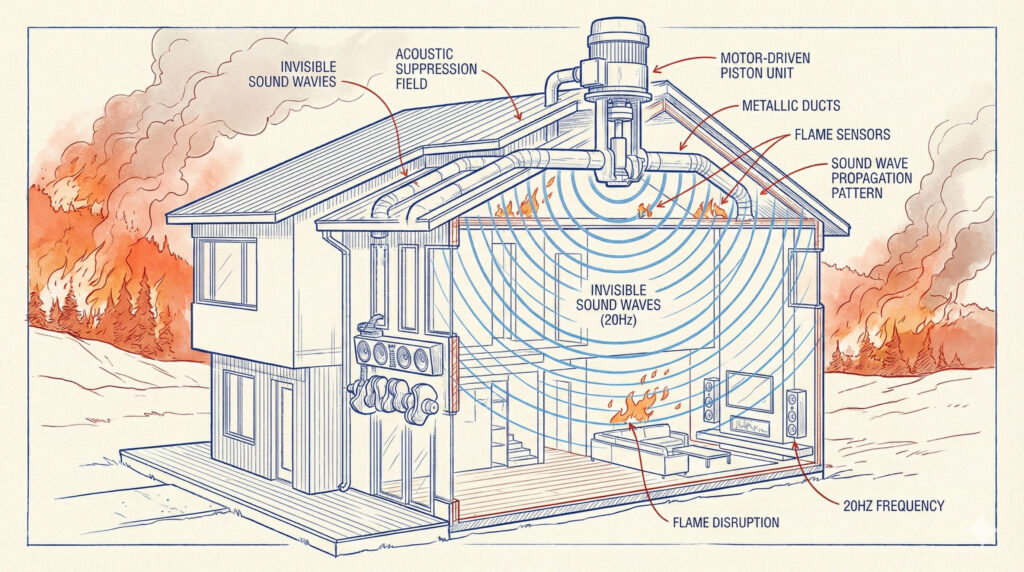
This method uses a type of sound wave, infrasound, to suppress wildfires. An infrasound wave is a very low-frequency sound wave. Sound waves are vibrations that we feel as sound. They are produced by vibrations in objects that move back and forth in the air. The object’s movement produces waves in the air. When these waves hit our ears, we hear them as sound. Infrasound waves have frequencies lower than 20 Hz. Since we cannot hear infrasound, it does not disturb us or cause discomfort.
Acoustic suppression technology works by disrupting the fundamental chemistry of combustion. Infrasound waves are generated by a device called a piston. Piston devices produce a type of sound wave with a very low frequency that travels long distances through the air. The infrasound waves generated by the pistons disrupt the fundamental chemistry of combustion, thereby disrupting the fire. This is because the combination of heat, oxygen, and fuel is required to sustain the fire. Infrasound waves remove oxygen from the fire by pushing it away from the fuel source faster than the combustion reaction can consume it and the fire starves of one of the three elements needed to burn and goes out.
Acoustic suppression technology has been tested in laboratories. Lab tests have demonstrated that acoustic suppression can extinguish fires. These tests were performed with small fires that burned in a contained environment. The fires were ignited and then suppressed with the infrasound waves. The tests showed that the fires went out completely and did not reignite after the infrasound waves stopped. The results of these tests indicate that acoustic suppression technology can extinguish small fires.
Unlike other fire suppression technologies, acoustic suppression does not use water. Water is used in many fire suppression systems because it is effective at cooling fires. However, water has some limitations. Water can damage property and equipment. Also, during severe droughts, water may not be available for fire suppression. Therefore, acoustic suppression technology offers an alternative fire-suppression option independent of water availability.
Acoustic technology has also been tested outdoors. Outdoor tests have demonstrated that acoustic suppression can extinguish small fires. The tests were performed with small fires that burned in a contained environment. The fires were ignited and then suppressed with the infrasound waves. The tests showed that the fires went out completely and did not reignite after the infrasound waves stopped. It has also been tested with flame sensors that detect the presence of a fire. When the flame sensor detects a fire, it sends an electrical signal to the piston device. The piston device responds to the signal by producing the infrasound waves that extinguish the fire. Therefore, acoustic suppression technology can be automated to detect the presence of a fire and automatically extinguish it.
To be clear, Acoustic suppression technology is still in the experimental stage and has not yet been implemented on a commercial scale. However, researchers believe that acoustic suppression technology is a viable option for suppressing wildfires. Acoustic suppression technology has the potential to suppress wildfires because it can be deployed remotely and automatically to detect fires and extinguish them.
Acoustic suppression technology may also help suppress wildfires in remote areas. Remote areas often lack access to water for fire suppression meaning new acoustic suppression tech offers an alternative fire-suppression option independent of water availability.
TLDR
- New acoustic suppression system uses infrasound waves (below 20Hz) to extinguish fires by disrupting combustion chemistry
- Technology works by pushing oxygen away from fuel sources faster than flames can consume it, starving fires of essential components
- System features motor-driven pistons generating sound pulses through roof-mounted metallic ducts with integrated flame sensors
- Infrasound frequencies are inaudible to humans and travel up to 25 feet, making them superior to previous 30-60Hz acoustic attempts
- Technology targets ember attacks—the most common wildfire spread mechanism—providing water-free protection during grid failures
- Limited to small fires only; large fires create turbulence that scatters acoustic waves and reduces effectiveness
- 50 pilot installations planned with California utilities for early 2026 testing in real wildfire conditions
- Designed as a preventive early intervention rather than a replacement for traditional firefighting methods