Construction & Infrastructure
The Iron Bridge in Shropshire opened in 1781 as the world's first iron bridge. Here is how it was designed, cast and built, and why civil engineering history starts there.
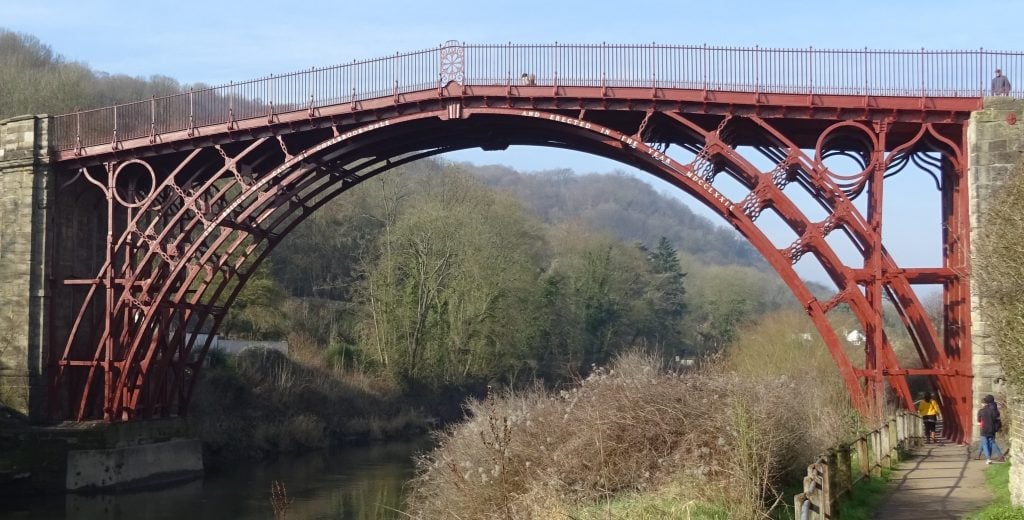
On New Year’s Day 1781, a single arch of iron across the River Severn in Shropshire opened to traffic[1]. Nobody had built a bridge like it. The Iron Bridge is described as the world’s first iron bridge[2], and it is a good place to start any story about civil engineering history, because it shows what happens when a new material meets people willing to try something unproven.
By the 1770s traffic on the Severn had grown, and the river had only ferries and one bridge to cross it[3]. A new crossing was needed, but it could not block the river itself, which was a working waterway full of boats.
The answer was a bridge with a single arch, thus causing no obstacle to boats[4]. Thomas Farnolls Pritchard, an architect from Shrewsbury, produced the design. Pritchard died in 1777, soon after work began[5], so the project passed to the ironmaster Abraham Darby III, who oversaw construction at his Coalbrookdale furnace.
Darby’s family had already changed British industry. His grandfather, the first Abraham Darby, began smelting iron with coke instead of charcoal at Coalbrookdale in 1709[6]. The change enabled a vast increase in iron production in Britain[7]. Cast iron went from a costly specialist material to something a foundry could produce in quantity.
That matters for a bridge. Cast iron is very strong when it is squeezed, which is exactly what happens in an arch, where the weight of the deck pushes the curved ribs together.
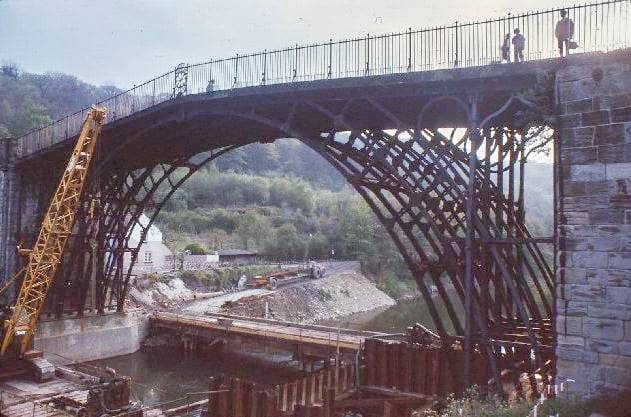
The finished bridge has a single span of 30 metres, made up of five semicircular main ribs[8] braced together. It contains about 378 tons of iron[9], all cast at Coalbrookdale. About 70 per cent of the components, including all the large castings, were made individually to fit[10].
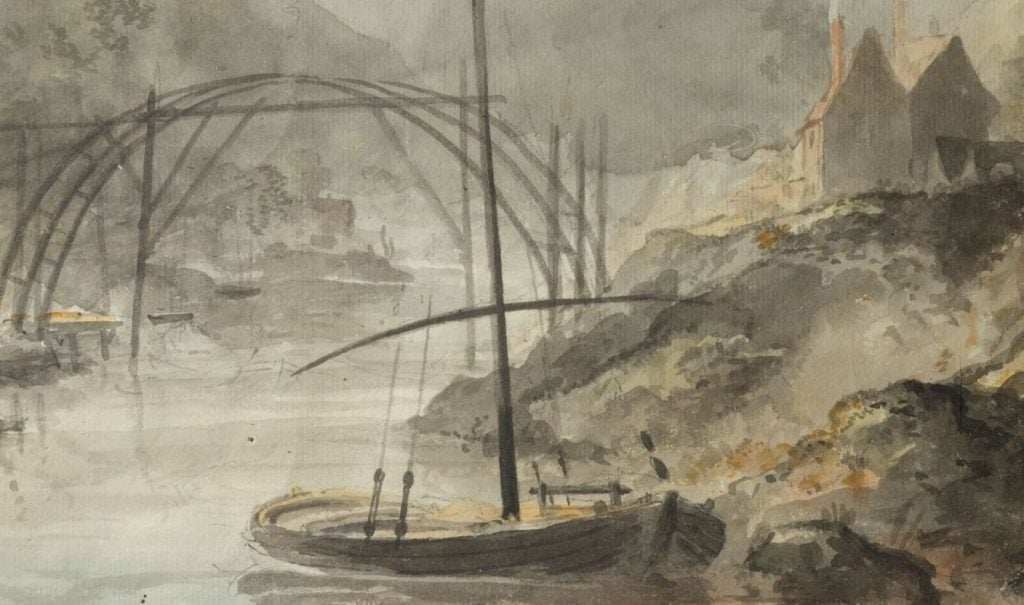
The joints are the most surprising detail. Nobody had a handbook for joining huge iron castings, so the builders borrowed from carpentry and used dovetail and shouldered joints[10], the kind a woodworker uses to join a cabinet. Darby’s accounts suggest that scaffold poles, timber and rope were used to lift the sections into place, and a watercolour by Elias Martin shows a wooden framework raising half-ribs from a boat on the river.
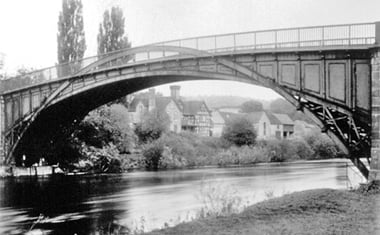
The bridge proudly carries its own label. An inscription reads that it was cast at Coalbrook-Dale and erected in 1779[11]. It was completed that year and opened to traffic on 1 January 1781.
Think of the bridge as a stack of forces. The deck and everything on it push downwards. The curved ribs turn that downward push into a squeeze that runs along the arch and into the ground at each end. Stone arches had worked this way for centuries, and the Iron Bridge used the same shape with a new material.
The bridge stood up to the great flood of 1795 and went on to inspire other engineers, including Thomas Telford[12]. Cast iron soon spread to bridges, aqueducts and buildings across Britain. The town that grew up beside the crossing took its name from it: Ironbridge.
It has long since stopped carrying vehicles, closing to them in 1934[13], but it still stands and is now a Scheduled Monument[14] and part of a UNESCO World Heritage Site.
The Iron Bridge was not built by inventing everything from scratch. The engineers took a new material, borrowed joints from carpentry, thought hard about the river traffic below, and tested the idea at full scale. That mix of borrowing, problem solving and nerve is still how engineering works. Civil engineers today use steel, concrete and composites, and they still start by asking what the site needs.
If this story makes you curious about the different branches of the profession, the guide Which Engineering Discipline Suits You? is a good next step. For other people whose work shaped the built world, read 19 Historic Female Engineers Who Shaped Our World, and for a picture of who works in UK engineering now, see Women Engineers in the UK 2025: Progress & Challenges.
Curriculum links: Chemistry (KS3 and KS4, materials, extraction and properties of metals), Design and Technology (KS3 and KS4, materials and structures).
Engineering discipline: Civil engineering, with links to structural engineering and materials. Teachers can find ready-made resources on the Born to Engineer teachers page and in the STEM classroom toolkits.
formally opened on New Year's Day 1781
Checked 27 October 2026
recognized as the first iron bridge in the world
Checked 27 October 2026
The History of the Iron Bridge
only ferries and one bridge to cross it
Checked 27 October 2026
The History of the Iron Bridge
a single arch, thus causing no obstacle to boats
Checked 27 October 2026
Abraham Darby III oversaw construction
Checked 27 October 2026
pioneered coke-fuelled iron smelting at Coalbrookdale in 1709
Checked 27 October 2026
The History of the Iron Bridge
a vast increase in iron production in Britain
Checked 27 October 2026
Five semicircular main ribs
Checked 27 October 2026
used a total of 378 tons of iron
Checked 27 October 2026
dovetail and shouldered joints
Checked 27 October 2026
This Bridge was cast at Coalbrook-Dale and erected in the year MDCCLXXIX
Checked 27 October 2026
inspired engineers such as Thomas Telford
Checked 27 October 2026
closed to vehicles in 1934
Checked 27 October 2026
It is a Scheduled Monument
Checked 27 October 2026
Construction & Infrastructure
Construction & Infrastructure
Construction & InfrastructureInnovation
Construction & Infrastructure