Aerospace, Defence & Marine

ClearSpace has completed Phase 2 of the UK Space Agency’s Active Debris Removal (CLEAR) mission, marking significant progress in developing technology to safely remove defunct satellites from low-Earth orbit.
The milestone represents a critical step toward addressing the growing orbital debris problem through practical engineering solutions.
The Switzerland-based company, operating through its UK subsidiary, has focused this phase on de-risking key technologies essential for the mission’s success.
With space debris increasing as more satellites enter orbit, this engineering initiative aims to establish viable methods for removing non-functional objects that pose collision risks to operational spacecraft.
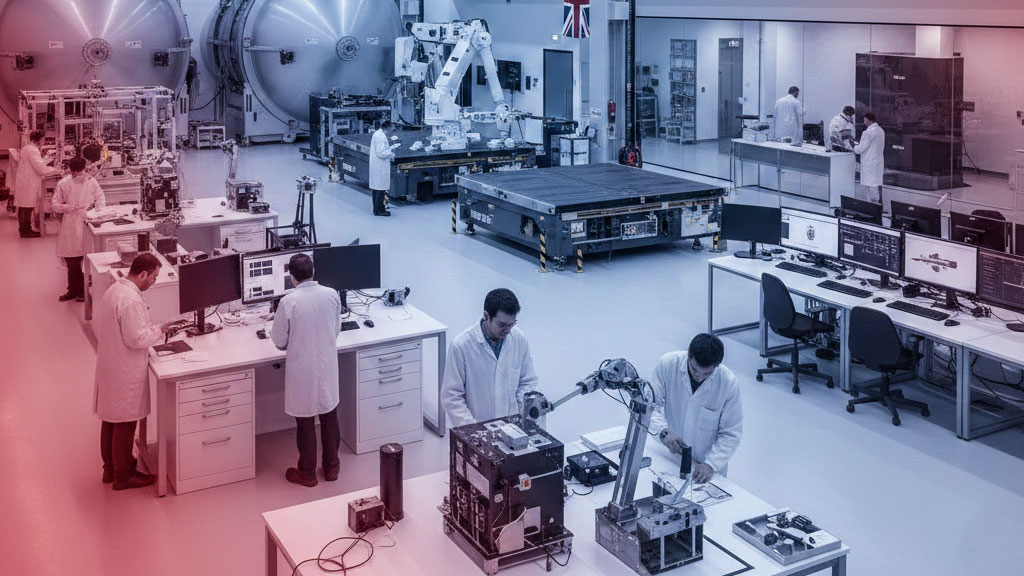
During this phase, ClearSpace conducted comprehensive testing across several critical systems. The spacecraft’s robotic capture mechanism successfully underwent mechanical testing, demonstrating its ability to withstand launch loads exceeding several times Earth’s gravity. This structural validation confirms the system’s resilience under extreme conditions.
The company also made significant progress in sensor technologies crucial for the mission:
Technical validations like these are essential for any mission that requires precision, reliability, and autonomous operation in a challenging orbital environment.
The CLEAR mission has a defined operational structure. Once launched, the servicer spacecraft will:
This dual-target approach should provide a more comprehensive test of the new technology. The UK Space Agency has identified this capability as critical for future space sustainability efforts, particularly as the number of satellites in low-Earth orbit continues to grow.
The project highlights the collaborative nature of advanced space engineering, with several specialized partners contributing key technological components:
Critical Software developed the flight software integration system using its Karvel Onboard Software Platform, the computational foundation for all mission operations.
Indra-Deimos focused on rendezvous guidance, navigation, and control (GNC) algorithms that enable precise manoeuvring in orbit-essential for approaching debris objects safely.

Plextek refined the RPO radar technology to provide critical situational awareness during proximity operations, enhancing the mission’s safety margins.
Spirit AeroSystems applied its aerospace manufacturing and structural testing expertise to support development objectives, leveraging its experience in advanced aerostructures.
“By demonstrating the capability to design, build, test, license, launch, and operate this mission from the UK, we are proving that the UK has what it takes to lead in space sustainability,” said Rory Holmes, ClearSpace UK Managing Director.
A crisis has been quietly brewing for decades in the vast expanse above our planet. The orbital regions surrounding Earth, particularly low-Earth orbit (LEO), have become increasingly congested with human-made objects-from operational satellites providing essential services to defunct spacecraft, discarded rocket stages, and fragments from collisions and explosions. As we launch more satellites to meet our global communication, observation, and scientific needs, the risk of collisions and the creation of additional debris escalates, potentially threatening future access to space.
Since the launch of Sputnik in 1957, humans have placed thousands of satellites into orbit. As of early 2025, more than 7,500 operational satellites circle the Earth, with commercial satellite constellations like Starlink accounting for a significant portion. However, these functioning satellites represent only a small percentage of tracked objects.
The U.S. Space Surveillance Network tracks approximately 27,000 pieces of orbital debris larger than 10 cm. Beyond these trackable objects lie an estimated 900,000 objects between 1-10 cm and tens of millions smaller than 1 cm. Even these tiny fragments pose significant threats-travelling at orbital velocities of approximately 7-8 km/s, a collision with an object as small as 1 cm can damage or turn off a satellite, while impacts with larger debris can be catastrophic.
The problem is self-perpetuating. In 2007, China conducted an anti-satellite missile test, destroying one of its weather satellites and creating over 3,000 trackable debris fragments. Two years later, a defunct Russian Cosmos satellite collided with an operational Iridium communications satellite, generating another 2,000 trackable pieces of debris. These two events alone increased the trackable debris population by nearly 40%.
The Kessler Syndrome, theorized by NASA scientist Donald J. Kessler in 1978, describes a scenario where the density of objects in LEO becomes high enough that collisions between objects could cause a cascade-each collision generating debris that increases the likelihood of further collisions. This runaway chain reaction could render specific orbital ranges unusable for generations.
The technical challenges facing engineers attempting to solve the orbital debris problem are formidable:
Before anything can be removed, it must be precisely located and identified. This requires:
Engineering teams must develop systems that can distinguish between different types of debris, assess their tumbling rates, and determine their physical characteristics-all essential information for planning a removal operation.
Approaching an uncooperative, potentially tumbling object in orbit presents significant challenges:
These operations require engineering solutions that combine spacecraft propulsion, sensor fusion, and artificial intelligence systems capable of making split-second adjustments.
Once a debris object is reached, it must be securely captured without creating additional fragments. Engineers have developed several approaches:
Each approach requires extensive testing on Earth and space-like conditions to ensure reliability. Material scientists must develop components that can withstand the space environment’s extreme temperature variations and radiation exposure while maintaining their mechanical properties.
After capture, debris must be removed from crowded orbital regions:
These manoeuvres demand sophisticated propulsion systems, thermal protection for re-entry, and careful mission planning to minimize risks to ground populations and other space assets.
ClearSpace’s CLEAR mission represents one of the most advanced attempts to address these challenges. Their engineering approach incorporates several innovative elements:
The ClearSpace servicer spacecraft employs a modular architecture that allows for:
This modular approach enables iterative improvements in future missions based on operational experience gained during initial debris removal operations.
Successful debris removal relies heavily on accurate sensing capabilities. ClearSpace’s system incorporates:
These sensors must function reliably despite challenging lighting conditions, reflection issues, and the potential for equipment degradation in the space environment.
At the heart of the ClearSpace approach is its innovative capture system:
The robotic system underwent rigorous testing to ensure it could withstand launch loads-experiencing forces several times Earth’s gravity-while remaining precise enough to handle delicate operations in orbit.
Due to communication delays and limited windows for ground control, significant portions of the mission must be performed autonomously:
The software architecture, developed with Critical Software using their Karvel Onboard Software Platform, integrates these autonomous functions while maintaining strict safety parameters.
Precision is essential for debris removal operations. ClearSpace’s navigation system includes:
These systems must perform reliably in an environment where GPS is unavailable and visual references change constantly due to orbital movement and lighting conditions.
The orbital debris challenge exemplifies the complex, multidisciplinary problems that modern engineers must tackle. Several engineering disciplines converge to create viable solutions:
Aerospace engineers design the spacecraft structures, propulsion systems, and thermal control mechanisms essential for debris removal missions. They must balance competing requirements, including:
The structural testing performed by Spirit AeroSystems during ClearSpace’s Phase 2 reflects this critical aspect of mission development.
The capture of uncooperative objects in space represents one of the most challenging applications of robotics:
Robotics engineers must address these challenges within strict mass and power budgets.
Software forms the backbone of modern space missions, with debris removal requiring particularly sophisticated systems:
Critical Software’s work on ClearSpace’s flight software demonstrates the essential role of software engineering in enabling complex space operations.
Perhaps most importantly, systems engineers integrate these diverse technologies into a coherent, reliable mission architecture:
The successful completion of ClearSpace’s Phase 2 milestone reflects effective systems engineering practices that brought contributions from multiple partners into a cohesive design.
While engineering solutions are essential, addressing the orbital debris problem comprehensively requires complementary policy and economic frameworks. No single nation can solve the debris problem alone, so engineers must work within international frameworks that facilitate the work.
Of course, prevention remains more cost-effective than fixing the problem after it occurs. Engineers are already implementing design approaches that minimize future debris:
If the CLEAR mission succeeds, it will represent a technical achievement and a paradigm shift in how we approach space operations-moving from a “launch and forget” model to sustainable, responsible stewardship of the orbital environment.
Today’s engineers working on debris removal are pioneering techniques that will become standard practice in future decades, ensuring that access to space remains available for generations. Their work exemplifies how engineering can address humanity’s most complex challenges, combining cutting-edge technology with environmental responsibility and international cooperation.
As we continue to rely on space-based infrastructure for communications, navigation, Earth observation, and scientific discovery, the importance of these engineering efforts will only grow. The orbital debris problem presents a crisis and an opportunity to demonstrate how human ingenuity can correct past oversights and create a sustainable path to space exploration and utilization.
Completing this phase provides the UK Space Agency with detailed programmatic estimates, offering valuable data for mission planning and resource allocation. These engineering insights are crucial for transitioning from testing to implementation.
Ray Fielding, UK Space Agency Head of Sustainability, described this as “a significant milestone in our national ADR program,” noting that the agency is “delighted that ClearSpace and partners have successfully delivered all requirements in this de-risking-focused phase of work.”
ClearSpace’s CLEAR mission is competing with another project from Japan-based Astroscale for a UK Space Agency contract to remove two defunct satellites from low-Earth orbit in 2026. This competitive process has accelerated innovation in space sustainability technologies.
With Phase 2 completed, the UK Space Agency recently hosted an engagement event outlining the next steps for the national UK ADR mission. The project is scheduled to move toward a System Critical Design Review (CDR), with a target launch date in 2026.
ClearSpace is simultaneously working on the separate ClearSpace-1 mission with the European Space Agency, building complementary expertise and technology.
If the mission succeeds, it will demonstrate practical engineering solutions to a problem that has concerned space agencies and satellite operators for decades. The ability to safely remove non-functional satellites would reduce collision risks in increasingly congested orbital regions.
The technologies being developed have applications beyond debris removal. They potentially support in-orbit servicing, assembly, and manufacturing (ISAM) capabilities. These include satellite life extension, on-orbit repairs, and component replacements-all crucial for the sustainable development of space infrastructure.
The project also contributes to establishing technical standards and operational protocols for proximity manoeuvres around non-cooperative targets, addressing a significant gap in current space operations.
By focusing on the practical engineering aspects of debris removal rather than theoretical approaches, ClearSpace and the UK Space Agency are making tangible progress toward enhancing orbital safety while developing valuable technical capabilities for the future space economy.
Credit via spacenews.com
Aerospace, Defence & Marine

Aerospace, Defence & Marine
Aerospace, Defence & Marine