Energy & Environment
Raindrops Can Launch Microplastics Into the Air, High-Speed Cameras Show
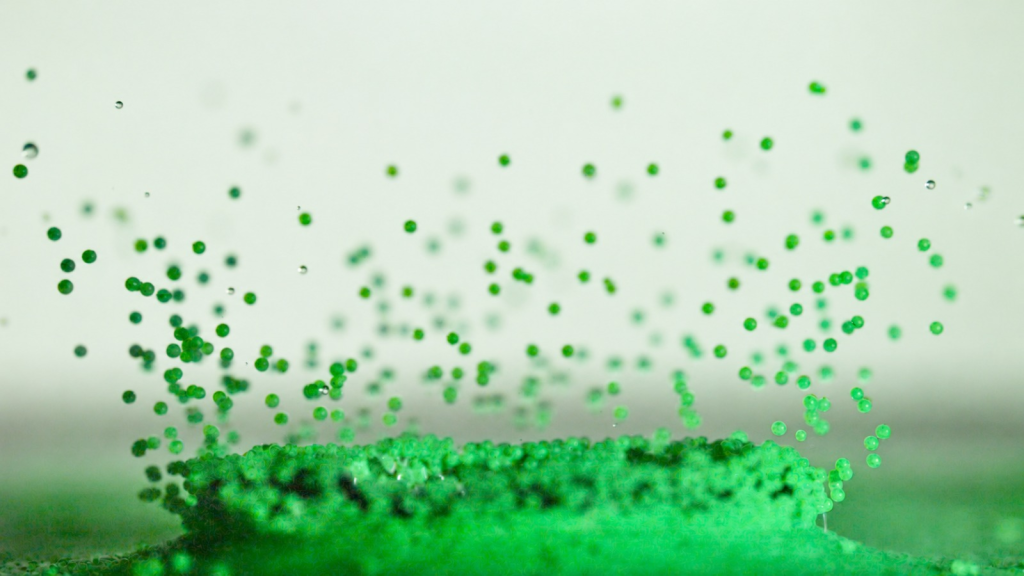
Engineers at Oxford, UCL and UNAM filmed raindrop-sized drops hitting water covered in plastic particles, and found the splash and a thin upward jet…
16 November 2026 · 10 minutes

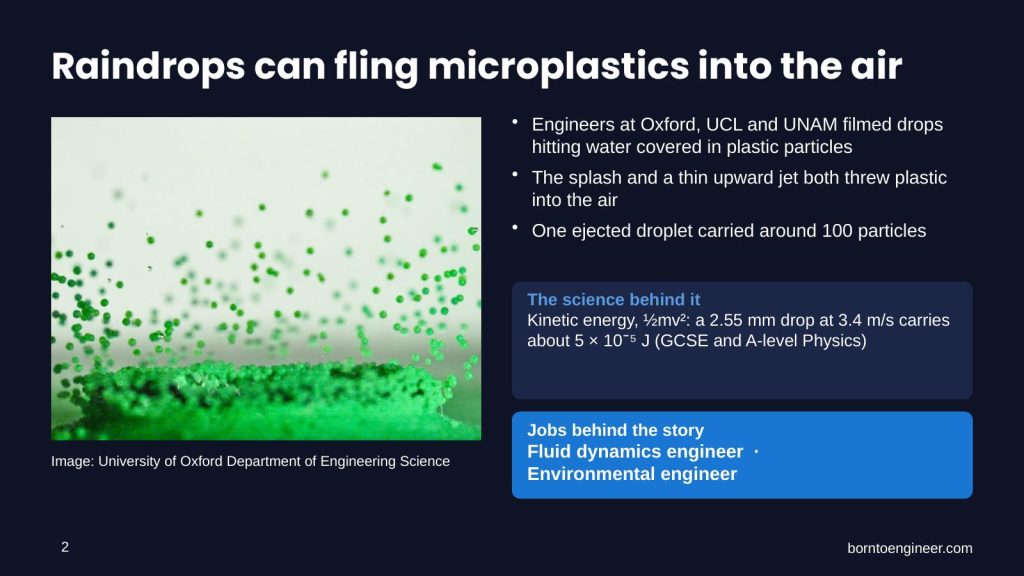
Engineers at the University of Oxford, UCL and UNAM used high-speed cameras to film raindrop-sized drops landing on water covered in tiny plastic particles. Plastic was thrown into the air by the first splash and by a thin upward jet, and in some tests one ejected droplet carried around 100 particles. Read the story.
Science link: kinetic energy, ½mv². A 2.55 mm drop at 3.4 m/s carries about 5 × 10⁻⁵ J. Jobs: fluid dynamics engineer, environmental engineer.
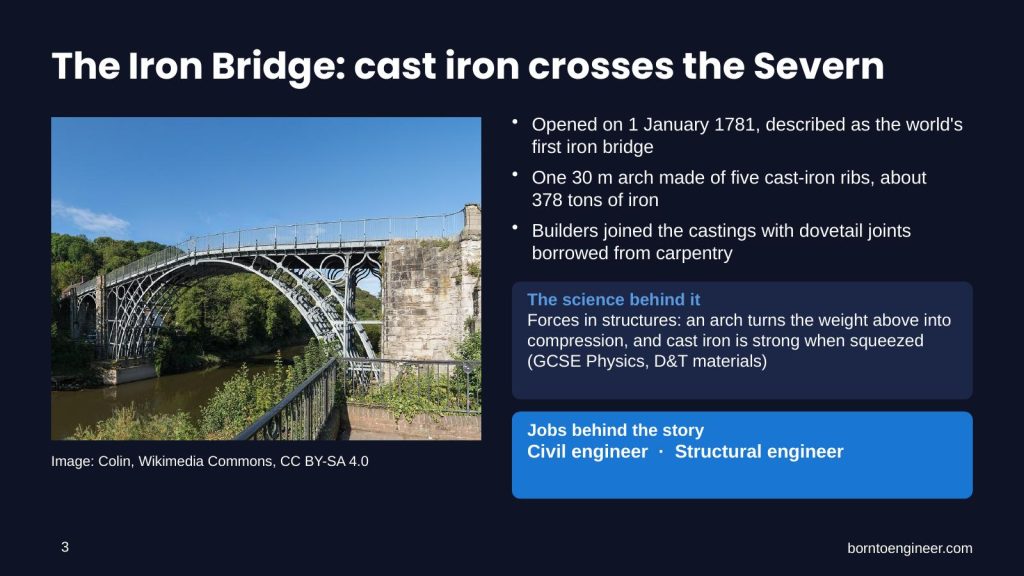
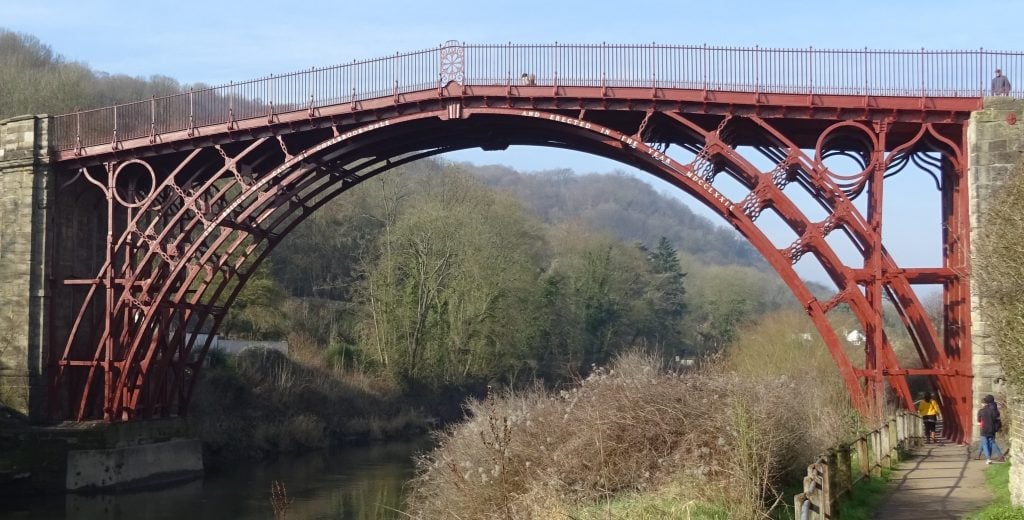
The Iron Bridge in Shropshire opened on 1 January 1781 and is described as the world’s first iron bridge. Its single 30 m arch is made of five cast-iron ribs, about 378 tons of iron, joined with dovetail joints borrowed from carpentry. Read the story.
Science link: forces in structures. An arch turns the weight above into compression, and cast iron is strong when squeezed. Jobs: civil engineer, structural engineer.
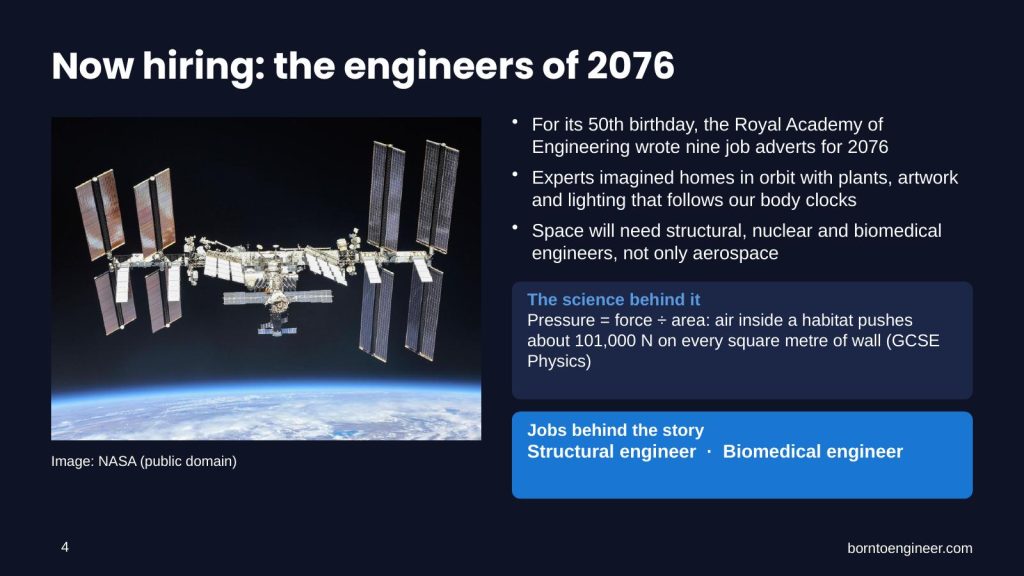
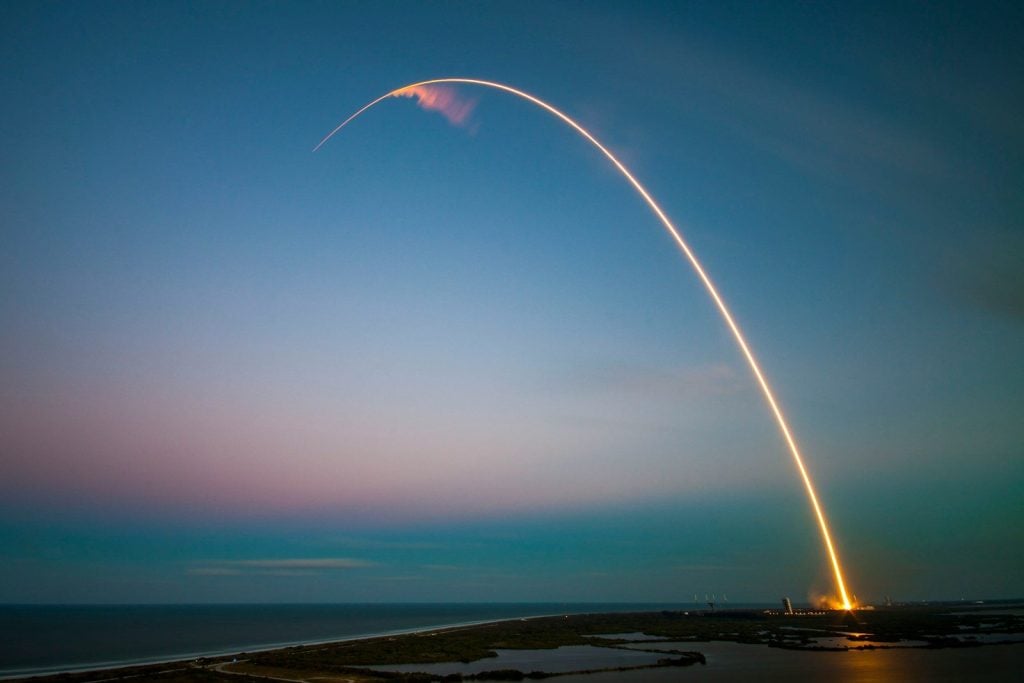
For National Engineering Day, the Royal Academy of Engineering marked its 50th anniversary with nine job adverts for engineers in 2076, from homes in orbit to new kinds of structures. It expects to need structural, nuclear and biomedical engineers, not only aerospace specialists. Read the story.
Science link: pressure = force ÷ area. Air at about 101 kPa pushes about 101,000 N on every square metre of a habitat wall. Jobs: structural engineer, biomedical engineer.
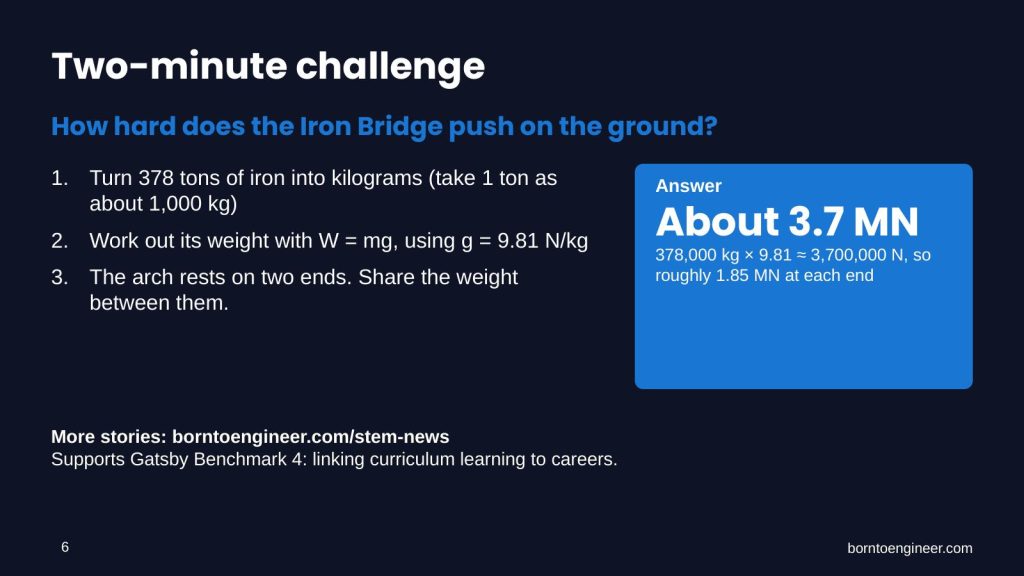
Using the historic long ton of 1,016 kg gives about 384,000 kg and 3.8 MN, so either answer is fine. Extension: an arch also pushes outwards at its ends, which is why the abutments are so massive.
More stories at borntoengineer.com/stem-news. This session supports Gatsby Benchmark 4: linking curriculum learning to careers.
Links to the curriculum: GCSE
Gatsby Benchmarks 2, 4, 5
Energy & Environment
Engineers at Oxford, UCL and UNAM filmed raindrop-sized drops hitting water covered in plastic particles, and found the splash and a thin upward jet…
Construction & Infrastructure
The Iron Bridge in Shropshire opened in 1781 as the world's first iron bridge. Here is how it was designed, cast and built, and…
Space
For National Engineering Day, the Royal Academy of Engineering is advertising nine jobs for the engineers of 2076. Here is what they tell us…