
Energy & Environment
Nearly a mile underground in South Dakota, crews have started building the vast cryostats for DUNE, a neutrino experiment for which the UK is making 137 of the 150 wire detector panels.
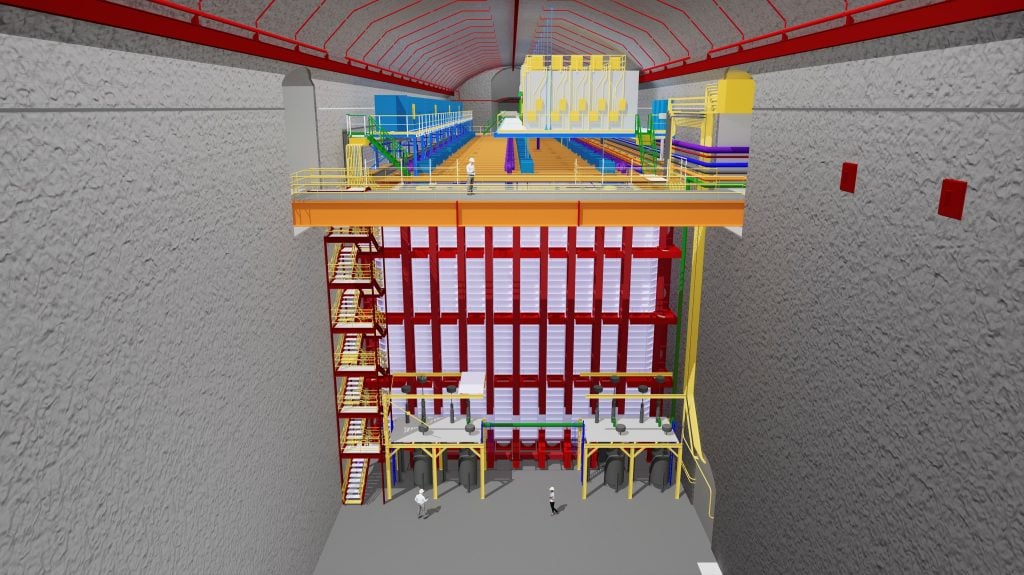
Almost a mile below the hills of South Dakota, workers are bolting together rows of red steel beams in caverns carved from solid rock. These beams will form two of the largest refrigerated tanks ever built, and inside, wire panels made in Britain will be installed. This marks the start of construction on the Deep Underground Neutrino Experiment, or DUNE.[1][2]
Neutrinos are some of the most common particles in the universe, but they are also some of the hardest to detect. Trillions pass through your body every second, yet almost none interact with anything. DUNE aims to catch a few of these elusive particles to help answer some of physics’ biggest questions. More than 1,500 researchers from around the world are involved, and the UK is the largest international partner.[3]
Teams from Fermilab, CERN, and the Sanford Underground Research Facility (SURF) are putting together large steel beams to build the outer structure of the detectors.[4] Some of the 2,600 steel beams for the cryostats - giant insulated tanks - have already been moved underground.[5] Each cryostat is 65.8 meters long, 18.9 meters wide, and 18.3 meters high, and will hold about 17,000 tons of liquid argon kept at around minus 300°F (about minus 184°C).[6][7] The caverns are 4,850 feet, or 1,478 meters, below ground, where the rock protects the detectors from cosmic rays that hit the surface.[8]
Neutrinos will be produced at Fermilab near Chicago and sent 1,300 kilometers through the Earth to the detectors in South Dakota.[9] There is no need for a tunnel because neutrinos travel through rock as if it is not there. This experiment is also the first time CERN has made such major contributions to a project outside Europe.[10]
The UK’s role is led by the Science and Technology Facilities Council (STFC), bringing together 15 UK universities and two STFC national laboratories: Daresbury Laboratory and Rutherford Appleton Laboratory.[11][12] In 2017, the UK committed £79 million to DUNE and its supporting infrastructure.[13]
One of the UK’s main tasks is building 137 out of 150 Anode Plane Assemblies, or APAs.[14] Each APA is about 6.3 meters tall and 2.3 meters wide - roughly as tall as a two-story building - and holds about 24 kilometers of thin wire that detects the tiny electrical signals left when a neutrino hits the argon.[15][16] By October 2026, the team had finished half of the 137 APAs.[17]
Professor Gary Barker from the University of Warwick, who leads DUNE-UK, said: “We are well advanced to completing our production runs and this milestone is a key step towards our goal”[18] of getting the detectors underground and collecting data. Professor Dave Newbold of STFC summed it up: “The DUNE experiment has the potential to change our understanding of the universe.”[19]
You can read the full announcements from UKRI, STFC, and Fermilab. We first covered this plan in 2017 in our article, Meet the 1,300km-long underground science experiment.
Engineering deep dive
DUNE is as much an engineering project as a physics one. A few sums show the scale, using the figures above and some labelled assumptions.
Step 1: how much argon? Each cryostat holds about 17,000 tons of liquid argon. Treat that as 17,000,000 kg and take the density of liquid argon as about 1,400 kg/m³ (an assumption close to the textbook value). Volume = mass ÷ density = 17,000,000 ÷ 1,400 ≈ 12,000 m³. An Olympic swimming pool holds about 2,500 m³ (another assumption), so each tank holds nearly five pools' worth of liquid argon. The outer box, 65.8 × 18.9 × 18.3 ≈ 22,800 m³, has room for that liquid plus the thick insulation and steel around it.
Step 2: how much wire? The UK is building 137 APAs, each with about 24 km of wire. 137 × 24 = 3,288 km of wire, more than twice the 1,300 km distance the neutrinos will travel from Fermilab.
Step 3: how long is the neutrino's journey? Neutrinos travel at almost the speed of light, 3 × 10⁸ m/s. Time = distance ÷ speed = 1,300,000 ÷ 300,000,000 ≈ 0.0043 s, or about 4.3 milliseconds from Illinois to South Dakota.
Step 4: how is a neutrino seen? When a neutrino hits an argon nucleus, it sends charged particles flying. These knock electrons off argon atoms along their tracks. A strong electric field pulls those freed electrons towards the wire planes. Assume the electrons drift at about 1.6 mm per microsecond across 3.5 m of argon (both assumptions for illustration): time = 3,500 mm ÷ 1.6 mm/µs ≈ 2,200 µs, about 2.2 ms. By recording when each wire sees a signal, computers rebuild a 3D picture of the collision. Electric fields, charge and the speed equation are all in A-level Physics.
Links to the curriculum: A level, GCSE
The underground space is expected to be finished by 2029, and the detectors by 2030.[20] The neutrino beam should reach South Dakota by 2031.[21] The experiment will run into the late 2040s.[22] Before that, engineers need to fill the tanks, keep 17,000 tons of argon pure and cold, and make sure every wire works deep underground.
DUNE relies on electronic engineers who design the detector readout, mechanical engineers and technicians who build the APAs and carefully string kilometers of wire, and software engineers who turn electrical signals into images of particle collisions.
Our guide to studying and working in electronic engineering can help you get started, and our guide to studying A-level Physics for engineering explains how the physics in this story can lead to a career.
National labs like Daresbury and Rutherford Appleton also train engineers through apprenticeships, and our beginner’s guide to finding an engineering apprenticeship explains how to search for one.
Credit via ukri-newsroom.prgloo.com
Construction begins on giant underground neutrino experiment, with UK-built technology at its heart
Nearly a mile underground in South Dakota, construction is underway on the Deep Underground Neutrino Experiment (DUNE),
Checked 10 November 2026
Nearly a mile underground in South Dakota, scientists are building a world-leading experiment to study neutrinos
Checked 10 November 2026
Construction begins on giant underground neutrino experiment, with UK-built technology at its heart
Bringing together more than 1,500 researchers from around the world, with the UK as its largest international partner,
Checked 10 November 2026
Currently, crews from Fermilab, CERN and SURF are assembling large steel beams to form the outer structure
Checked 10 November 2026
A portion of the 2,600 steel beams destined for DUNE's cryostats
Checked 10 November 2026
Each cryostat measures 216 feet long (65.8 meters), 62 feet wide (18.9 meters) and 60 feet high (18.3 meters).
Checked 10 November 2026
Each will house approximately 17,000 tons of liquid argon maintained at approximately minus 300 degrees Fahrenheit.
Checked 10 November 2026
SURF is proud to support this world-class research 4,850 feet (1,478 meters) below ground level.
Checked 10 November 2026
Once operational, Fermilab will send a beam of neutrinos 800 miles (1,300 kilometers) through Earth
Checked 10 November 2026
The DUNE experiment marks the first time CERN has made such significant contributions
Checked 10 November 2026
Construction begins on giant underground neutrino experiment, with UK-built technology at its heart
The UK's contribution is led and coordinated by the Science and Technology Facilities Council (STFC)
Checked 10 November 2026
Construction begins on giant underground neutrino experiment, with UK-built technology at its heart
bringing together 15 UK universities and two STFC national laboratories
Checked 10 November 2026
Construction begins on giant underground neutrino experiment, with UK-built technology at its heart
In 2017, the UK committed £79 million to DUNE and its supporting infrastructure,
Checked 10 November 2026
Construction begins on giant underground neutrino experiment, with UK-built technology at its heart
One of the UK's biggest contributions to DUNE is the production of 137 of the 150 Anode Plane Assemblies (APAs)
Checked 10 November 2026
Construction begins on giant underground neutrino experiment, with UK-built technology at its heart
Each APA is around 6.3 metres tall and 2.3 metres wide, roughly the height of a two-storey building.
Checked 10 November 2026
Construction begins on giant underground neutrino experiment, with UK-built technology at its heart
It carries around 24 kilometres of hair-thin wire, which detects the tiny electrical signals
Checked 10 November 2026
Construction begins on giant underground neutrino experiment, with UK-built technology at its heart
In October 2026, the team reached a major production milestone, completing half of the 137 APAs
Checked 10 November 2026
Construction begins on giant underground neutrino experiment, with UK-built technology at its heart
We are well advanced to completing our production runs and this milestone is a key step towards our goal
Checked 10 November 2026
Construction begins on giant underground neutrino experiment, with UK-built technology at its heart
The DUNE experiment has the potential to change our understanding of the universe.
Checked 10 November 2026
Construction begins on giant underground neutrino experiment, with UK-built technology at its heart
The underground space of DUNE is planned to be completed by 2029, and the detector apparatus in 2030.
Checked 10 November 2026
the terrestrial neutrino beam is expected to be sent to the underground detectors in South Dakota by 2031,
Checked 10 November 2026
This massive experiment is slated to run into the late 2040s, with the potential to impact science for generations.
Checked 10 November 2026
Energy & Environment

Electronics & Communications

Electronics & CommunicationsBreakthroughs
Energy & EnvironmentInnovation