Battery Energy Storage Takes Shape on the Old Fiddler’s Ferry Coal Site
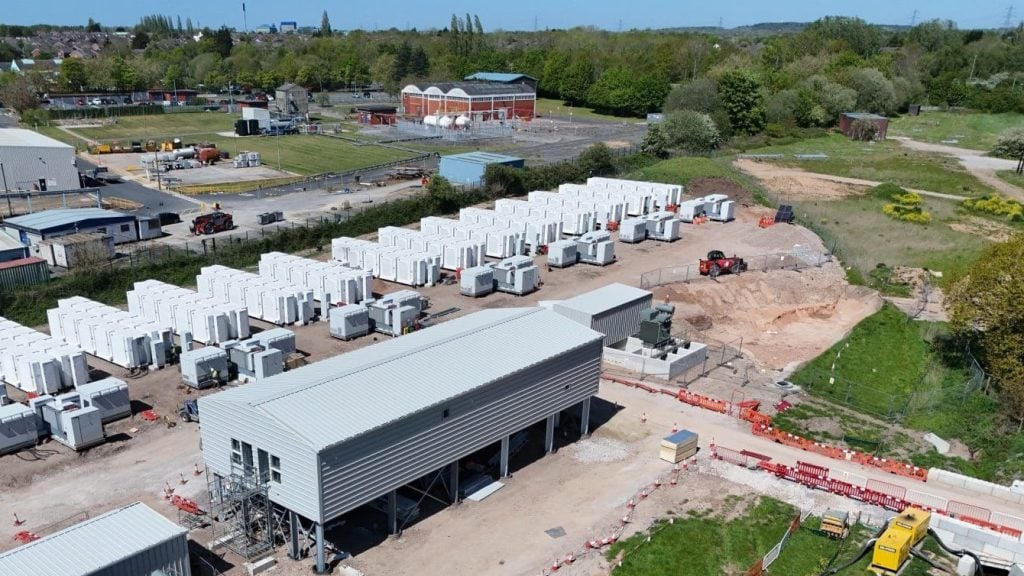
Control buildings are now in place at SSE Renewables' 150MW/300MWh battery energy storage site on the former Fiddler's Ferry coal power station near Warrington.
Key points
For years, Fiddler’s Ferry near Warrington was known for its cooling towers. The coal power station shut down in March 2020, and the towers were finally demolished in 2023.[1][2] Today, white cabinets and steel buildings have replaced them, and these are being connected to store electricity for the national grid.
This project is a battery energy storage system (BESS) with a 150MW/300MWh rating.[3][4] SSE Renewables, the owner, started building it in early 2024, with OCU Energy and Fluence leading the work.[5][6] On 9 November, engineering firm RSK Group announced a big milestone: the buildings for the control equipment are now in place.
What a battery energy storage site actually does
A grid battery does not generate electricity. It stores extra power when there is a lot available, like on a windy night, and sends it out when demand is high. Lee Binks, Pre-Construction Manager at AJ Engineering & Construction Services, explained it clearly: “When fully operational, the BESS site will store power for release back to the UK national grid when it is needed the most”[7].
The two numbers in the rating mean different things. The 150MW shows how quickly the site can send energy to the grid. The 300MWh shows how much energy it can store. If you divide 300MWh by 150MW, you get two hours. This matches SSE’s statement that the site could power up to 250,000 homes for two hours at a time.[8][9]
The milestone RSK announced may not be as exciting as the batteries, but it is just as important. Kiosk buildings for electrical relays, switchgear, control panels, and communication systems are now on site.[10] Relays and switchgear protect the system by detecting faults and disconnecting equipment in milliseconds to prevent fires. AJ Engineering designed, built, and clad two auxiliary transformer buildings and one portable relay room[11]. Since these kiosks were built off site from steel and cladding, they were ready to install in six weeks and then lifted into place.[12]
Plugging into the high-voltage grid
Batteries store energy as direct current at low voltage, while the national grid uses alternating current at very high voltage. Inverters and transformers connect the two. Civil Engineering Today reports that OCU Group is building a new 275kV National Grid connection and a 140/180MVA 275/33kV main transformer[13]. This large transformer changes the voltage between the site’s 33,000-volt network and the 275,000-volt grid.
The location makes sense because old power stations already have strong grid connections built for coal plants. Using these existing routes is much faster than installing new lines across the countryside. An SSE Renewables spokesperson explained: “Similar to our Ferrybridge project, our grid-scale battery at Fiddler’s Ferry will be built on what was a former SSE-owned coal-fired power station”[14].
The next step is to install the internal grid-connection equipment. RSK says the site should be up and running in 2027.[15]
Engineering deep dive
why the grid runs at 275,000 volts
Start with the rating. Energy is power multiplied by time, so a site that can deliver 150MW and holds 300MWh can run flat out for:
t = E / P = 300 MWh / 150 MW = 2 hours
Spread that across 250,000 homes and each gets 300,000,000 Wh / 250,000 = 1,200 Wh, or 1.2kWh, over two hours. That is an average of 0.6kW per home, roughly what a fridge, lights, a TV and a laptop draw together on a winter evening (an assumption for illustration).
Now the voltage. In A-level Physics, electrical power is P = IV. For a fixed power, raising the voltage lowers the current. Using that simple formula (real grids are three-phase, which shares the current across three conductors, but the comparison holds):
At 33kV: I = 150,000,000 / 33,000 ≈ 4,500A
At 275kV: I = 150,000,000 / 275,000 ≈ 545A
Why does that matter? Cables heat up as current flows, and the power wasted is Ploss = I²R. Losses depend on the square of the current. Stepping up from 33kV to 275kV cuts the current by a factor of 275 / 33 ≈ 8.3, so for the same cable resistance the losses fall by about 8.3² ≈ 69 times. That is why the main transformer is the heart of any grid-scale battery site.
To get a feel for the scale, take a typical smartphone battery of about 15Wh (an assumption). Fiddler's Ferry could fill 300,000,000 / 15 = 20 million of them from a single full charge.
The turns on a transformer's coils set the voltage ratio: Vp / Vs = Np / Ns. A 275/33kV transformer needs roughly 8.3 turns on its high-voltage side for every turn on its low-voltage side. You can explore this further in our guide to how Physics A-level prepares you for engineering.
Links to the curriculum: A level, GCSE
What this means for you
This work involves electrical engineers who design the grid connection and protection systems, structural engineers who design the steel buildings, and fabricators and welders who build them off site. Commissioning engineers test every relay and switch before the site starts running. Our guide to starting in electrical engineering explains the subjects and career paths, and many of these jobs are available through apprenticeships, as our beginner’s guide to engineering apprenticeships shows. If you are still deciding, start by looking at the main types of engineering.
Credit via rsk.co.uk
Further reading
Sources
15 sources
The site is located on the grounds of the former SSE-owned Fiddler’s Ferry power station, which was decommissioned in March 2020.
Checked 17 November 2026
Final demolition of its cooling towers was completed in 2023.
Checked 17 November 2026
Fiddler’s Ferry is a 150MW/300MWh battery storage project currently under construction near Warrington, Cheshire.
Checked 17 November 2026
Electrical equipment installed at SSE’s 150MW Fiddler’s Ferry battery site in Cheshire
where SSE Renewables is building a 150MW/300MWh battery energy storage system with OCU and Fluence.
Checked 17 November 2026
Construction on the project began in early 2024.
Checked 17 November 2026
Construction is being delivered by lead contractors OCU Energy and Fluence.
Checked 17 November 2026
Major milestone for Warrington battery energy scheme powering 250,000 homes
When fully operational, the BESS site will store power for release back to the UK national grid when it is needed the most
Checked 17 November 2026
power the equivalent of up to 250,000 homes* for up to two hours at a time
Checked 17 November 2026
Major milestone for Warrington battery energy scheme powering 250,000 homes
When complete, it will be capable of providing power for approximately 250,000 homes for a two-hour period at a time.
Checked 17 November 2026
Major milestone for Warrington battery energy scheme powering 250,000 homes
Kiosk buildings, which will house electrical relays, switchgear, control panels and communication systems, are now in place
Checked 17 November 2026
Major milestone for Warrington battery energy scheme powering 250,000 homes
We have designed, fabricated and cladded two auxiliary transformer buildings and one portable relay room
Checked 17 November 2026
Major milestone for Warrington battery energy scheme powering 250,000 homes
Having been built with steel and cladding, the kiosks were ready to be installed on-site within six weeks.
Checked 17 November 2026
Electrical equipment installed at SSE’s 150MW Fiddler’s Ferry battery site in Cheshire
According to OCU Group, its works include a new 275kV National Grid connection and a 140/180MVA 275/33kV main transformer.
Checked 17 November 2026
Major milestone for Warrington battery energy scheme powering 250,000 homes
Similar to our Ferrybridge project, our grid-scale battery at Fiddler's Ferry will be built on what was a former SSE-owned coal-fired power station
Checked 17 November 2026
Major milestone for Warrington battery energy scheme powering 250,000 homes
It is expected to be operational in 2027.
Checked 17 November 2026