
Construction & Infrastructure
Karen Spärck Jones came to computing from History and Philosophy, then worked out how a computer can judge which words matter most. Her 1972 idea still helps search engines rank results.

Karen Spärck Jones, sometimes spelled Karen Sparck Jones, was a British computer scientist at the University of Cambridge. She figured out how computers can identify the most important words in a document. She published this idea in 1972, and it still helps search engines decide which results to show first.[1]
Karen Spärck Jones was born on 26 August 1935 and grew up in Huddersfield[2]. She studied at Girton College, Cambridge, from 1953 to 1956.[3] Her degree was not in computing; she started with History and then graduated in Philosophy (Moral Sciences)[4]. She became interested in computing later, through her work with language.
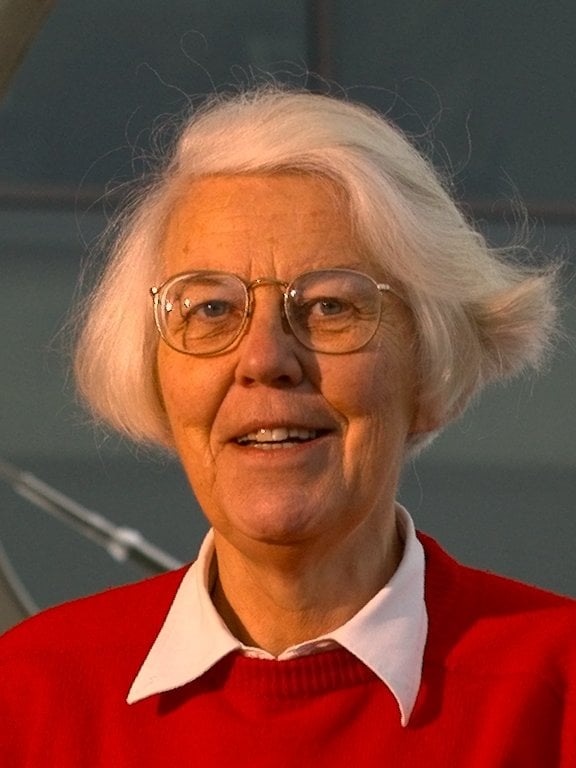
In 1957, she joined the Cambridge Language Research Unit, where she first learned about computing. Her early work focused on thesauri, which are books that group words with similar meanings. She wondered if a computer could build one automatically.[5] This question became the topic of her PhD, which she finished in 1964 and called Synonymy and Semantic Classification.[6] Cambridge’s obituary said her work was far ahead of its time.[7]
Picture a computer with ten thousand documents and a short search request. Some words in the request show up everywhere. For example, the word “the” appears in almost every document, so it does not help the computer choose which one to pick. A rare word like “thesaurus” appears in only a few documents, so finding it gives a strong clue.
This idea is the basis of inverse document frequency, or IDF. In a 1972 paper in the Journal of Documentation, Spärck Jones suggested that a word’s importance should be measured by how often it is used, not by what it means.[1] Simply put, a computer does not need to understand a word to know if it is useful. It just needs to count how many documents contain it. Words that appear in many documents get a low score, while words that appear in few documents get a high score.
This is a clever engineering approach: instead of asking what a word means, just ask how often it appears and see how well that works. It turned out to work very well. John Tait’s obituary in the journal Computational Linguistics says IDF is part of the foundation for all weighting methods used by popular internet search engines. Cambridge’s obituary also says she introduced IDF term weighting, which is now standard in modern systems.[8]
She later worked with Stephen Robertson to show how important it is to give different weights to terms based on their relevance, which was another step forward in information retrieval.
In 1968, she started working full time at the Computer Laboratory at Cambridge and later became Professor of Computers and Information[9].[10] The university notes that she officially retired on 30 September 2002[11].
Her work covered two related fields. Information retrieval is about finding what you need in a large amount of text. Natural language processing is about getting computers to work with human language. Cambridge’s obituary calls her a pioneer in both areas.[12]
Her peers recognized her work. She became a Fellow of the American Association for Artificial Intelligence in 1993[13] and a Fellow of the British Academy in 1995[14]. The Association for Computational Linguistics gave her its Lifetime Achievement Award in 2004[15]. In 2007, she received the British Computer Society’s Lovelace Medal and said she was especially pleased to be the first woman to receive it.[16][17]
She was also clear about who she wanted to see in computing. Her slogan was “Computing is too important to be left to men[18].” She spoke at the first Grace Hopper Conference[19] and said it was very important to bring more women into computing.[20]
You do not have to start out in engineering. Spärck Jones studied History and Philosophy, then joined a research unit in 1957 and found a field that matched her curiosity.
A simple idea can be very powerful. Counting how often words appear might seem too easy, but it gave search engines a strong foundation. Good engineering often means finding the simplest way that works.
The next time a search gives you the page you want in the top results, it is probably thanks to ranking ideas like those Spärck Jones developed. She spent her career helping people find what they need.
She is one of many British women who have shaped computing. To learn more, see Explore-Women in Computing: a British Perspective, Happy Ada Lovelace Day-6 Things You Might Not Know About Ada Lovelace, and 19 Historic Female Engineers Who Shaped Our World. For current information, look at Women Engineers in the UK 2025: Progress & Challenges, and if you are deciding where to specialise, try Which Engineering Discipline Suits You?
Curriculum links: Computer Science (KS4 and KS5) and Maths (KS4 and KS5). Engineering discipline: software and systems engineering, especially information retrieval and natural language processing.
Teachers can find more ready-made activities in the STEM Classroom Toolkits.
A Statistical Interpretation of Term Specificity and Its Application in Retrieval
It is suggested that specificity should be interpreted statistically, as a function of term use rather than of term meaning.
Checked 10 November 2026
Oral-History:Karen Spärck Jones
Karen Spärck Jones was born on August 26, 1935 and grew up in Huddersfield, England.
Checked 10 November 2026
Karen Spärck Jones (26 August 1935-4 April 2007)
Karen was an undergraduate at Girton College from 1953 to 1956
Checked 10 November 2026
She initially read History at Cambridge, but graduated in Philosophy (Moral Sciences).
Checked 10 November 2026
Oral-History:Karen Spärck Jones
I was in particular interested in the idea of building a thesaurus automatically
Checked 10 November 2026
BA (1956), PhD (1964), University of Cambridge
Checked 10 November 2026
Her PhD thesis “Synonymy and Semantic Classification” is now recognised as having been far ahead of its time
Checked 10 November 2026
She introduced IDF term weighting, a technique which has been adopted as standard in modern systems
Checked 10 November 2026
Professor of Computers and Information
Checked 10 November 2026
Oral-History:Karen Spärck Jones
I moved to the lab, and I became full-time based in the lab.
Checked 10 November 2026
Karen Spärck Jones (26 August 1935-4 April 2007)
Karen officially retired on 30 September 2002
Checked 10 November 2026
Professor Karen Spärck Jones was one of the pioneers in information retrieval (IR) and natural language processing (NLP).
Checked 10 November 2026
Fellow, American Association for Artificial Intelligence
Checked 10 November 2026
Fellow, The British Academy
Checked 10 November 2026
Karen Spärck Jones (26 August 1935-4 April 2007)
She received several major awards for her research including, in 2004, the ACL Lifetime Achievement Award
Checked 10 November 2026
in 2007 she won the BCS Lovelace Medal
Checked 10 November 2026
Karen Spärck Jones (26 August 1935-4 April 2007)
But I was especially pleased to see that I was the first woman to get it.
Checked 10 November 2026
Karen Spärck Jones (26 August 1935-4 April 2007)
My slogan is: Computing is too important to be left to men.
Checked 10 November 2026
Her standing as a senior woman in computing was marked by her speaking at the first Grace Hopper Conference
Checked 10 November 2026
Karen Spärck Jones (26 August 1935-4 April 2007)
I think it's very important to get more women into computing.
Checked 10 November 2026
Construction & Infrastructure

Construction & Infrastructure

Electronics & CommunicationsBreakthroughs