Energy & Environment
All 95 Subsea Cables Laid at East Anglia THREE Offshore Wind Farm
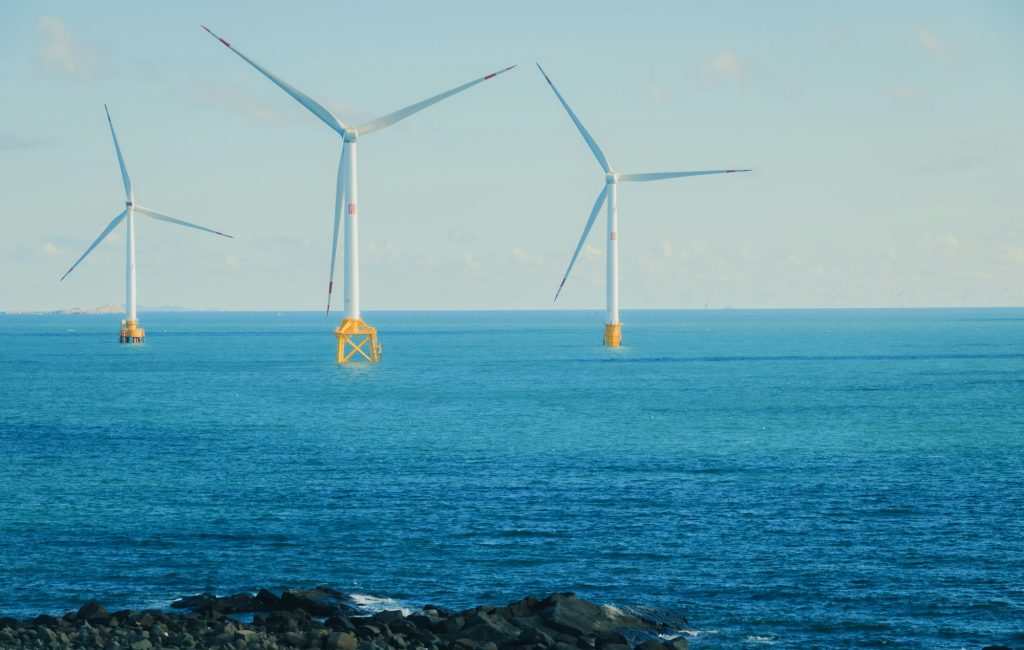
Seaway7 has laid all 95 inner-array cables at the 1.4GW East Anglia THREE offshore wind farm off Suffolk, more than 240km of subsea power…
9 November 2026 · 10 minutes
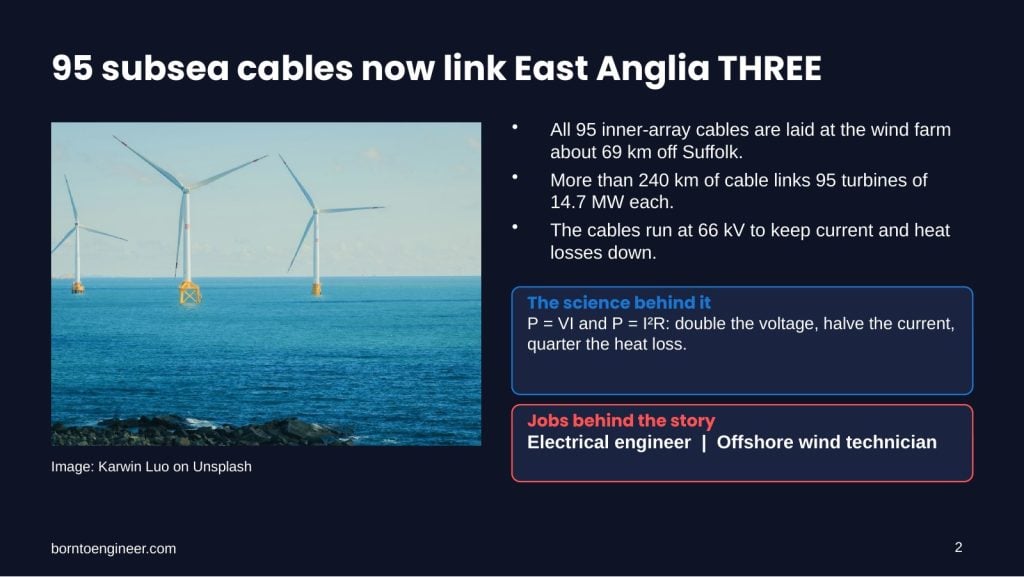
Seaway7 has laid all 95 inner-array cables at the 1.4GW East Anglia THREE wind farm, about 69km off the Suffolk coast. More than 240km of 66kV cable links 95 Siemens Gamesa turbines of 14.7MW each to the offshore substation. Read the story.
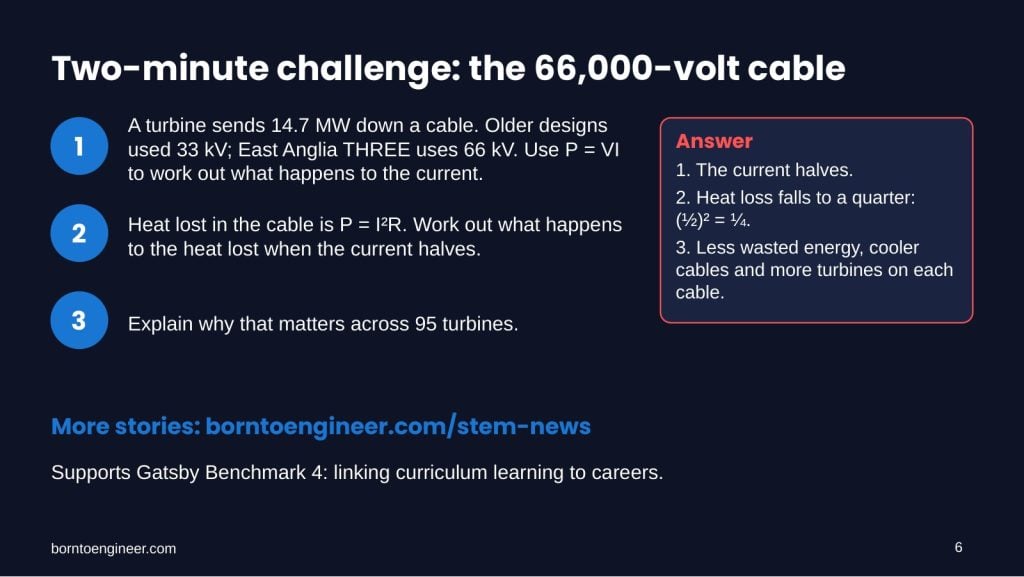
Science link: GCSE and A-level Physics, electricity. P = VI and P = I²R: doubling the voltage halves the current and cuts heat loss to a quarter.
Jobs behind the story: electrical engineers, offshore wind technicians.
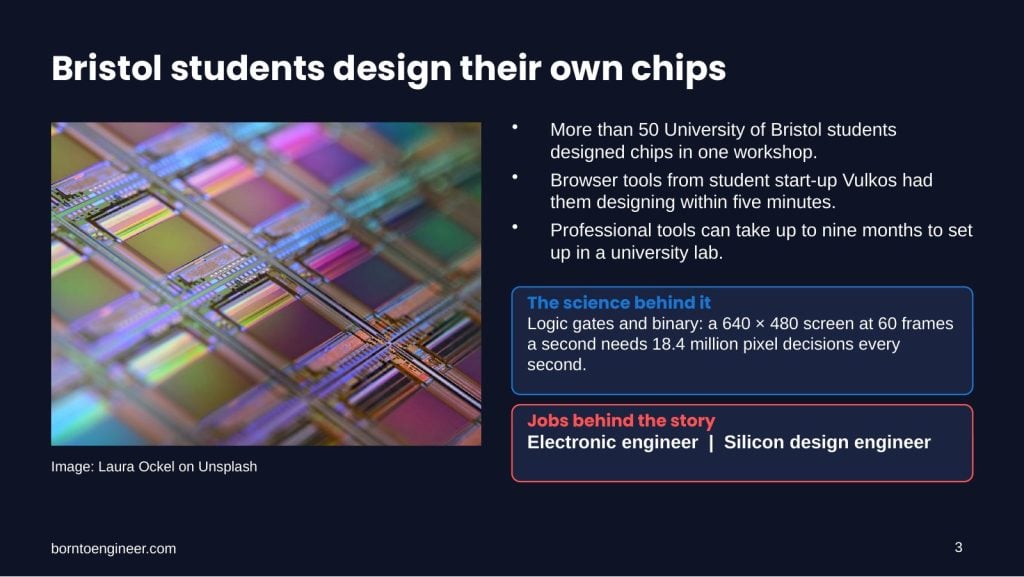
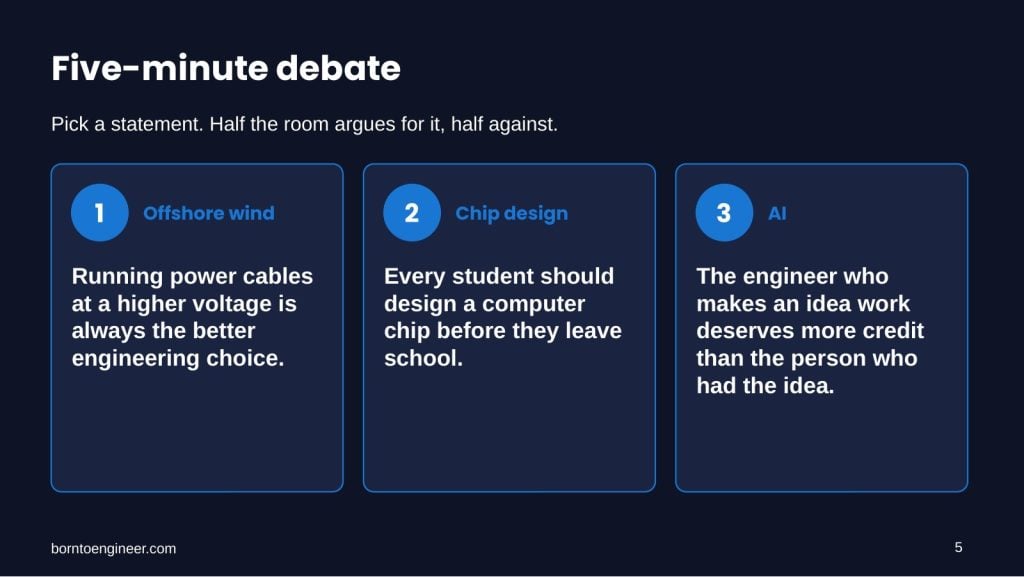
More than 50 University of Bristol students designed their own chips in a single workshop run by student start-up Vulkos with the Bristol Electrical and Electronic Engineering Society. Its browser tools had them designing within five minutes, compared with up to nine months to set up professional tools in a university lab. Read the story.
Science link: GCSE Computer Science, computer systems. Binary and logic gates: a 640 × 480 screen at 60 frames a second means 18,432,000 pixel decisions every second, about 54 nanoseconds each.
Jobs behind the story: electronic engineers, silicon design engineers.
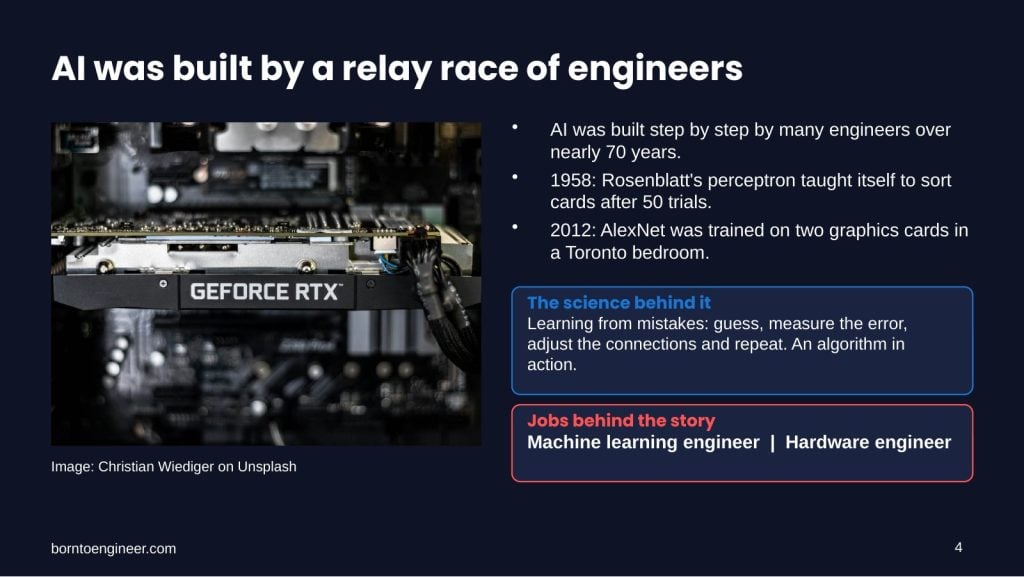
AI was built step by step by many engineers over nearly 70 years. In 1958 Frank Rosenblatt’s perceptron taught itself to sort cards after 50 trials, and in 2012 AlexNet was trained on a computer with two graphics cards in a Toronto bedroom. Read the story.
Science link: GCSE and A-level Computer Science, algorithms and data. A learning algorithm guesses, measures its error and adjusts its connections to reduce it.
Jobs behind the story: machine learning engineers, hardware engineers.
A turbine sends 14.7MW down a cable. Older designs used 33kV; East Anglia THREE uses 66kV.
A-level extension: for three-phase AC, I = P ÷ (√3 × V) = 14,700,000 ÷ (1.732 × 66,000) ≈ 129 A per turbine.
More stories: borntoengineer.com/stem-news
Links to the curriculum: A level, GCSE
Gatsby Benchmarks 2, 4, 5
Energy & Environment
Seaway7 has laid all 95 inner-array cables at the 1.4GW East Anglia THREE offshore wind farm off Suffolk, more than 240km of subsea power…

Electronics & Communications
More than 50 University of Bristol students designed their own computer chips in a browser-based workshop run by student start-up Vulkos. Here is how…

Electronics & Communications
AI was not one invention. From a 1958 learning machine to a bedroom in Toronto and the 2017 transformer, meet the engineers who built…