Aerospace, Defence & MarineBreakthroughs
NC State researchers built a teardrop-shaped soft robot from liquid crystal elastomer that jumps 80 times its body height under infrared light and resets itself for continuous leaping.
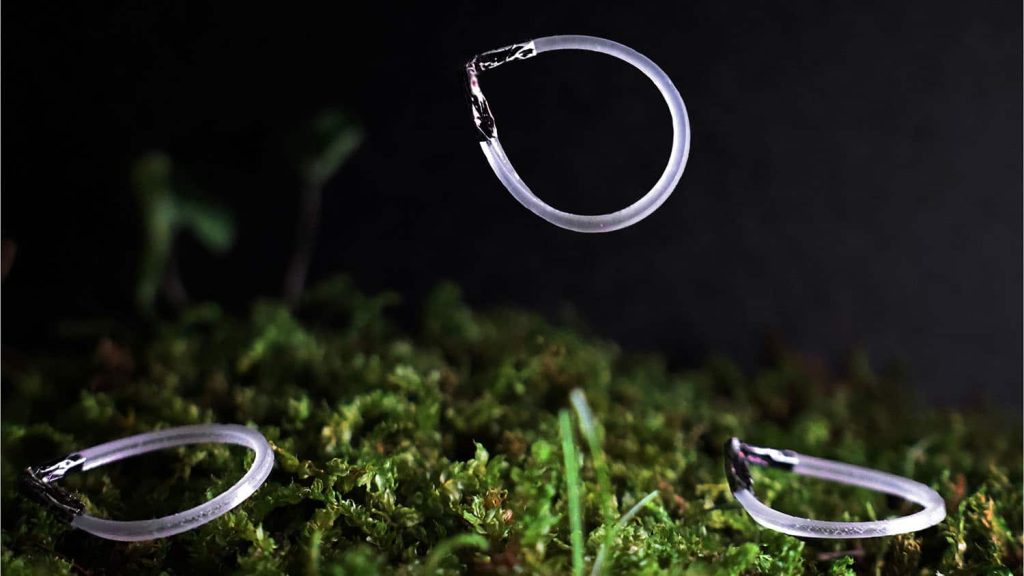
In a laboratory at North Carolina State University there is a translucent loop, the size of a fifty-pence piece, which is bouncing off a table. It has been doing so for some time now. No one is touching it and there are no batteries, no motors, and no wires extending from the loop. An infrared lamp is shining down from above and as a result the loop jumps, lands and then jumps again[1].
The light-powered soft robot, which was described in a paper published in PNAS by Jie Yin’s research group[2], seems incredibly simple. It consists of a ribbon of liquid crystal elastomer, formed into the shape of a teardrop, with a small piece of aluminium tubing in the shape of a V fixed at the pointed end[3]. That is all the robot comprises. Nevertheless, it jumps more than 80 times its own body height[4] and will continue to do so as long as the light is on.
You can show how the mechanism works using a rubber band. If you twist the band until it is tight, it stores elastic energy and when you release one end it snaps back; Yin’s robot works in the same way, except that in this case the twisting is caused by light not by fingers.
When the infrared radiation acts on the liquid crystal elastomer ribbon, the surface layer shrinks. Since the ribbon is formed into a loop, this shrinking causes it to rotate. The stiff V-shaped tail at one end opposes the rotation, and as a result of this opposition the ribbon winds ever more tightly, thus storing torsional energy[5]. When a certain threshold is reached, the tail snaps down against the surface and all the stored energy is released at once, throwing the loop into the air. While in flight the ribbon untwists itself back to its original shape and by the time it has landed it is ready to begin winding once again.
Professor Yin and Fangjie Qi discovered that they could control the robot’s movements by altering just one parameter. When the V-angle is wide - 120 degrees - the robot moves in a crawling fashion. If the angle is reduced to 90 degrees, the robot jumps forward. At 50 degrees the robot leaps straight up[6]. Putting a small weight on the rounded end of the teardrop shifts the centre of mass and increases the distance over which it jumps forward, just as a swimmer does when leaning into a dive[7].
This design involves several aspects of engineering and materials science, most of which relate to ideas taught at A-level and in the first year of university.
Liquid crystal elastomers are polymers in which the molecular chains are arranged in an ordered fashion, much like the liquid crystals found in a phone screen but instead being incorporated into a stretchy, rubber-like substance. On heating the molecular order is lost and the material shrinks in the direction of its alignment. In this robot infrared light supplies the heat, which is absorbed by the dark-coloured surface of the elastomer. The photothermal effect is quick enough to enable repeated actuation cycles.
The torsional energy storage mechanism is a neat piece of mechanics. A-level students who have studied Hooke’s Law know that elastic potential energy is proportional to the square of the deformation. In torsion, the equivalent relationship holds: energy stored equals half the torsional stiffness multiplied by the angle of twist squared. The teardrop geometry means the twist accumulates gradually as the surface contracts, building up energy smoothly until a critical instability, a snap-through buckling. Snap-through buckling is a phenomenon that has been thoroughly studied within the field of structural engineering. If you push the middle of a plastic lid, it will pop out. While the structure is in a deformed state it holds elastic energy, after which it quickly changes to a second stable form and releases that energy in the form of kinetic motion. In the robot the V-shaped tail focuses this release into a downward blow on the ground, turning the stored torsional energy into translational kinetic energy. The height achieved by the jump depends on the efficiency of this energy conversion.
The self-resetting feature is probably the most ingenious one; while the robot is in flight, with no contact between it and a surface and no further infrared heating (since the robot temporarily moves away from the lamp), the elastomer cools down and the ribbon returns to its original shape. The time constants are such that the resetting is finished before the robot touches down. This process takes place automatically and does not need any external control signal.
The team led by Qi used Cosserat rod theory to model the complete dynamics[8], this being a mathematical approach for describing the mechanics of thin elastic structures and one which takes into account bending, twisting, and stretching at the same time. The model was able to predict accurately the transition between crawling, forward jumping, and vertical leaping as the tail angle was varied, and the jump heights obtained from the experiment were matched to within a few per cent.
The robot worked reliably on level ground as well as on slopes, over parallel hurdles, on grass, sand, rocks, mulch and on water surfaces[9]. When landing on water, surface tension supports the lightweight robot, and the snap-through launch then releases it from the surface for the next jump. This versatility is due to the inherent compliance of the elastomer, which absorbs the shocks from landing without breaking.
There is no commercial product arising from this work[10], and the researchers are clear about this point. However, the principles shown here - self-resetting actuation powered by ambient energy, scalable geometry, and the ability to move independently of the terrain - are fundamental components for future systems. The group says swarm robotics is worth exploring. Although the gap between a bouncing loop on a laboratory bench and a practical machine is still large, the physics involved is sound.
Credit via news.ncsu.edu
Light-Powered Soft Robots Can Keep Jumping Forever
Researchers from North Carolina State University have created teardrop-shaped soft robots that leap upward or forward when exposed to infrared light – and will keep jumping as long as the light is present.
Checked 14 October 2026
Light-Powered Soft Robots Can Keep Jumping Forever
The paper, “ A Self-Resetting Soft Ring for Autonomous, Continuous Leaping in Unstructured Environments ,” is published in PNAS .
Checked 14 October 2026
Light-Powered Soft Robots Can Keep Jumping Forever
The robots are made of a liquid crystal elastomer ribbon shaped like a teardrop, with a thin aluminum tube shaped like a V at one end.
Checked 14 October 2026
Light-Powered Soft Robots Can Keep Jumping Forever
Optimized designs achieve vertical jumps exceeding 80 body heights and directional leaps over 3 body lengths.
Checked 14 October 2026
Light-Powered Soft Robots Can Keep Jumping Forever
When exposed to light from an infrared lamp, the surface of the ribbon contracts, causing the ribbon to rotate. The stiff V at one end of the robot prevents the ribbon from simply rolling in place, causing the ribbon to twist tighter and tighter.
Checked 14 October 2026
Light-Powered Soft Robots Can Keep Jumping Forever
“If the V at one end of the teardrop is very wide – an angle of 120 degrees – the robot simply crawls forward. If you reduce the angle to 90 degrees, it jumps forward. And if you reduce the angle further to 50 degrees, the robot leaps vertically.
Checked 14 October 2026
Light-Powered Soft Robots Can Keep Jumping Forever
“We could also improve the robot’s jumping distance by adding a small amount of weight to the rounded end of the teardrop,” says Qi.
Checked 14 October 2026
Light-Powered Soft Robots Can Keep Jumping Forever
The snapping mechanism and full leaping dynamics are captured by combined static and dynamic Cosserat-rod models.
Checked 14 October 2026
Light-Powered Soft Robots Can Keep Jumping Forever
the jumper demonstrates resilient multimodal locomotion across slopes, parallel hurdles, water–land interfaces, and diverse natural terrains including grass, sand, rocks, mulch, and water surfaces.
Checked 14 October 2026
Light-Powered Soft Robots Can Keep Jumping Forever
“There are no immediate applications for this work, but it’s a fundamental advance that is worth exploring for potential use in environmental navigation, swarm robotics, and unstructured terrain navigation,” says Yin.
Checked 14 October 2026
Aerospace, Defence & MarineBreakthroughs
Electronics & CommunicationsBreakthroughs
Electronics & CommunicationsBreakthroughs