Energy & Environment
Voodin Blade Technology is building the world's first factory for wooden wind turbine blades in Spain, replacing hard-to-recycle fiberglass composites.
In some landfill there currently is a wind turbine blade which is not breaking down; in one hundred years it will still be there, basically unchanged, acting as a 60-metre monument to the unintended consequences of clean energy. This outcome applies to about 78% of the turbine blades that have been decommissioned, since the fibreglass composites which they are made from resist all feasible efforts at recycling.
There is a possibility that a factory in northern Spain could provide a solution. Voodin Blade Technology, a German company which has received €48 million from the EU Innovation Fund, is constructing the world’s first facility on an industrial scale for wooden wind turbine blades. The project, referred to as VB1F, is situated in Navarra and is expected to start commercial production in 2031, according to Interesting Engineering.
The total capacity for wind power has now exceeded 1,000 gigawatts and must increase to 3,000 gigawatts by the end of the decade to achieve the required climate goals. About 10 metric tonnes of blade material are needed per megawatt of wind power, and blade waste could amount to 43 million metric tonnes globally by 2050.
The problem lies in the nature of the materials used. Today’s blades are made by combining glass fibres with a thermoset epoxy resin. After it has cured, the resin creates permanent cross-links among its polymer chains, so that it cannot be melted, reshaped, or easily separated from the matrix. Attempts have been made to deal with it using pyrolysis, grinding, and chemical digestion, but none of these methods is economically viable on a large scale. The outcome is a clean energy sector that produces its own problematic waste stream.
Voodin’s method avoids this issue by employing Nordic spruce fir timber as the main structural material. The wood is peeled into thin sheets, dried, and then bonded together to form laminated veneer lumber, or LVL. This type of engineered wood provides the strength, dimensional stability, and fatigue resistance required for the turbine blade to endure the repeated bending loads it experiences over a 20-year service life.
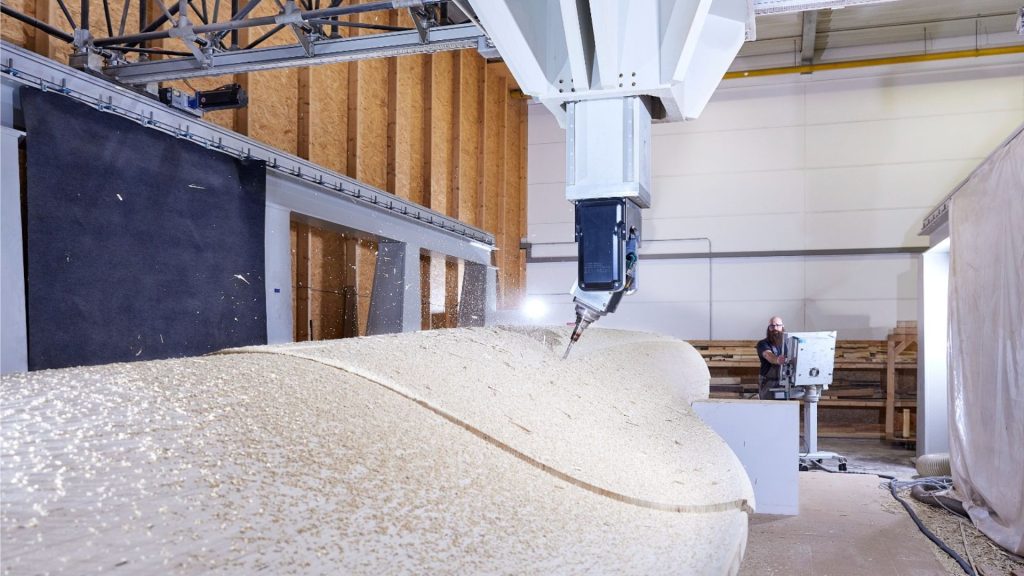
The way in which the blades are manufactured is entirely different from any method currently used in the industry. In the traditional production of blades, enormous moulds - some as long as 80 metres - are used, into which layers of glass fibre fabric are manually laid before resin is introduced and then cured. Voodin has got rid of the mould altogether. The LVL blocks are shaped into exact aerodynamic profiles by means of automated CNC milling machines that are directed by digital CAD files. The process is quicker, more consistent, and results in less waste than the manual laying-up method.
When operating at full capacity, the Navarra plant intends to produce as many as 160 blade sets each year. The project is anticipated to generate about 450 jobs and, as its developers state, might avoid more than 2.4 million metric tonnes of CO₂ equivalent emissions over its first ten years. The trees used to make the LVL take in biogenic carbon as they grow, and this carbon stays locked into the blade for the entire time it is in use. At the end of its life, the wood can be recycled for other industrial or organic purposes rather than being dumped in a hole in the ground.
The overall cost of the project is more than €100 million, of which €48 million is supplied by the EU Innovation Fund and the rest is contributed by a consortium consisting of four European partners. Navarra was selected for its existing wind energy infrastructure and proximity to European wind farm markets.
Engineering deep dive
At first sight, substituting fiberglass composites with wood appears to be a step backwards since wood was the material that engineers used before modern materials were available. However, this response overlooks an important aspect of how wind turbine blades function.
A turbine blade is basically a big cantilever beam exposed to varying aerodynamic loads. The forces it endures - bending moments caused by wind pressure, centrifugal loads due to its rotation, and gravitational fatigue resulting from its weight moving continuously between horizontal and vertical positions - are thoroughly understood. What is important here is the particular properties of the material, namely its strength and stiffness in relation to its density.
Laminated veneer lumber made of spruce has a density of about 480 kg/m³, whereas glass-fibre reinforced plastic (GFRP) has a density of approximately 1,800 kg/m³. Although GFRP has a higher absolute tensile strength, the strength-to-weight ratio of wood is competitive. As is explained in A-level Mechanics through the concept of specific strength (which is strength divided by density), engineered wood is on a par with glass-fibre composites when it comes to the bending-dominated load cases that are relevant to blade design.
Wood really surprises in the area of fatigue performance. It has been found that it is able to retain a high proportion of its static strength when subjected to cyclic loading, a fact partly due to its natural microstructure, which is arranged in a hierarchical fashion from cellulose microfibrils up to the growth rings and thus provides a number of mechanisms for absorbing and distributing energy. Cracks in wood tend to spread along the grain rather than going straight across the cross-section, a feature that is advantageous for damage tolerance. Since a turbine blade may experience between 10⁸ and 10⁹ load cycles during its lifetime, a figure equivalent to bending a paper clip back and forth a billion times, fatigue resistance is not something that can be ignored.
Getting rid of moulds involves a major change in the way blades are manufactured. In the traditional method of producing blades, moulds are costly, inflexible, and cause a bottleneck; each mould is only suitable for making one blade size and the hand layup process is both labour-intensive and inconsistent. By contrast, Voodin's approach using CNC milling treats each blade as a problem in subtractive machining by beginning with a solid block of LVL and then cutting away all the material that isn't part of the blade. This idea is similar to the way aerospace components are made from aluminium billets, a process which A-level Design and Technology students might have come across when studying CNC manufacturing.
The reason why the material is recyclable lies in its chemical composition. LVL employs thermoplastic adhesives or formaldehyde-free bonding systems which are easier to break down than thermoset epoxy. When the wood reaches the end of its life, it can be chipped and then used in particleboard, burned as a source of biomass energy with net-zero carbon emissions (because the amount of CO₂ released is equal to the amount that the tree had absorbed), or it can be composted; none of these possibilities are available in the case of fiberglass.
There are still some genuine engineering questions to be settled. The most apparent of these is related to moisture absorption. Since wood expands when it gets wet, a turbine blade working in the North Sea will have to endure for many decades exposure to rain, salt spray, and humidity. It will be necessary to apply surface coatings and seal the edges, and at the same time long-term data on durability in marine conditions is still very limited. The blades also have to achieve the same level of aerodynamic performance as those made from fiberglass, meaning that the same surface finish tolerances and resistance to leading-edge erosion must be obtained.
For those students who are thinking of studying environmental engineering or materials science, this project is situated at an interesting crossroads since it brings together forestry science, structural engineering, manufacturing automation and lifecycle analysis in one product. The engineering involved is not about selecting the most advanced material that is available; instead it is about picking the appropriate material for the particular application, and in some cases the correct answer has been growing in the forests of Scandinavia for decades.
Links to the curriculum: A level, GCSE
It is still the main question whether wooden blades can compete with established fibreglass technology in terms of both cost and performance when produced on a large scale. The physics is promising. As for the economics, they will depend on the output of the Navarra plant when it starts production in 2031 and on whether the wind industry is willing to reconsider the assumptions about blade materials that have prevailed over the past thirty years.
Credit via interestingengineering.com
Energy & Environment
Construction & Infrastructure