
Energy & EnvironmentBreakthroughs
RWE is building the UK's largest Pembroke battery storage facility in Wales, a 350MW lithium-ion system that could power the grid for two continuous hours.
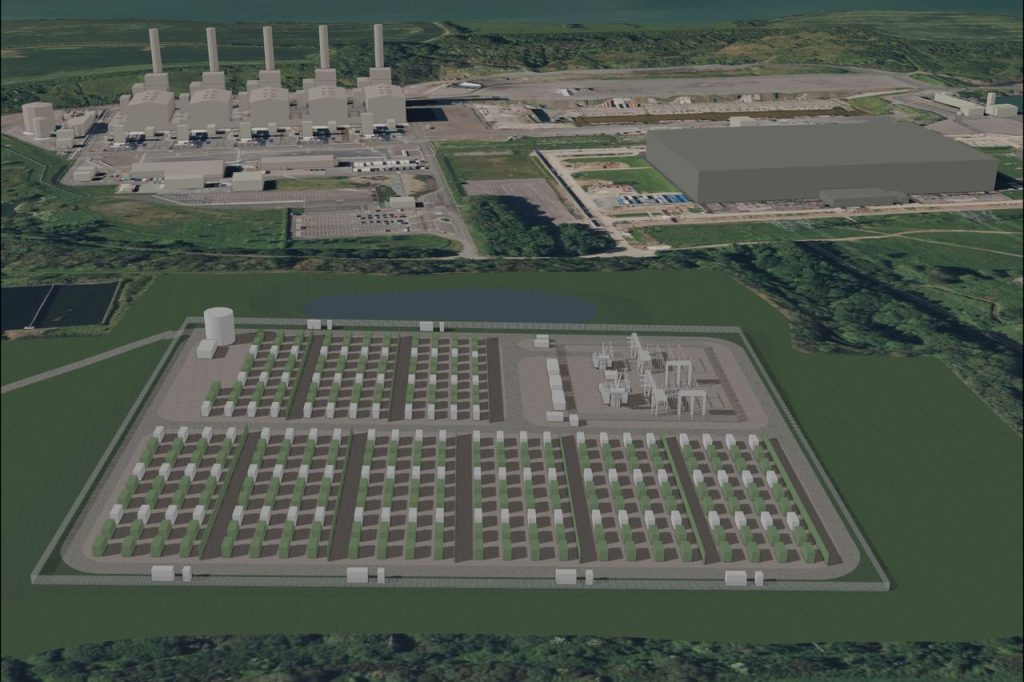
South Wales has been generating electricity for more than a century. The Pembroke Power Station, a gas-fired plant on the shores of Milford Haven, is one of the largest in Europe. Now, on a 5.1-hectare patch of land just south of that power station, something quite different is taking shape. Two hundred and twelve lithium-ion battery containers, arranged in rows, collectively capable of discharging 350 megawatts of electricity into the national grid for two continuous hours.
RWE, the German energy company that operates Pembroke Power Station, reached its final investment decision on the project in late 2025 and confirmed construction would begin in the first half of 2026.
The approximately £200 million Pembroke battery storage project is the UK’s largest battery energy storage system, or BESS. Commissioning is expected in the second half of 2028.
With 700 megawatt-hours of stored energy, the facility could, in theory, supply roughly 350,000 typical UK homes for two hours during a peak-demand period. That is not how it will actually be used; the grid is more nuanced than that, but the number gives a sense of the scale involved.
The UK generated more electricity from renewable sources than from fossil fuels in 2025 for the first time. Wind and solar are now the backbone of the system. But they have an inconvenient characteristic: they produce power when the wind blows, and the sun shines, not necessarily when people switch on their kettles at half-time during a football match.
Grid-scale battery storage fills that gap. When renewable generation exceeds demand (a windy night in spring, say), excess electricity charges the batteries. When demand spikes or generation drops (a still, cold winter evening), the batteries discharge. The faster a battery system can respond, the more valuable it is. Lithium-ion batteries can go from standby to full output in milliseconds, far faster than any gas turbine.
The Pembroke project sits within RWE’s wider Pembroke Net Zero Centre, a decarbonisation hub that will also include green hydrogen production. The site’s existing grid connection infrastructure, built to serve the power station, makes it an efficient location for a massive battery installation. You need serious grid connections to push 350 megawatts anywhere.
Engineering deep dive
A grid-scale BESS like Pembroke is, at its core, a very large collection of the same lithium-ion cells found in electric vehicles and smartphones, housed in shipping-container-sized enclosures with sophisticated thermal management, fire suppression, and power electronics.
Each battery container typically holds multiple racks of battery modules. A module contains individual cells, usually in a pouch, prismatic, or cylindrical format, connected in series and parallel to achieve the required voltage and capacity. For grid storage, lithium iron phosphate (LFP) chemistry is increasingly preferred over the nickel-manganese-cobalt (NMC) cells used in many EVs. LFP cells have lower energy density (meaning more physical space per kilowatt-hour) but offer longer cycle life, better thermal stability, and lower fire risk, all of which matter more than weight in a stationary application.
Power electronics serve as the interface between DC batteries and the AC grid. Each container has an inverter that converts the batteries' DC output to AC at the grid frequency (50 Hz in the UK). These inverters must synchronise precisely with the grid's voltage and frequency. Modern grid-forming inverters can actually help stabilise the grid by providing synthetic inertia, mimicking the behaviour of the heavy rotating generators in conventional power stations that naturally resist frequency changes.
Thermal management is critical. Lithium-ion cells perform best between 15°C and 35°C. Below that, internal resistance rises and capacity drops. Above it, degradation accelerates, and safety risks increase. Each container in the Pembroke facility will have its own HVAC system, maintaining cell temperatures regardless of Welsh weather. The containers are also equipped with fire detection and suppression systems, typically using inert gas flooding rather than water, since water and lithium-ion cells in thermal runaway are a poor combination.
The "two-hour duration" specification (350 MW for 2 hours = 700 MWh) is a design choice based on grid service requirements. The UK's Capacity Market, which pays generators and storage operators to be available during peak demand, has increasingly favoured longer-duration storage. Two hours is currently the sweet spot for lithium-ion systems, balancing cost against revenue from grid services. Longer durations (4, 8, or 12+ hours) are better suited to alternative technologies like flow batteries, compressed air, or gravity storage, none of which have yet reached the commercial maturity of lithium-ion.
For A-level students, this project connects to several core concepts. Electrochemistry underpins how cells store and release energy via redox reactions and electrode potentials. AC-DC conversion links to the electromagnetic induction and transformer principles in A-level Physics. The economics of grid balancing introduces supply-demand modelling from A-level Economics. And the sheer scale of the engineering, 212 containers, 350 MW, 5.1 hectares, demonstrates how textbook principles translate into real infrastructure.
The site selection is also instructive. Pembroke already has the grid connection capacity, the land, the planning permissions, and the operational expertise from decades of power generation. Building a new 350 MW grid connection from scratch would add years and tens of millions of pounds to the project. Repurposing existing energy infrastructure for battery storage is a pattern being replicated across the UK and Europe.
The Pembroke project is not alone. The UK had over 4 GW of operational battery storage by the end of 2025, with a pipeline of projects that could push that past 15 GW by 2030. Whether that pipeline delivers depends on grid connection timelines, planning approvals, and the economics of battery technology, all of which remain fluid. But the direction of travel is unmistakable.
Credit via theengineer.co.uk
Energy & EnvironmentBreakthroughs


Electronics & CommunicationsBreakthroughs
Energy & EnvironmentBreakthroughs