
Energy & EnvironmentInnovation
From liquid air batteries to fusion breakthroughs—what's actually happening on British soil

Engineers in the U.K. have never seen so much money invested in their work. With £47.8 billion in total research funding provided by UK Research and Innovation (UKRI) over the next decade and with an estimated £ 30 billion of private capital in clean energy and advanced manufacturing being invested in England alone, the U.K.’s engineering landscape will be transformed at a level not seen since World War II.
This transformative period in U.K. engineering is due to a combination of factors, including aggressive Net Zero target deadlines, current limitations within the existing grid system and the rapidly increasing power needs of the A.I. industry, which together represent a historic opportunity for innovation. As part of the Modern Industrial Strategy, the Government has committed to doubling the amount businesses invest each year in advanced manufacturing to £39 billion by 2035[1]. The first phase of National Grid’s £35 billion planned transmission upgrade program will begin in April 2026, and it will represent the largest grid upgrade in England in centuries.
The UK's most significant innovation in terms of energy in the coming years won't be related to some brand new generation of technologies; instead, it's finally going to solve the long-standing storage issue that has been limiting the adoption of renewables.
Traditional Lithium Ion Batteries are fantastic for short-duration (less than or equal to four hours) applications but are simply too expensive to apply economically for longer periods.
A new generation of storage technologies is now entering commercial scale.
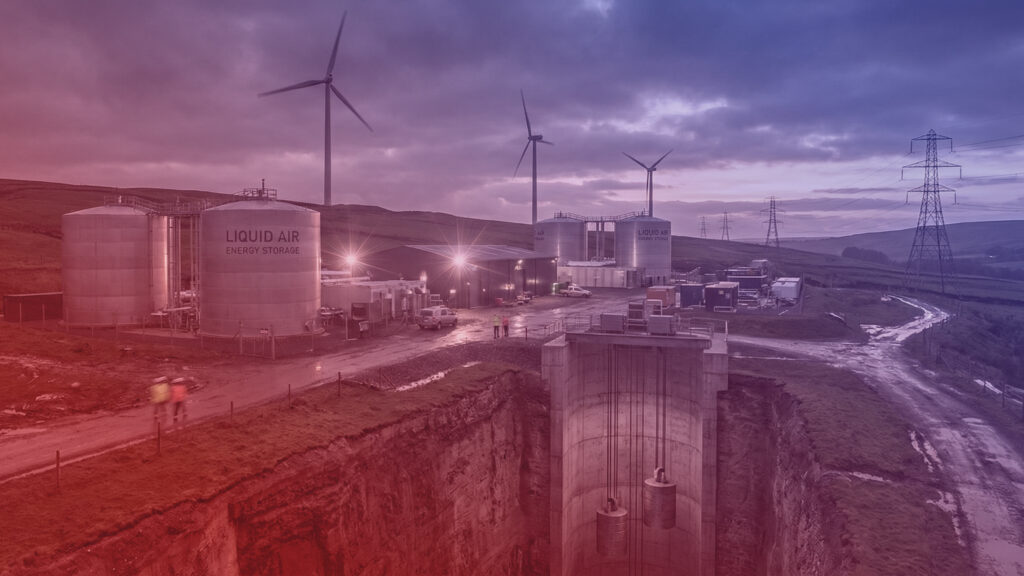
In November 2025, Highview Power officially broke ground on their[2] Liquid Air Energy Storage plant in Carrington, just outside Manchester which will start operations towards the end of 2026 and represents a 50 MW/ 300 MWh facility[3] based upon the very simple principle that ambient air can be cooled to -196°C, compressed to about one-seventieth of its original volume and then stored in insulated containers. The stored air is then warmed to expand through turbines when electricity is required. The system reportedly offers 40-50 year lifespan with no degradation through multiple cycles-a marked difference to the 10-15 year lifespan typically seen in Lithium-Ion Battery Technology.
Investment of £300m was brought into this project through the UK Infrastructure Bank (£165m), plus participation from Centrica, Rio Tinto and Goldman Sachs[4].
While Highview’s ambitions appear to be limited to their current plans for two 3.2 GWh Liquid Air Energy Storage Facilities[5] at Hunterston, Scotland and Killingholme, Lincolnshire that have successfully navigated Ofgem’s Cap-and-Floor Eligibility Screening Process, with expected Final Investment Decisions being made before Summer 2026, the combination of these two new facilities and the existing 50MW/300MWh facility at Carrington could potentially create around 7GWh of potential storage capacity-sufficient to supply enough electricity to meet the needs of in excess of 2 million homes for several hours during periods of high demand.
Gravitricity, another Edinburgh-headquartered firm, is pursuing an alternative method using massive weights suspended in abandoned mine shafts. Using the GraviStore system, they suspend massive weights (typically 500-12,000 tonnes) in shafts as deep as 1,500 meters and achieve efficiencies of 80-90 per cent in each direction, while responding in less than 0.5 seconds-faster than virtually all battery systems. Following a successful 250 kW demonstrator at the Port of Leith, the company partnered with ABB in 2023 to develop the technology for the thousands of decommissioned mines across Europe. Commercial-scale demonstrations of the technology are currently underway in a Polish coal mine.
Flow batteries are gaining popularity for use in grid-scale applications. Invinity Energy System’s 20.7 MWh Vanadium Flow Battery at the Copwood Project in East Sussex will become the largest Vanadium Flow Battery in Europe when it begins full operation in the first quarter of 2026. With 20,000+ cycles before degradation, the VS3 batteries manufactured at Invinity’s Motherwell Factory in Scotland represent an attractive economic option for daily cycling applications.
In November 2025, the U.K.’s nuclear ambitions were given their most definitive statement to date when Wylfa was selected to host the U.K.’s first small modular reactors (SMRs), designed by Rolls-Royce SMR.[6] This came after an initial £2.5 billion-plus commitment from the government[7] for a series of projects, with Great British Energy as the lead investor. The first deployment will occur at the Wylfa site in North Wales, which has the potential to host up to eight of the 470MW units[8]. It is anticipated that site preparation will begin in 2026, and the project’s first power will be generated in the mid-2030s[8].
Rolls-Royce’s SMR design is unique among SMR technologies, as it utilises a conventional pressurised water reactor design, and uses approximately 90% pre-assembled modular manufacturing techniques, utilising approximately 1,500 transportable modules, produced off-site and assembled at the plant site. This may result in both faster and lower-cost build times and costs than those associated with traditional nuclear construction methods. Approval for Step 2 of the Office for Nuclear Regulation’s Generic Design Assessment process was granted in July 2024, with approval expected by the end of Step 3 in August 2026.
Fusion energy, long considered to be ‘decades away,’ is making rapid progress on British soil. Funding for the UK fusion programme, including the UK Atomic Energy Authority’s STEP (Spherical Tokamak for Energy Production) program, totalled a record £410 million in January 2025[9]. The STEP program plans to have operational a 100MWe prototype reactor at the former West Burton coal-fired power station in Nottinghamshire by 2040[10]. The consortium partners for the STEP prototype are expected to be selected in early 2026. Three consortia have been shortlisted, with major contractors Balfour Beatty, Vinci and Ferrovial having submitted bids for the contract[10].
Tokamak Energy made significant strides in November 2025, achieving 11.8 Tesla at -243 °C with high-temperature superconducting materials in the Demo4 magnet system. This demonstrates the validity of the compact spherical tokamak design and, as such, provides the possibility of developing commercial fusion reactors that are significantly smaller and less expensive than existing conventional designs. A collaborative £52 million upgrade program between the U.S. Department of Energy and the U.K. Government is currently underway to further develop Tokamak Energy’s ST40 facility. It is expected to be completed in 2027.
While the U.K. cannot lead the way in cutting-edge silicon chip technology (the same technology used in smartphones and computers), the country has developed an international leadership role in what is called compound semiconductors-materials such as silicon carbide (SiC), gallium nitride (GaN) and gallium arsenide - all of which have key roles in power electronics, 5G communications and EV systems.
CS connected in South Wales, an area known as the ‘South Wales semiconductor cluster,’ is the first purpose-built compound semiconductor “ecosystem” in the world. In March 2025, the U.K.’s biggest semiconductor manufacturing plant, Vishay Newport, announced a £250 million investment to build a silicon carbide (SiC) production facility, in part funded by the Automotive Transformation Fund. The Newport-based facility, covering 28 acres, currently manufactures over 30,000 wafers per month and will produce over 500 new high-skilled jobs by 2030.
In a different field altogether, Pragmatic Semiconductor in County Durham is developing flexible electronics, an entirely new type of electronics. The company’s 300mm wafer fabrication line - the first of its kind in the U.K. - makes skinny chips using indium gallium zinc oxide instead of silicon, at significantly lower cost and environmental impact than traditional fab facilities. Flexible IC Technology (FlexIC Tech) from Pragmatic Semiconductor has now achieved 10x improvements in digital power efficiency compared to its previous versions. Applications include innovative packaging and pharmaceutical product identification.
A £138m R&D and manufacturing centre was opened in Newport by SPTS Technologies (now KLA) in May 2025. The focus of this facility is the development of plasma etch and deposition equipment - key equipment for power semiconductor production. Since 2018, this facility alone has generated over £1.25 billion in export earnings, demonstrating that semiconductor equipment manufacturing in the U.K. can be successful without the need for leading-edge chip production.
Nissan's proposed rollout of the UK's first on-board, vehicle-to-grid (V2G) certified charger as part of the Nissan Leaf Plus in 2026 represents a significant leap forward in terms of what can be expected from charging technology. Nissan claims the new technology will allow users to sell energy back to the National Grid at times when it is most needed. It also claims the technology will reduce an average user's annual electricity bill by 50%. Furthermore, this technology will offer the National Grid greater flexibility during periods of high demand, helping prevent the need for brownouts or blackouts in the future. Nissan's bidirectional AC charger is believed to be significantly less expensive than the bidirectional DC chargers used in past trials, if successful, it may make V2G technology economically viable for the mass adoption of electric vehicles in the near future.
The deployment of the UK's first dedicated eHGV charging network by the consortium behind the Electric Freightway project has been funded to the tune of over £100 million, with £62.7 million being provided by the Government. The consortium has pledged to deploy more than 200 high-speed charging points across the UK, with at least 2 capable of 1 MW. British company Voltempo has recently entered series production of its Hypercharger at Birmingham's Tyseley Energy Park. This product is claimed to deliver more than 1 MW of electrical energy dynamically to multiple vehicles simultaneously, with up to 6 cars charged at the same time.
While wireless charging is still in the early stages of development, there are now several projects underway that demonstrate it is moving from proof-of-concept demonstrations to deployment in real-world applications. For example, the WiCET project in Nottingham conducted a six-month public trial of wireless taxi charging at the city's railway station. During the trial, ground pads were installed under the taxi bays, and these delivered between 3.7 kW and 22 kW of electrical energy to the taxis, at an average efficiency of 92%.
The Dynacov project in Coventry is even more ambitious in scope, aiming to assess the feasibility of dynamic wireless charging to power vehicles while in motion. The project is utilising ElectReon technology, which involves embedding electromagnetic induction coils into the road surface.
AI is changing the way we think about electrical engineering as well as the processes involved in manufacturing it, from optimising how energy moves throughout our country's energy network to optimising the processes involved in making the energy hardware itself.
The National Energy System Operator (NESO) has used an AI-based solar forecasting process that utilises satellite imagery and a transformer-based deep neural network to achieve three times the accuracy of traditional physics-based methods. This will eliminate the need to have back-up generation using fossil fuels due to the increased certainty of when renewable generation will occur.
NESO has also established an "Energy AI Centre of Excellence" which will serve as an AI resource hub for all companies involved in the GB energy sector.
UK usage of AI in manufacturing leads the rest of Europe: 53% of all manufacturers in Britain are utilising AI on the factory floor; worldwide, this number is 41%. Jaguar Land Rover uses AI-based analytics across its 128 locations to detect anomalies in real time. A UK-based electronic component manufacturer reduced defects by 45% and idle time by 35% by linking robotic sorting systems to an AI-based machine vision system.
As part of the Made Smarter program, up to £99 million will be allocated beginning in 2026 to assist an additional 5,500 SMEs in implementing digital technologies in their manufacturing operations. The program plans to expand to Scotland, Wales, and Northern Ireland between 2026-27. Professor Chris Dungey of the High Value Manufacturing Catapult has been named as the national AI Champion for manufacturing, and he will lead a twelve-month program to promote AI adoption across the UK's manufacturing sectors.
In Bristol, the National Composites Centre (NCC) announced the Large Structures Innovation Centre in December 2025, an open-access centre for producing components on an industrial scale-the first of its kind in the UK. The centre will target three sectors - Wind Energy, Construction and Maritime - enabling large-scale production testing of full-size wind turbine blades and validating sustainable composite materials.
Britain was selected as the Partner Country for the world's leading additive manufacturing exhibition, Formnext 2026, in recognition of Britain's growing strengths in 3D printing. The National Centre for Additive Manufacturing at the Manufacturing Technology Centre (MTC) in Coventry provides Europe's most extensive range of complete end-to-end metal, polymer and ceramic additive manufacturing capabilities; the MTC also has access to over £35 million of equipment. GKN Aerospace and Airbus have led £48.5 million in additive manufacturing projects for the aerospace industry, announced at the 2025 Paris Air Show.
There is increasingly strong institutional backing for sustainable manufacturing. The ReMake Value Retention Centre, a £5.5m partnership between NMIS and the Universities of Strathclyde, Exeter and Sheffield, is working on circular innovation methods that can potentially achieve up to 99% reductions in CO2 emissions when compared to producing new parts. In 2025 a pilot project was undertaken with SSE Renewables that used additive manufacturing to repair damaged wind turbine pinion shafts.
The AI boom has driven a massive transformation in the Data Centre market, with rack power densities (for AI workloads) now ranging from 40 to 140+ kW, up from 15-20 kW for non-AI applications. The resulting demand for new and innovative cooling technologies has been unprecedented. In fact, a UK-based data centre recently announced that it had deployed the first ORv3 immersion cooling solution in Europe using Submer's technology - an approach in which servers are submerged in dielectric fluid to cool the equipment, which can be done much more efficiently than with air cooling.
Research conducted by Microsoft was published in September 2025. It found that using microfluidic cooling techniques removed heat up to three times better than traditional cold plates[11] by passing coolant directly through channels on the chip. As a result, this technique may significantly improve processor performance - some estimates predict that the cooling capacity could reach 15,360 W.
The massive build-out of datacentres is putting significant strain on the existing grid infrastructure. The National Grid's new Uxbridge Moor sub-station, located in Buckinghamshire, will provide an additional 1.8 GW of capacity to support 12 + new datacentres that will feature Britain's first large-scale deployment of SF6-free insulation technology. Other major investment projects currently underway in the UK datacentre market include Blackstone's £10 billion AI campus at Blyth; Google's £5 billion datacentre expansion program; and Microsoft's partnership with NScale to deploy the UK's largest supercomputer at Loughton.
The next couple of years will also be important for the deployment of many new technologies which have been demonstrated. For example, Invinity will deploy its flow batteries at its Copwood Project, and Highview Power will deploy its Liquid Air Energy Storage (LAES) at its Carrington Facility; both will be the first large-scale deployments of this technology type in the United Kingdom. Nissan will also test whether Bidirectional Charging can be viable in a mass-market environment when it launches its V2G products. Ofgem is expected to make decisions regarding the cap and floor for Long Duration Storage (LDS) in Summer 2026, and if these decisions support an increase in the LDS price, then there could be billions invested into long-duration energy storage by 2030.
A clean energy imperative and an AI infrastructure demand have created some interesting partnerships in the field. The North Wales AI Growth Zone was developed to create a data centre zone alongside a Small Modular Reactor (SMR) at Wylfa. This partnership recognised that AI may need to use dedicated generation rather than pulling its power directly from the grid due to its high power consumption.
For Engineers, the message is simple: the technologies that were once thought to be five years away from becoming commercially available-such as Commercial Fusion, ubiquitous V2G, and gigawatt-scale energy Storage-are now entering a critical developmental phase. Funding has been allocated to deploy these technologies, regulatory frameworks are beginning to take shape, and leading-edge companies are already ramping up production.
While the UK's position as a manufacturing nation may be changing, the country's engineering capabilities are still very much involved in solving some of the world's most pressing problems.
Credit Follow more trends at borntoengineer.com/stem-news
Advanced Manufacturing Sector Plan
Our ambition is to near double the annual business investment in the sector from £21 billion to £39 billion in 2035, driving growth across the economy.
Checked 14 October 2026
London and Manchester, 21 November 2025: Highview, a global leader in long duration energy storage solutions (LDES) today welcomed Andy Burnham, Mayor of Greater Manchester, to the official breaking of ground for its new facility
Checked 14 October 2026
The Carrington plant will deliver 300 MWh of storage and an output of 50 MW for six hours, enough clean, renewable energy to serve 480,000 homes.
Checked 14 October 2026
The £300 million funding round was led by the UK Infrastructure Bank (UKIB) and the British multinational energy and services company Centrica, alongside a syndicate of investors including Rio Tinto, Goldman Sachs, KIRKBI and Mosaic Capital.
Checked 14 October 2026
Highview Power, a leading provider of long-duration energy storage (LDES) technology, announced today that two 3.2GWh power plants, planned for development in the UK by 2030, have been accepted by Ofgem as 'projects eligible' to receive support under the government's 'cap and floor' scheme
Checked 14 October 2026
North Wales to pioneer UK’s first small modular reactors
North Wales will become a beacon in the "golden age" of nuclear, delivering the UK's first ever small modular nuclear reactors built by publicly-owned Great British Energy-Nuclear and, subject to final contract, designed by Britain's Rolls-Royce SMR
Checked 14 October 2026
North Wales to pioneer UK’s first small modular reactors
In the Spending Review, the government confirmed major investment in Sizewell C, which will provide power for the equivalent of 6 million homes and 10,000 jobs, as well as over £2.5 billion funding for the country's first SMR programme.
Checked 14 October 2026
North Wales to pioneer UK’s first small modular reactors
GBE-N will start activity on the site in 2026. The initial project will be for 3 SMR units, but Great British Energy-Nuclear assesses the site could potentially host up to 8 mini reactors. The ambition is for Wylfa's small modular reactors to be supplying power to the grid from the mid-2030s.
Checked 14 October 2026
Plan for Change to deliver jobs and growth in UK leading fusion industry
The £410 million investment of R&D funding will fund the UK fusion programme in 2025 to 2026. This includes: STEP (a world leading prototype powerplant)
Checked 14 October 2026
Plan for Change to deliver jobs and growth in UK leading fusion industry
Five construction and engineering bids have progressed to the next round of the UKIFS competition to deliver the prototype fusion energy plant by 2040
Checked 14 October 2026
The company's lab-scale tests showed microfluidics performed up to three times better than cold plates at removing heat, depending on workloads and configurations involved.
Checked 14 October 2026
Energy & EnvironmentInnovation


Electronics & CommunicationsBreakthroughs

Energy & Environment