
Aerospace, Defence & MarineBreakthroughs
British researchers develop groundbreaking technology that converts seawater directly into hydrogen fuel for ships, enabling zero-emission maritime transport with ambient storage and no desalination required. Learn how this £1.44M project could revolutionise marine propulsion.

British researchers are developing a system that converts seawater directly into hydrogen fuel for maritime vessels, potentially eliminating carbon emissions from ships while addressing critical storage challenges that have long hindered the adoption of hydrogen in marine transport. The technology, if successful, could address multiple engineering obstacles simultaneously by creating hydrogen from seawater without desalination, storing it at room temperature without pressurisation, and burning it in modified engines that emit only water vapour.
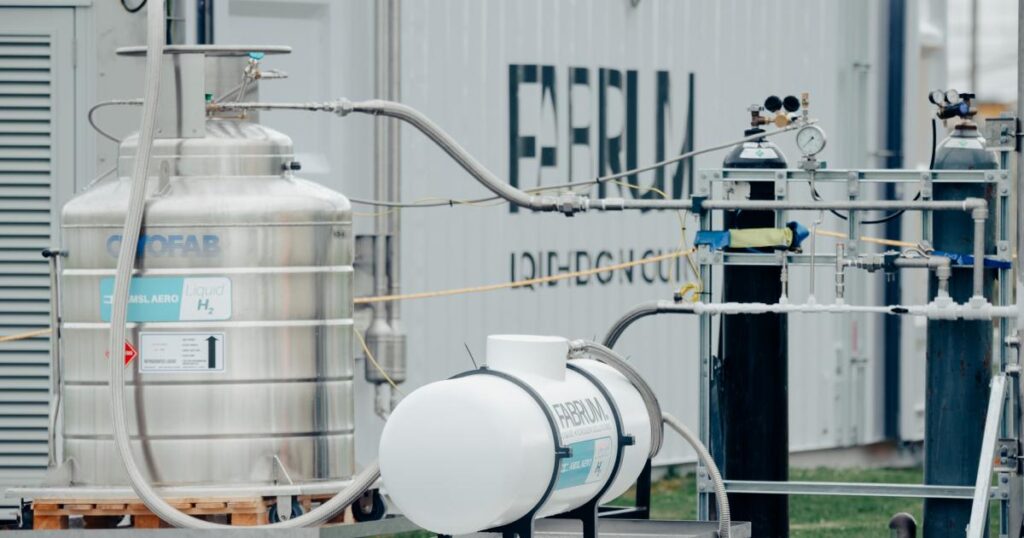
The £1.44 million project brings together Brunel University’s Centre for Advanced Powertrain and Fuels with hydrogen startup Genuine H2 to create Britain’s first integrated hydrogen maritime demonstrator. The system represents a departure from conventional hydrogen production methods, which typically require purified freshwater and energy-intensive storage solutions that have limited the practical application of hydrogen in marine environments.
The core innovation centres on specialised electrodes capable of splitting hydrogen directly from seawater, bypassing the expensive and energy-intensive desalination process that conventional electrolysis requires. Traditional hydrogen production through electrolysis uses purified water to prevent electrode degradation from salt and other minerals, adding significant cost and complexity to marine applications. The new electrodes, though their specific composition remains undisclosed, appear engineered to withstand the corrosive marine environment while maintaining efficiency.
This direct seawater approach could fundamentally change the economics of maritime hydrogen production. Ships equipped with this technology could theoretically produce fuel while at sea using renewable electricity from solar panels or wind turbines, creating a self-sustaining energy cycle. The elimination of desalination infrastructure reduces both capital costs and energy requirements, making hydrogen more competitive with traditional marine fuels.
Understanding the Engineering Behind Seawater-to-Hydrogen Conversion
The process of converting seawater to hydrogen involves several sophisticated engineering solutions that address fundamental challenges students encounter in electrochemistry, materials science, and thermodynamics courses. At its heart, electrolysis splits water molecules (H₂O) into hydrogen (H₂) and oxygen (O₂) using electrical current, but seawater presents unique obstacles.
In standard electrolysis, electrical current passes through two electrodes immersed in water. At the cathode (negative electrode), water molecules gain electrons and form hydrogen gas through the reduction reaction: 2H₂O + 2e⁻ → H₂ + 2OH⁻. At the anode (positive electrode), water loses electrons through oxidation: 2H₂O → O₂ + 4H⁺ + 4e⁻. This process requires approximately 1.23 volts under ideal conditions, though practical systems operate at higher voltages to overcome resistance.
Seawater complicates this process significantly. The high salt content (approximately 35 grams per litre) creates competing reactions at the electrodes. Chloride ions from dissolved salt can form chlorine gas instead of oxygen at the anode, creating toxic byproducts and corroding electrode materials. The engineering solution involves developing selective electrode coatings that preferentially catalyse water splitting over chloride oxidation, likely using materials with specific electronic band structures that favour the desired reaction pathway.
The storage breakthrough employs what researchers describe as a \”nano film\” that absorbs hydrogen into a solid-state matrix at room temperature. This approach leverages metal hydride technology, where hydrogen atoms diffuse into the crystal lattice of specific metals or alloys, forming stable compounds. When metals like magnesium, titanium, or specialised alloys absorb hydrogen, they undergo a phase transformation that stores hydrogen at densities potentially exceeding liquid hydrogen without requiring cryogenic temperatures or high pressure.
The engineering challenge lies in optimising the absorption and desorption kinetics-how quickly hydrogen enters and exits the storage material. Students familiar with diffusion equations understand that temperature, pressure, and material microstructure all affect these rates. The \”thinner-than-paper\” description suggests a high surface-area-to-volume ratio design, maximising contact between hydrogen gas and the storage medium to accelerate absorption rates.
For the combustion engine component, engineers must modify traditional diesel engines to burn hydrogen efficiently. Hydrogen’s wide flammability limits (4-75% in air compared to diesel’s narrow 0.6-5.5%) and high flame speed require redesigned injection systems and combustion chamber geometries. The absence of carbon means no particulate formation or carbon deposits, but engineers must manage higher combustion temperatures that can increase nitrogen oxide formation unless properly controlled through techniques like exhaust gas recirculation or lean-burn strategies.
Perhaps the most significant engineering achievement involves the hydrogen storage system. The researchers have developed an ultra-thin “nano film” capable of locking hydrogen in solid form at room temperature and atmospheric pressure. This advancement addresses one of hydrogen’s most persistent challenges-its extremely low density requires either compression to 700 bar or cooling to -253°C for practical storage, both energy-intensive processes requiring specialised equipment unsuitable for many marine applications.
The solid-state storage method utilises advanced metal hydride or similar technology, where hydrogen atoms integrate into a material matrix, achieving storage densities potentially comparable to those of compressed gas without the associated safety risks and infrastructure requirements. For maritime applications, this eliminates the need for heavy pressurised tanks or cryogenic systems that would otherwise consume valuable cargo space and add significant weight to vessels.
The ability to store hydrogen at ambient conditions fundamentally changes the safety equation for marine hydrogen systems. Traditional compressed hydrogen tanks pose an explosion risk if damaged, while cryogenic systems require a constant energy input to maintain low temperatures. Solid-state storage at room temperature and pressure substantially reduces these hazards, making hydrogen more practical for smaller vessels, such as fishing boats and ferries, that lack specialised crew training for handling hazardous materials.
The project, officially designated GH2DEM (Clean Maritime Propulsion via Direct Seawater Electrolysis and Ambient Hydrogen Storage), forms part of the UK Government’s broader £30 million initiative to decarbonise maritime transport. The demonstrator will undergo testing until March 2026, initially on land using Brunel University’s heavy-duty hydrogen combustion engine facility.
The complete system integration presents its own engineering challenges. The electrolyser must produce hydrogen at rates that match engine consumption, while the storage system buffers supply and demand mismatches. The modified combustion engine must efficiently burn hydrogen across varying load conditions typical of marine operations, from idle speeds in port to full power in open water. Coordinating these subsystems requires sophisticated control algorithms that optimise efficiency while maintaining reliability in harsh marine environments.
Should the technology prove scalable, it could particularly benefit smaller commercial vessels operating in coastal waters where battery-electric propulsion faces range limitations and conventional hydrogen infrastructure remains economically unviable. The ability to produce fuel from seawater using renewable electricity could enable truly zero-emission marine transport, with vessels generating their own fuel from solar or wind power while emitting only water vapour that returns harmlessly to the ocean.
The researchers aim to develop a manufacturable product utilising UK supply chains, suggesting confidence in the technology’s commercial viability. However, questions remain about the long-term durability of electrodes in seawater, the energy efficiency of the complete cycle, and whether the storage material can withstand thousands of charge-discharge cycles without degradation. The two-year testing program is expected to provide data addressing these concerns while demonstrating whether this integrated approach can deliver the reliability and economics necessary for commercial maritime adoption.
Credit via eandt.theiet.org
Aerospace, Defence & MarineBreakthroughs

Automotive & Transport

Automotive & Transport
Aerospace, Defence & Marine