Construction & Infrastructure
University of Hull tests for Flood Re found that duct tape on the outside of a front door cut flood leakage by up to 98%, beating a wall of sandbags.

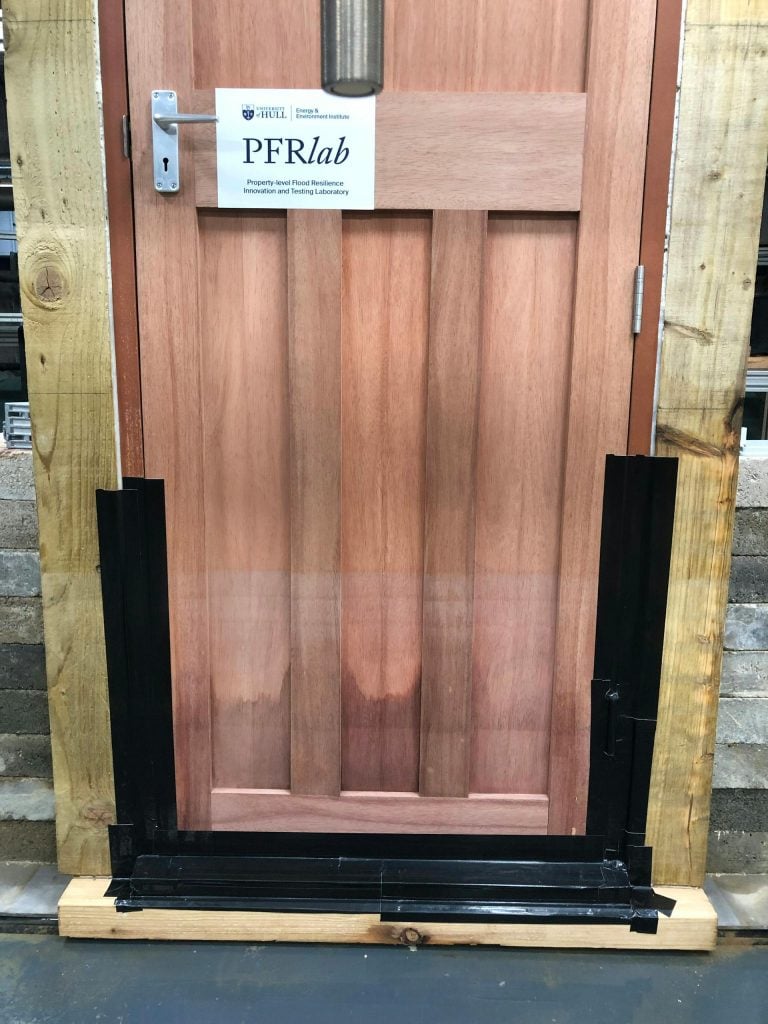
Imagine a front door in a Hull test lab with floodwater coming up against it in 5cm increments. Without any protection the water just pushes right through the gaps in the frame. The engineers then go and put a good width of duct tape around the outside of the door and raise the water again. Almost nothing comes through.
That’s the surprising result of new tests by the University of Hull on behalf of Flood Re (the UK’s flood reinsurance scheme). Correctly applied duct tape on the outside of a domestic door reduced water ingress by 97 to 98% as opposed to an unprotected door.[1][2] Sandbags, the long established symbol of flood defence, only managed around 70%.[3]
The experiments were carried out at PFRlab (Hull’s purpose built property flood resilience testing facility) with support from Flood Re and the Environment Agency.[4] Six common door types were tested at water depths of up to 600mm.[5] The water level was raised in 5cm increments to a maximum of 60cm and the amount of leakage at each stage was recorded.
For the sandbag test they stacked 54 sandbags with a plastic sheeting between the bags and the door.[6] Even the weakest tape they tried outperformed that wall of sand, reducing the leakage by 80%.[7] The best tape was the flood putty tape (the butyl type) which achieved up to 99% reduction in leakage and was as much as ten times more effective than the sandbags under the test conditions.[8]
The tests revealed a few more useful engineering lessons. A standard outward opening door allowed 74% less water in than an inward opening one.[9] Tape on the outside of the door was clearly superior to tape on the inside.[10] With no protection at all, leakage through a standard door could easily reach tens of thousands of litres per hour at 60cm depth.
The real numbers are what make this interesting. It took about 10-20 minutes to tape each door and a roll of duct tape is £10 or less.[11][12] Jonathan Kassian, Head of Flood Resilience at Flood Re, said it all in one go: “Sandbags are the archetypal flood defence but these tests completely overturn that.”
Hull knows all about flooding having seen over 8,600 homes and 1,300 businesses flood in 2007.[13] The researchers are very clear that duct tape is not in any way a substitute for properly designed flood doors and barriers and will not prevent water getting in through the floor, the walls or the drains. It is, however, a quick and cheap first step for a household and one that is backed up by actual measurements rather than just anecdote. If you’re the sort of person who likes the idea of tackling real problems with actual tests and data then our guide on which engineering discipline is right for you is well worth a look.
Engineering deep dive
Water pressure grows with depth. The pressure at any depth in a still liquid is p = ρgh, where ρ is the density of water (about 1,000 kg/m³), g is 9.81 m/s² and h is the depth. At the bottom of a 60 cm flood:
p = 1,000 × 9.81 × 0.60 = 5,886 Pa, or about 5.9 kPa.
At the surface the pressure is zero, so across the wetted part of the door the average pressure is half the maximum, about 2,943 Pa. Take a typical door 0.9 m wide. The wetted area is 0.9 × 0.6 = 0.54 m², so the total force from the water is:
F = 2,943 × 0.54 ≈ 1,590 N
That is about the weight of a 162 kg mass pressing on the bottom of the door. Halve the depth to 30 cm and the force drops to a quarter, because both the average pressure and the wetted area halve. Force rises with the square of depth, which is why the last few centimetres of a flood are the hardest to hold back.
Now the leak. Torricelli's law, which comes from energy conservation, says water escaping through a gap at depth h leaves at about v = √(2gh). At 60 cm:
v = √(2 × 9.81 × 0.6) ≈ 3.4 m/s
Suppose the door has a 1 mm gap along its 0.9 m bottom edge. The gap area is 0.001 × 0.9 = 0.0009 m², so the ideal flow is 0.0009 × 3.4 ≈ 0.0031 m³/s, or about 11,000 litres per hour. Friction and the shape of real gaps slow the water down, so measured flows are lower, but this simple estimate shows why unprotected doors leak thousands of litres per hour.
Cut that leak by 97% and only about 3% gets through: roughly 330 litres per hour from our ideal estimate. A 70% cut leaves 30%, ten times as much.
The tape result also makes physical sense. On the outside, water pressure pushes the tape against the door and frame, so the seal gets tighter as the flood rises. On the inside, the same pressure tries to peel the tape away. This is the kind of reasoning you meet in A-level Physics when you study pressure, energy and forces on surfaces.
Tape is best for very shallow flooding at the door. Water will still find its way in through airbricks, walls, floors and drains and the temporary barriers are only as good as their installation. The next challenge for the flood engineers is to take results such as this and turn them into clear guidance and better permanent products so that when the water finally goes down the homes can get back to normal much more quickly.
Behind it all are civil and hydraulic engineers who work out how floodwater moves and the forces it exerts on buildings, and laboratory technicians who build and operate the test rigs (e.g. PFRlab). A lot of people in these roles come through a civil engineering degree or a degree apprenticeship and our guide on engineering degrees v degree apprenticeships will explain the difference. The pressure and flow calculations above are straight from the syllabus and that’s why an A-level in Physics is such a useful stepping stone into this type of work.
Credit via scitechdaily.com
Scientists Discover a $10 Flood Protection Trick That Works Better Than Sandbags
In controlled tests, correctly applied duct tape on the outside of a household door reduced water leakage by 97-98%.
Checked 27 October 2026
Low-cost duct tape can help in flood situations
High-quality wide duct tape reduced water leakage by 97-98% compared with an unprotected door
Checked 27 October 2026
Low-cost duct tape can help in flood situations
Even the lowest-performing tape reduced leakage by 80%, compared to 70% for sandbags.
Checked 27 October 2026
Tape beats sandbags at keeping floodwater out, tests find
the experiments took place at PFRlab, Hull’s purpose-built property flood resilience testing facility
Checked 27 October 2026
Tape beats sandbags at keeping floodwater out, tests find
Six common door types faced water depths of up to 600mm, roughly two feet,
Checked 27 October 2026
Scientists Discover a $10 Flood Protection Trick That Works Better Than Sandbags
When testing sandbags, we stacked 54 sandbags with plastic sheeting between the door and the sandbags.
Checked 27 October 2026
Tape beats sandbags at keeping floodwater out, tests find
Even the runt of the tape litter cut leakage by 80%.
Checked 27 October 2026
Tape beats sandbags at keeping floodwater out, tests find
The star turn was flood putty tape, a butyl-style product, which cut leakage by up to 99%
Checked 27 October 2026
Tape beats sandbags at keeping floodwater out, tests find
Before any protection went on, a standard outward-opening door let in 74% less water than an inward-opening one.
Checked 27 October 2026
Tape beats sandbags at keeping floodwater out, tests find
tape on the outside of the door comfortably beat tape on the inside
Checked 27 October 2026
Scientists Discover a $10 Flood Protection Trick That Works Better Than Sandbags
It took about 10-20 minutes to apply the tape to each door.
Checked 27 October 2026
Scientists Discover a $10 Flood Protection Trick That Works Better Than Sandbags
A household may already have duct tape or be able to purchase a roll for £10 or less.
Checked 27 October 2026
Tape beats sandbags at keeping floodwater out, tests find
when more than 8,600 homes and 1,300 businesses flooded
Checked 27 October 2026
Construction & Infrastructure
Construction & Infrastructure

Automotive & Transport

Automotive & Transport