
Energy & Environment
Seaway7 has laid all 95 inner-array cables at the 1.4GW East Anglia THREE offshore wind farm off Suffolk, more than 240km of subsea power line.
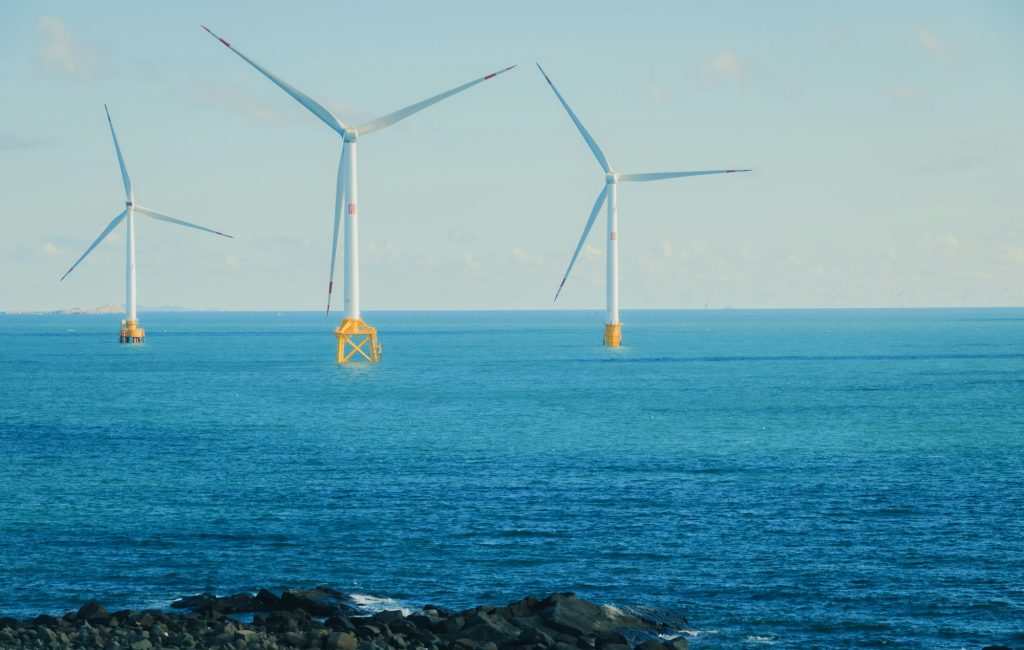
Almost 70km out in the North Sea a wind turbine is just a very tall tower until it’s plugged in. At East Anglia THREE off the Suffolk coast that plugging in has just passed a major milestone. Seaway7 has now completed the laying of all of the wind farm’s inner array cables (the subsea power cables which link the turbines together).
The team have installed the 95 inner array cables (loading, laying and pulling each one into the turbine foundations). They total over 240km in length (more than the straight line distance from London to Birmingham). The cables are now in place and testing, termination and trenching is ongoing.
East Anglia THREE (developed by ScottishPower Renewables and Masdar) is located some 69km off the Suffolk coast and is comprised of 95 Siemens Gamesa turbines (14.7MW each, 230m rotor diameter). The 1.4GW project has a cost of £4bn and the developers state it will supply around 1.3 million UK homes per year.
Each turbine is on a monopile (a huge steel tube driven into the seabed) with a transition piece on top. All 95 of the monopiles and transition pieces were installed earlier this year. The inner array cables then link the turbines in strings and carry the power to an offshore substation where the voltage is stepped up once more for the journey to shore.
These are no ordinary cables. The East Anglia THREE inner array uses 66kV three core cables (made at Hellenic Cables in Corinth, Greece). Each of the three cores carries one of the three phases of the AC, insulated, screened and steel armoured to cope with anchors, fishing gear and all the years of seawater exposure.
Laying them is a very careful operation. The cable is normally laid from a cable lay vessel which unspools it from a massive rotating carousel onto the seabed, with the crews and ROVs guiding each end up through the foundation and into the turbine. Then comes the rather tedious work of termination where the cable cores are spliced to the turbine switchgear and then a series of electrical tests are carried out to verify that every joint is sound.
Seaway7 won the contract to install the foundations and cables in June 2023[1]. The first turbine was erected in April this year (with 115m blades) and the project is due to be fully commissioned by the end of 2026. If you’re interested in seeing where you might fit into a project of this nature then our guide to which engineering discipline is right for you is a good place to start.
Engineering deep dive
Power, voltage and current are linked. For three-phase alternating current, the power carried is roughly P = √3 × V × I, where V is the voltage between phases and I is the current in each conductor.
Take one turbine running flat out at 14.7MW on a 66kV cable:
I = P ÷ (√3 × V) = 14,700,000 ÷ (1.732 × 66,000) ≈ 129 A
Now suppose several turbines share one cable string. In our worked example, if six turbines feed the same cable, the section nearest the substation carries about 6 × 129 ≈ 770 A.
Here is the key physics. A cable heats up because of its resistance. The power lost as heat is P = I²R, so it depends on the square of the current. If engineers used an older 33kV design for the same power, the current would double. Double the current and the heat loss goes up by a factor of four, for the same copper.
This is one reason newer, bigger wind farms use 66kV inner-array cables. Doubling the voltage halves the current, cuts losses to a quarter, and lets each cable carry more turbines. Fewer, longer strings mean fewer cables and less seabed work.
There is a geometry lesson too. More than 240km of cable shared across 95 cables gives an average of about 2.5km per cable. With rotors 230m across, that is around 11 rotor diameters. Turbines are spread out like this so each one is not sitting in the slow, churned-up wake of its neighbour.
Finally, the energy. At full output, one 14.7MW turbine produces 14.7 megawatt-hours every hour. Across all 95 turbines, that is about 1,400 megawatt-hours in a single windy hour. You will meet P = VI, P = I²R and energy = power × time in A-level Physics, and three-phase power in electrical engineering courses.
Laying the cables is only half the job. Every connection still has to be terminated, tested and buried or otherwise protected and the remainder of the turbines then lifted into position before the wind farm can go fully operational. The cables will then be monitored over the years for wear and heat.
Behind it all are the electrical engineers who design the cable network, the marine engineers who work out how each cable is to be laid and the offshore wind technicians who pull in, terminate and test every connection. A lot of the people in this field start off via an engineering apprenticeship or a degree and our guide to getting into electrical engineering covers the subjects and the qualifications that will help. If you’re not sure which route is right for you then have a read of our guide to finding an engineering apprenticeship.
Credit via offshorewind.biz
Seaway7 completes inner-array cable installation at East Anglia Three
Seaway7 was awarded the contract for foundation and cable installation in June 2023.
Checked 27 October 2026
Energy & Environment
Automotive & Transport