Construction & Infrastructure
Engineers completed a world-first £23M Severn Tunnel overhead line upgrade, replacing 9,000 metres of wiring in one of Britain's most corrosive rail environments.
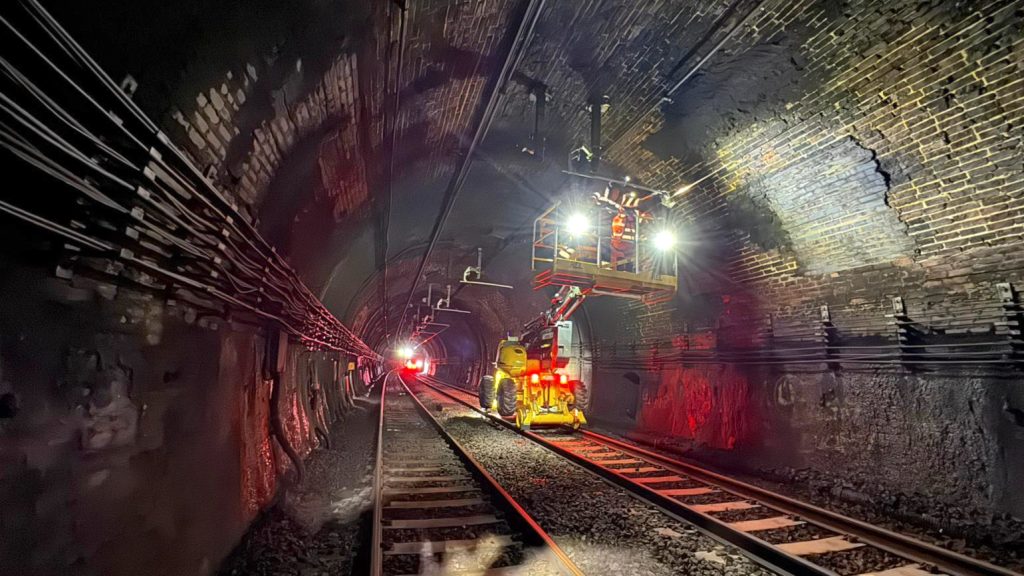
Somewhere beneath the Severn Estuary, saltwater seeps through Victorian brickwork and settles on copper wire. It is a corrosive, relentless process that has been eating away at the tunnel’s overhead power system for years. Now, after a 16-day engineering marathon, the Severn Tunnel overhead line upgrade is complete. A team of 250 engineers has replaced the entire overhead line equipment inside one of Britain’s most hostile railway environments, using a method never before attempted at this scale.
The £23 million project, delivered by Network Rail’s Wales & Borders team and contractor ARQ, finished on 9 June 2026. The railway between Newport and Bristol Parkway had been closed since 23 May, and the work demanded round-the-clock shifts in a tunnel where conditions push both people and materials to their limits.
The Severn Tunnel stretches 4.35 miles beneath the estuary. Completed in 1886, it remains one of the longest underwater tunnels in the UK. When the Great Western Main Line was electrified, overhead line equipment was installed inside the tunnel to carry 25,000 volts of alternating current to trains passing below. But the tunnel’s atmosphere is uniquely aggressive. Moisture is constant. Saltwater infiltration, a problem that has plagued the tunnel since construction, accelerates corrosion on metal components. Standard overhead line setups, designed for open-air railways, degrade faster here than almost anywhere else on the network.
The old system used a conventional catenary arrangement: a messenger wire strung along the tunnel ceiling, with droppers suspending a contact wire below. Each connection point, each dropper, each clip is a place where corrosion can take hold. Maintenance was frequent and expensive. Network Rail’s engineers wanted something simpler, with fewer components exposed to the salt-laden air.
Their solution was a single 7-kilometre copper contact wire, supported at regular intervals by modified bridge arms fixed directly to the tunnel walls. No messenger wire. No droppers. Fewer parts to corrode, fewer points of failure. Nia Watkins, Regional Asset Manager at Network Rail, described it as “an innovative solution developed by our teams,” and, in engineering terms, the understatement is justified. This is the first time a simplified overhead line system of this kind has been deployed at such a length inside a tunnel.
The numbers behind the Severn Tunnel overhead line upgrade tell the story of its scale. Workers replaced 838 bridge arms, each one bolted to the tunnel lining. They renewed 9,000 metres of overhead wiring. All of this happened inside a confined, damp, dark space with limited ventilation, and the single-track approaches at each end constrained logistics.
The closure also allowed Network Rail to carry out track upgrades further along the line, preparing the route for the new Bristol Brabazon station. That station, built on the site of the former Filton airfield, is due to open in autumn 2026. It will bring passenger services back to the Henbury line for the first time since 1964.
Engineering deep dive
Every electric train on Britain's main lines collects power through a pantograph, a spring-loaded arm mounted on the roof that presses upward against a contact wire. That wire carries 25 kV AC, fed from trackside substations. On a typical stretch of open railway, the contact wire hangs from a catenary system - a thicker messenger wire runs along the top, supported by masts or gantries. Thinner dropper wires connect the messenger to the contact wire at intervals, keeping the contact wire at a consistent height so the pantograph can maintain a steady connection.
This arrangement works well outdoors. The wires can expand and contract with temperature changes, and the geometry keeps the contact wire level even across long spans. Inside a tunnel, though, the engineering changes. There are no masts. Instead, the wires are anchored to the tunnel lining using brackets and bridge arms, metal supports that bridge the gap between the tunnel wall and the wire's required position.
Metals corrode when exposed to moisture and dissolved salts. In the Severn Tunnel, both are present in abundance. The tunnel passes beneath an estuary where freshwater from the River Severn meets tidal seawater. Groundwater infiltrates through the tunnel lining. During construction in the 1880s, workers hit the Great Spring, an underground water source that still pumps millions of litres out of the tunnel every day.
This creates an environment where steel and copper components are constantly wet. Saltwater is particularly damaging because dissolved sodium and chloride ions accelerate electrochemical corrosion. In a standard catenary setup, every connection between the ropper and the messenger wire, every clip holding the contact wire, and every bolt securing a bracket becomes a potential failure point. Galvanic corrosion can also occur where different metals are in contact, as electrons flow from the more reactive metal to the less reactive one, gradually dissolving the weaker component.
Network Rail's engineers addressed this by eliminating the catenary. Instead of a messenger wire with droppers, the Severn Tunnel overhead line upgrade uses a single copper contact wire supported directly by modified bridge arms. These arms are spaced at regular intervals along the 7-kilometre run, holding the wire at the correct height and position for pantograph contact.
Copper was chosen for the contact wire because it offers excellent electrical conductivity and better corrosion resistance than steel in wet, saline conditions. Copper does form a patina of copper carbonate over time (the green coating seen on old copper roofs). Still, this layer is stable and protects the underlying metal from further attack.
The bridge arms themselves must resist the same conditions. Modified designs likely incorporate corrosion-resistant coatings or materials, though Network Rail has not published full specifications. Stainless steel, hot-dip galvanising, and polymer coatings are all standard approaches for protecting structural steelwork in aggressive environments.
Single-wire overhead systems exist elsewhere, typically on tramways and low-speed urban lines where spans are short. Deploying one across a continuous 7-kilometre run inside a tunnel is a different proposition. The wire must maintain consistent tension and height across the full length. Thermal expansion matters. Copper expands roughly 17 millimetres per degree Celsius per kilometre, so a 7 km wire experiencing a 20-degree temperature swing could change length by nearly 2.4 metres. Tensioning systems at each end must accommodate this movement without allowing the wire to sag or become too tight.
The engineering team also had to ensure that the simplified system meets Network Rail's standards for pantograph contact quality. Variations in wire height of just a few millimetres can cause arcing, where the pantograph briefly loses contact and an electrical arc jumps the gap. Arcing damages both the wire and the pantograph's carbon contact strip, so the support spacing and alignment had to be precise.
Installing the system meant 250 engineers working in shifts over 16 consecutive days. Tunnel work brings specific hazards: limited ventilation, restricted escape routes, noise amplification, and the psychological pressure of working underground. Moving heavy equipment, including bridge arms and drums of copper wire, through a confined space adds logistical complexity. Every component had to enter through the tunnel portals and be transported along the track to its installation point.
Links to the curriculum: GCSE
The Severn Tunnel overhead line upgrade is a clean example of engineering shaped by its environment. A problem, corrosion, led to a simpler, more durable design that had never been tried at this scale. If you are studying physics, the project touches on electrochemistry, thermal expansion, and electrical power transmission. If civil engineering appeals to you, there is the challenge of working inside a 140-year-old structure beneath an estuary. And if you are drawn to the idea of solving problems that have no off-the-shelf answer, this is what that looks like in practice. The tunnel is open again. The trains are running. And beneath the Severn, a single copper wire carries 25,000 volts through some of the most corrosive air on the British rail network.
Credit via networkrailmediacentre.co.uk
Construction & Infrastructure
Construction & InfrastructureInnovation
Construction & Infrastructure
Construction & Infrastructure