Energy & EnvironmentBreakthroughs
Tesla's Cybercab achieves 165 Wh/mi, making it the most efficient EV ever certified. The engineering behind the record reveals how mass reduction and aerodynamics push efficiency to its limits.
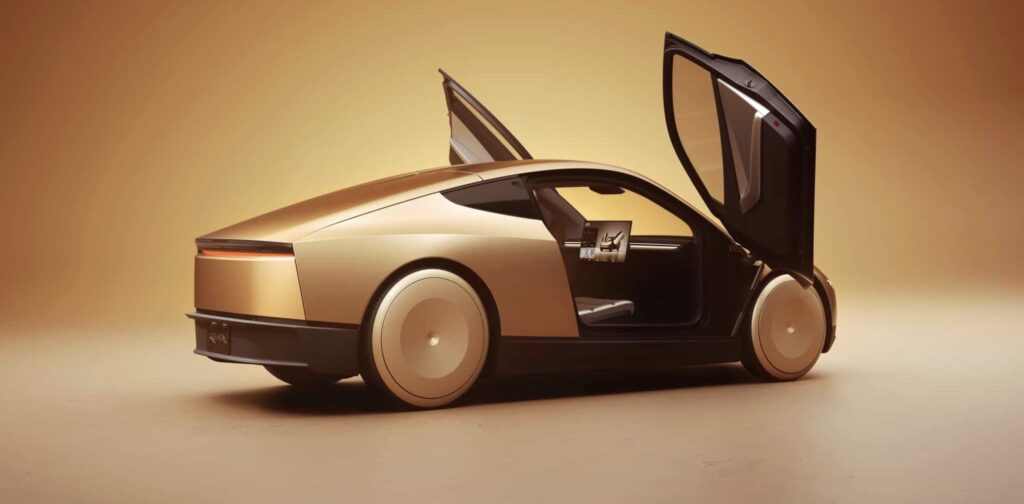
At 165 watt-hours per mile, the Tesla Cybercab consumes less energy than any electric vehicle ever certified.[1] That figure is not a marketing claim. It comes from the US Environmental Protection Agency’s standardised testing procedure, confirmed by Tesla’s VP of Vehicle Engineering, Lars Moravy.[2] The next-closest competitor, the Lucid Air Pure, uses 28 per cent more energy per mile.[3] A Tesla Model 3, one of the most efficient passenger EVs on sale, needs nearly a third more.[4]
The gap is enormous. And the engineering behind it is deceptively simple in concept, though fiendishly difficult in execution: build the smallest, lightest, most aerodynamic vehicle you can, then give it nothing it does not absolutely need.
The Cybercab carries two passengers. It has no steering wheel. No pedals.[5] No wing mirrors. No door handles that protrude into the airflow. The body tapers sharply towards the rear in a teardrop profile optimised exclusively for low aerodynamic drag, with no concessions to boot space or rear-seat legroom. The battery pack sits below 50 kWh, yet Tesla claims a range approaching 300 miles.[6] The maths checks out: at 165 Wh/mi, a 49.5 kWh battery delivers exactly 300 miles.
Every vehicle is a bundle of compromises. A family car must carry five people, their luggage, protect them in a side impact, and look appealing enough to sell in a showroom. Each of those requirements adds mass, increases frontal area, or worsens the drag coefficient. The Cybercab does not have those constraints. It is a single-purpose machine designed for one job: move two people through a city as cheaply per mile as physically possible.
Energy cost per mile is a dominant factor in robotaxi fleet economics. At average US electricity rates of roughly $0.16 per kWh, the Cybercab costs about 2.6 cents per mile in energy. A Model 3 costs 3.8 cents. A Hyundai Ioniq 5 costs 4.8 cents.[7] Over hundreds of thousands of fleet miles, those fractions compound into a structural cost advantage.
Production began at Tesla’s Giga Texas factory in April 2026[8], though the ramp is expected to be gradual. The vehicle still depends on unsupervised autonomous driving software that, as of May 2026, has not yet demonstrated the reliability needed for public deployment without a safety driver.
Engineering deep dive
Understanding why the Cybercab achieves 165 Wh/mi requires breaking down where energy goes in an electric vehicle. At constant speed on a level road, an EV's motor must overcome two primary forces: rolling resistance and aerodynamic drag.
Rolling resistance (Frr = Crr × m × g) depends on the vehicle's mass and the coefficient of rolling resistance of its tyres. It is roughly constant regardless of speed. Aerodynamic drag (Fdrag = ½ × ρ × Cd × A × v²) depends on air density, the drag coefficient, the frontal area, and the square of velocity. At city speeds below 30 mph, rolling resistance dominates. Above 50 mph, aerodynamic drag takes over and grows quadratically.
The Cybercab attacks both terms. Its mass is significantly lower than a typical EV because it carries a smaller battery (below 50 kWh versus 75-100 kWh in a Model 3 or Model Y), has no steering column or pedal assembly, carries only two seats instead of five, and uses a more compact crash structure (optimised for two occupants in fixed positions). A-level Physics students will recognise that reducing mass cuts rolling resistance linearly and also reduces the energy needed to accelerate.
The aerodynamic term receives even more aggressive treatment. The drag coefficient (Cd) describes how slippery a shape is. A flat plate perpendicular to the airflow has a Cd around 1.0. A sphere sits at about 0.47. A teardrop shape achieves 0.04. Production cars typically range from 0.22 (Mercedes EQS) to 0.35. The Cybercab's teardrop rear profile, flush surfaces, absence of wing mirrors and protruding handles, sealed underbody, and narrow two-seat cabin all combine to minimise both Cd and frontal area A.
The frontal area is the overlooked variable. Even if two cars share the same Cd, the physically smaller one experiences less drag because the product Cd × A is what matters. The Cybercab's two-seat width is substantially narrower than a five-seat saloon, so the air has less vehicle to push against.
The drivetrain itself also contributes. Electric motors convert electrical energy to mechanical energy with efficiencies above 90 per cent. However, losses still occur in the inverter (switching losses in power electronics), the motor windings (resistive heating), and the reduction gear. Tesla's permanent magnet synchronous reluctance motors are among the most efficient in production, and the Cybercab's lower mass means the motor operates more often in its peak-efficiency region rather than straining under high loads.
Regenerative braking recovers kinetic energy during deceleration. The effectiveness of regeneration depends on deceleration rate, motor characteristics, and battery state of charge. In urban driving with frequent stops, a well-calibrated regenerative braking system can recover 20-30 per cent of the energy that would otherwise be lost as heat in friction brakes. The Cybercab's lower mass means less kinetic energy to shed at each stop, improving the energy-recovery-to-energy-consumption ratio.
For students studying thermal physics, the efficiency gains compound. Every kilogram removed reduces rolling resistance, reduces braking energy, and allows a smaller battery (which itself is lighter, creating a virtuous cycle engineers call mass decompounding). Every reduction in Cd × A reduces the power needed at cruising speed, further shrinking the required battery capacity. The Cybercab represents the logical endpoint of this spiral: remove everything non-essential, and 165 Wh/mi follows from first principles.
Links to the curriculum: A level, GCSE
The efficiency record is real, and the engineering is sound. Whether it translates into a viable product depends on a question that sits outside the physics: can the car actually drive itself? That remains unproven at scale. For now, the Cybercab stands as a lesson in what happens when engineers are freed from compromise. Give a vehicle one job, strip away everything else, and the numbers become extraordinary.
Credit via electrek.co
Tesla Cybercab: hate it or love it, it is the most efficient EV ever
Tesla's Cybercab has been certified at 165 Wh/mi, making it the most efficient electric vehicle ever produced
Checked 14 October 2026
Tesla Cybercab: hate it or love it, it is the most efficient EV ever
Tesla VP of Vehicle Engineering Lars Moravy confirmed the figure, which represents a certified rating
Checked 14 October 2026
Tesla Cybercab: hate it or love it, it is the most efficient EV ever
The next most efficient EV on the market, the Lucid Air Pure, consumes 28% more energy per mile.
Checked 14 October 2026
Tesla Cybercab: hate it or love it, it is the most efficient EV ever
Even Tesla's own Model 3 — one of the most efficient passenger EVs you can buy — needs nearly a third more energy to cover the same distance.
Checked 14 October 2026
Tesla Cybercab: hate it or love it, it is the most efficient EV ever
Tesla accomplished this by building a tiny two-seat robotaxi with no steering wheel, no pedals, and a sub-50 kWh battery pack.
Checked 14 October 2026
Tesla Cybercab: hate it or love it, it is the most efficient EV ever
Tesla claims can deliver close to 300 miles of range.
Checked 14 October 2026
Tesla Cybercab: hate it or love it, it is the most efficient EV ever
the Cybercab costs about $0.026 per mile in energy — compared to roughly $0.038 per mile for a Model 3 and $0.048 for a Hyundai Ioniq 5.
Checked 14 October 2026
Tesla confirms Cybercab production has started despite delays in unsupervised driving
We have just started production of Cybercab
Checked 14 October 2026
Energy & EnvironmentBreakthroughs
Automotive & Transport

Automotive & TransportInnovation
Automotive & Transport