
JCB Hydrogen Land Speed Record: 1,600 hp Hydromax Targets 350 mph
JCB's Hydromax hydrogen car targets 350 mph at Bonneville with twin 800 hp engines, aiming to nearly double the current hydrogen land speed record this August.
Key points
- JCB's Hydromax targets 350 mph at Bonneville with two 800 hp hydrogen internal combustion engines
- Would nearly double the current hydrogen vehicle land speed record of 187.62 mph
- Driver Andy Green is the only person to break the sound barrier on land
- Part of JCB's £100 million, five-year hydrogen engine development programme
- Same engine technology already ships in production JCB excavators
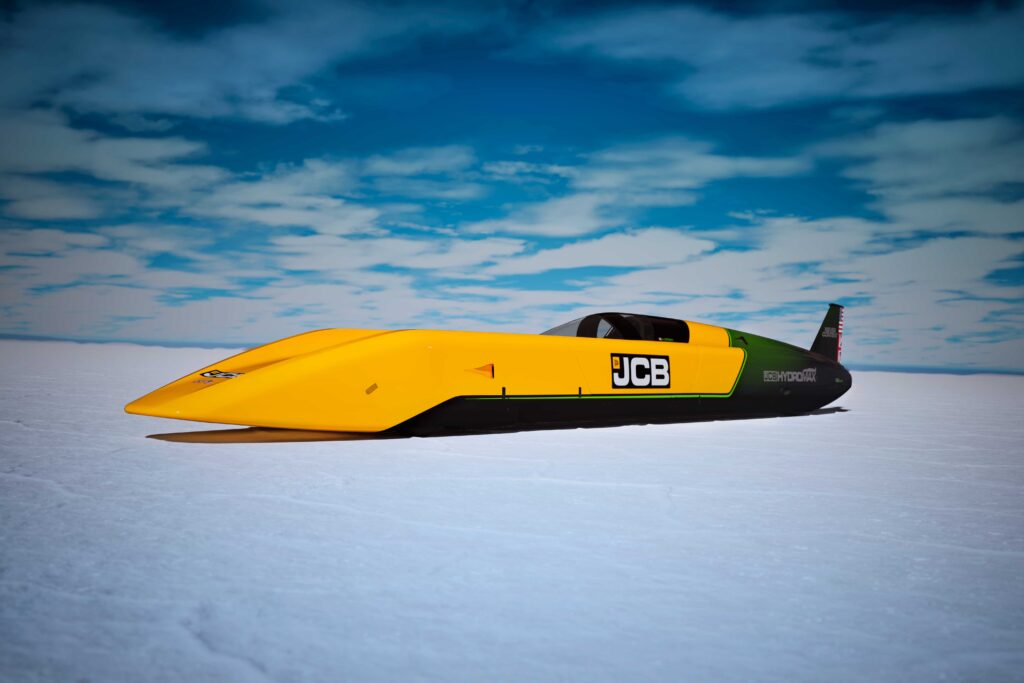
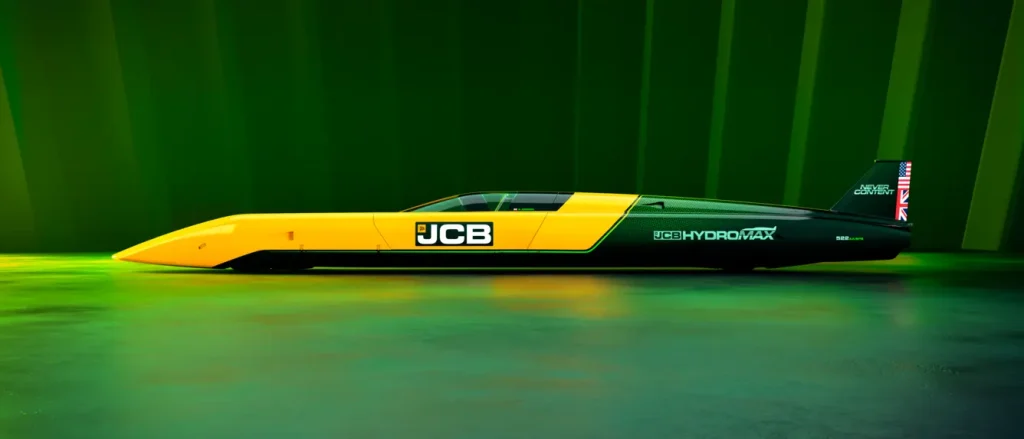
Somewhere in a Staffordshire factory better known for producing bright yellow excavators, a team of engineers has spent five years and £100 million building a car that runs on hydrogen and targets 350 mph. The JCB Hydromax, as first reported by New Atlas, is a 10-metre-long land speed racer powered by two hydrogen internal combustion engines producing a combined 1,600 horsepower. Its target? Nearly double the current world record for a hydrogen-powered vehicle.
The existing record for hydrogen internal combustion stands at 187.62 mph, set by BMW’s H2R prototype. The overall hydrogen vehicle record belongs to Ohio State University’s fuel-cell Buckeye Bullet 2, which clocked 303 mph back in 2009. JCB intends to beat both marks in a single run at the Bonneville Salt Flats this August.

Behind the wheel will be Andy Green, a retired RAF Wing Commander who also happens to be the only human being ever to break the sound barrier on land. Green set the current diesel land speed record of 350.092 mph in JCB’s Dieselmax back in 2006. That mark still stands twenty years later.
This is not a vanity project disguised as engineering. The two engines in the Hydromax are modified versions of the same hydrogen combustion units now shipping in JCB’s production excavators. The Bonneville attempt is, in effect, the most dramatic stress test imaginable for a technology the company is betting its future on.
JCB argues that hydrogen internal combustion offers a practical path for heavy machinery. Where batteries are too heavy, and refuelling takes too long for a 20-tonne excavator working 10-hour shifts, a hydrogen engine can deliver the energy density and fast refuelling that the construction sector demands. The engines produce zero carbon dioxide. They do produce small amounts of nitrogen oxides, though JCB has not disclosed specific figures for the Hydromax configuration.
The vehicle itself was developed with Prodrive, the Oxfordshire-based motorsport engineering firm responsible for rally and endurance racing programmes. The bodywork is entirely new, designed from scratch for aerodynamic efficiency at extreme speed. Every component, from suspension geometry to traction control calibration, has been validated through simulation before touching salt. Both engines drive all four wheels through a twin-clutch dual-transmission system.
“If you’re serious about emissions, you have to be serious about hydrogen,” says JCB chairman Anthony Bamford. “A land-speed project is the perfect way to prove it.”
Engineering deep dive
How do you build a 350 mph hydrogen car?
The core engineering challenge in the JCB Hydromax is adapting hydrogen combustion to extreme performance while maintaining the reliability needed for a measured-mile speed record attempt. A Bonneville record requires two runs in opposite directions within one hour, with the results averaged to produce the official speed. The car must survive both passes and everything in between.
Hydrogen combustion engines work on the same four-stroke cycle as petrol engines. Air enters the cylinder, fuel is injected, the mixture is compressed, a spark plug ignites it, and expanding gases push the piston down. The fundamental difference is the fuel itself. Hydrogen has an extremely wide flammability range (4 to 75 per cent concentration in air, compared to 1.4 to 7.6 per cent for petrol) and burns roughly ten times faster than petrol vapour. This means engineers must carefully manage the air-fuel ratio to prevent pre-ignition, a phenomenon known as knock, where the mixture detonates before the spark plug fires.
At A-level Physics, students encounter the ideal gas law (pV = nRT) and the relationship between pressure, volume, and temperature during compression. In a hydrogen engine, the low ignition energy of hydrogen (about 0.02 millijoules, compared to 0.24 mJ for petrol) means that even tiny hot spots in the combustion chamber can trigger premature ignition. JCB's engineers have addressed this through direct injection, which introduces hydrogen after the intake valve closes, reducing the time available for pre-ignition. The injectors operate at pressures exceeding 30 bar.
The engines produce 800 horsepower each. To put that in perspective, a standard JCB production hydrogen engine for excavators produces around 200-250 horsepower. The jump to 800 hp per unit involves higher-flow fuel injectors, modified camshaft profiles for greater valve lift and duration, strengthened bottom-end components (connecting rods and crankshaft bearings rated for the increased cylinder pressures), and a forced-induction system. Turbocharging hydrogen engines is notoriously tricky because hydrogen's fast flame speed can cause backfires into the intake manifold, so JCB uses carefully designed blow-off valves and flame arrestors.
Aerodynamics at 350 mph are unforgiving. Air resistance increases with the square of velocity (from GCSE physics: Fdrag ∝ v²). At 350 mph, the Hydromax experiences roughly four times the drag force it would at 175 mph. The teardrop profile minimises the frontal area and manages airflow separation at the rear. Any lift at these speeds could be fatal, so the underbody is flat, and the rear diffuser generates enough downforce to keep all four wheels firmly on the salt without adding excessive drag.
The dual-transmission system is another elegant engineering solution. Rather than a single gearbox handling all 1,600 hp, which would require enormously heavy components, each engine feeds its own gearbox. The twin-clutch mechanism allows seamless power delivery during acceleration runs while reducing the peak torque through any single drivetrain component. This is similar in principle to how Formula 1 cars distribute power, though adapted for straight-line speed rather than cornering.
Students studying A-level Design and Technology will recognise the materials science challenge here. The vehicle must be light enough to accelerate quickly yet strong enough to withstand aerodynamic loads at 350 mph and the vibration of two 800-hp engines. Carbon fibre composites form much of the bodywork, while the structural chassis uses aerospace-grade aluminium alloys and high-strength steel at critical mounting points.
Links to the curriculum: A level, GCSE
Whether the Hydromax reaches 350 mph depends on conditions at Bonneville in August, where surface quality varies year to year. But the engineering is already proven in principle. These engines move the earth every day on construction sites around the world. What happens at Bonneville will determine whether they can also rewrite the record books.
Credit via newatlas.com
Share
Related stories
All Automotive & Transport
Aerospace, Defence & MarineBreakthroughs
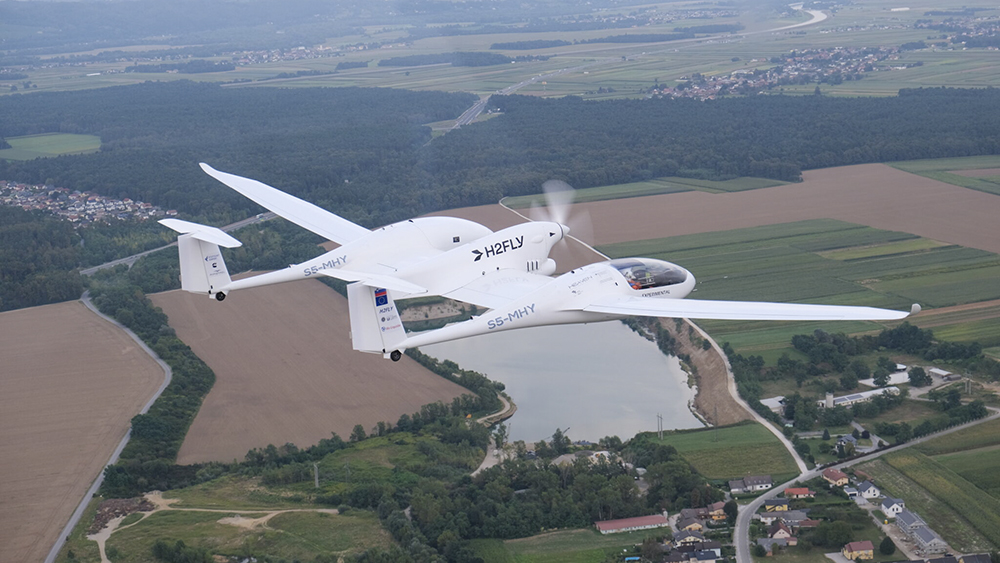
Revolution in the Skies: H2FLY’s Pioneering Liquid Hydrogen-Powered Flight
Energy & EnvironmentBreakthroughs