Construction & InfrastructureInnovation
Early construction works have begun on the Lower Thames Crossing tunnel, a £10.2bn project featuring Europe's largest tunnel boring machine.
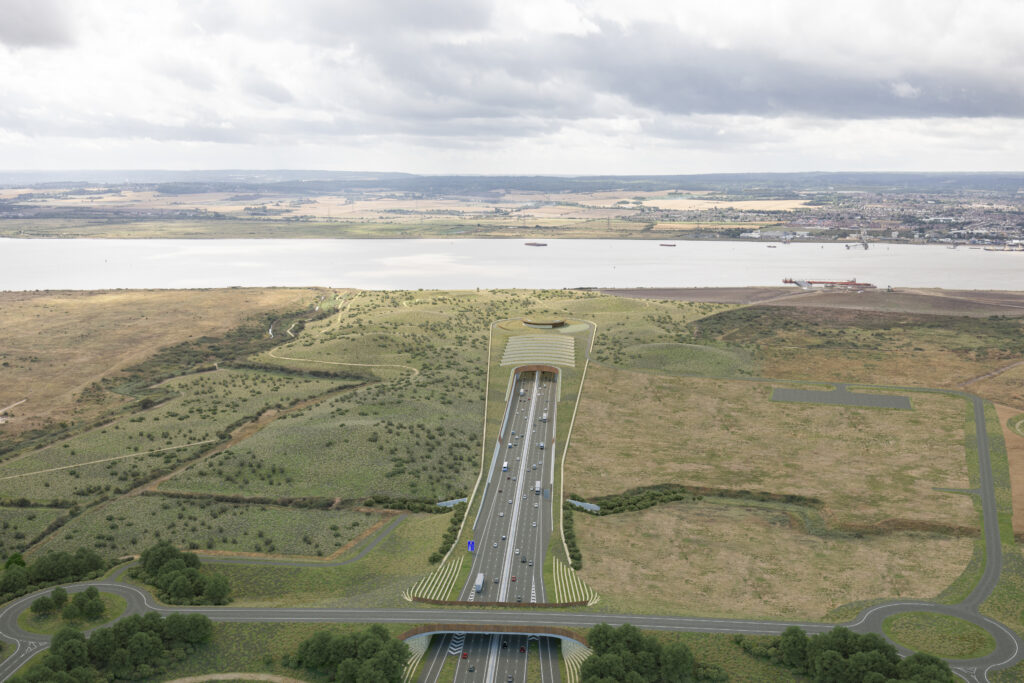
Somewhere beneath the Essex marshland near Coalhouse Fort, a team of about fifty archaeologists is carefully sifting through the dirt. They are there because the largest road infrastructure project in the UK needs to dig a 26-metre-deep shaft in roughly the same spot, and you cannot pour concrete without first recording what is underneath it.
The Lower Thames Crossing tunnel project entered its active construction phase in early 2026, with enabling works now underway on both sides of the River Thames. The scheme, managed by National Highways, will create a new 14.3-mile road link between Kent and Essex, including twin-bore tunnels running 4.2 kilometres beneath the river at a depth of roughly 60 metres. When complete, it will be the longest road tunnel in the UK and, at 16.4 metres in diameter per bore, one of the widest in the world.
The current phase of work is less glamorous than the tunnelling itself, but no less technically demanding. On the Essex side, engineers are preparing the northern tunnel portal site, where the tunnel boring machine will eventually be assembled and launched. This involves constructing a vast launch chamber, essentially a reinforced concrete box sunk 26 metres into the ground, from which the TBM will begin its journey southward beneath the Thames.
Ground conditions at the portal site are, to put it mildly, not straightforward. The geology transitions from alluvial deposits near the surface through layers of London Clay, Lambeth Group clays and sands, and finally into the Chalk that the tunnel will pass through. Each layer behaves differently under load, reacts differently to water, and presents different challenges for excavation. Fresh ground investigations conducted in early 2026 are mapping these layers in detail, because the TBM’s cutting tools, operating pressures, and advance rates will all need to be calibrated to whatever it encounters.
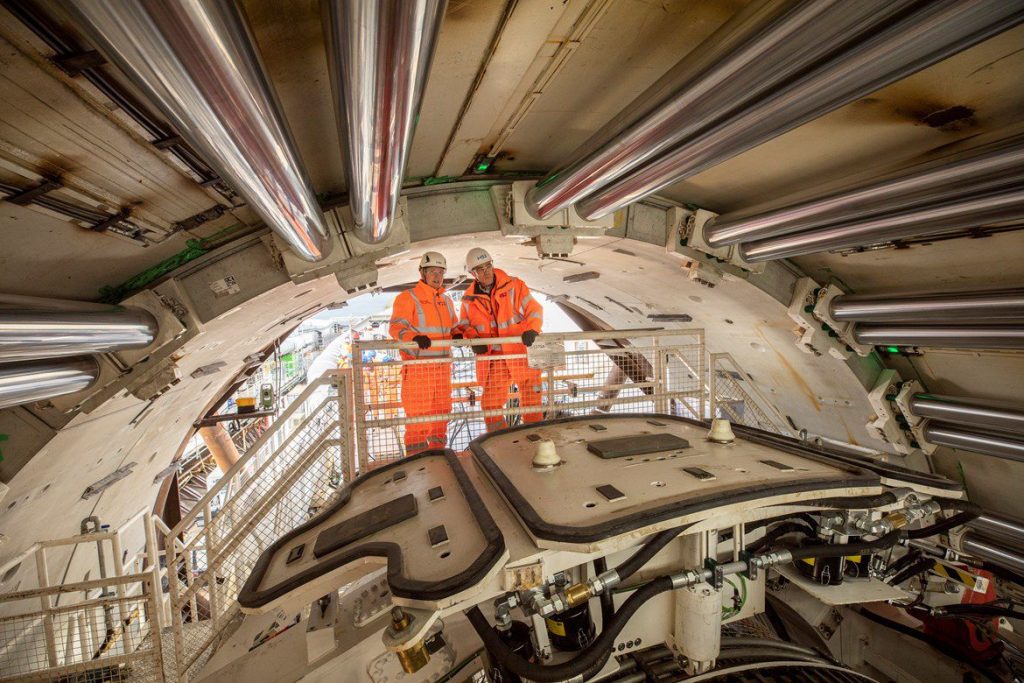
The tunnel boring machine itself has not yet been procured, but the specification is extraordinary. At 16.4 metres in diameter, it will be the largest TBM ever used in Europe and among the largest anywhere on Earth. The machine will be built by the Bouygues Travaux Publics-Murphy joint venture and will weigh approximately 12,000 tonnes. To grasp the scale, the cutterhead alone will be wider than a five-storey building is tall.
Meanwhile, utility diversion works are proceeding across both the Kent and Essex sides of the crossing. Existing gas mains, water pipes, electricity cables, and telecommunications infrastructure all need to be relocated before major earthworks can begin, a process that typically takes longer and costs more than anyone expects, because the records of what was buried where and when are not always what they ought to be.
Engineering deep dive
Tunnel boring machines are among the most complex pieces of engineering equipment ever devised. The machine planned for the Lower Thames Crossing will use an earth pressure balance (EPB) or slurry shield system, depending on the final design selected for the specific ground conditions. Both approaches work on the same principle. A rotating cutterhead at the front of the machine excavates the ground face, while the machine simultaneously installs precast concrete segments behind it to form the permanent tunnel lining.
In an EPB machine, the excavated material is kept in a pressurised chamber behind the cutterhead. This pressure balances the Earth's and water's pressure at the tunnel face, preventing the ground from collapsing inward. A screw conveyor extracts the spoil from the pressure chamber at a controlled rate, maintaining equilibrium. For A-level Maths students, the pressure balance is a direct application of the force-pressure relationship, F = PA, applied across the area of the tunnel face at varying depths.
The precast concrete segments that form the tunnel lining are manufactured in a temporary on-site factory adjacent to the launch chamber. Each ring of the tunnel consists of several curved segments bolted together, and the TBM installs a new ring every few metres of advance. The segments must be manufactured to very tight tolerances, typically within a millimetre, because any misalignment accumulates over the 4.2-kilometre tunnel length. This is precision engineering applied at an infrastructure scale.
The Chalk through which the tunnel will pass is generally a favourable tunnelling medium, being relatively soft and self-supporting over short distances. However, Chalk is not uniform. It contains flint bands, which are extremely hard nodules of silica that can damage cutting tools, and it can contain solution features, voids dissolved out of the rock by groundwater over geological time. Encountering a void unexpectedly can cause sudden ground loss and surface settlement, which is why the advance ground investigation programme is so thorough.
Students studying A-level Geography or Geology will recognise the stratigraphic sequence beneath the Thames Estuary. The London Clay, deposited in a warm, shallow sea roughly 50 million years ago, overlies the Lambeth Group, a variable sequence of clays, silts, sands, and gravels that records fluctuating sea levels during the Palaeocene. Below that sits the Chalk, the remains of countless microscopic marine organisms deposited during the Cretaceous period, around 70 to 100 million years ago. The tunnelling engineers must understand this geological history in intimate detail, because the behaviour of each stratum under pressure and in the presence of water differs markedly.
Ventilation is another significant engineering challenge. A road tunnel of this length requires a longitudinal ventilation system capable of managing air quality during normal operation and extracting smoke in the event of a fire. Jet fans mounted in the tunnel ceiling will push air through the bore, while the tunnel's geometric design, with a slight longitudinal gradient, assists natural airflow. Stringent European standards govern fire safety in long road tunnels, and the Lower Thames Crossing will incorporate fire-rated linings, emergency escape passages connecting the two bores, and automated incident detection systems.
Links to the curriculum: A level, GCSE
Major tunnelling is not expected to begin until 2028, and the crossing itself will not open to traffic until 2034. Between now and then, there is an enormous amount of unglamorous but technically demanding preparatory work. The archaeologists at Coalhouse Fort will finish their dig, the utility diversions will grind forward, and the launch chamber will take shape. Then, one day, a machine the width of a building will start chewing through Chalk beneath the Thames, and the real engineering spectacle will begin.
Credit via newcivilengineer.com
Construction & InfrastructureInnovation
Construction & InfrastructureInnovation
Construction & InfrastructureInnovation

Construction & Infrastructure