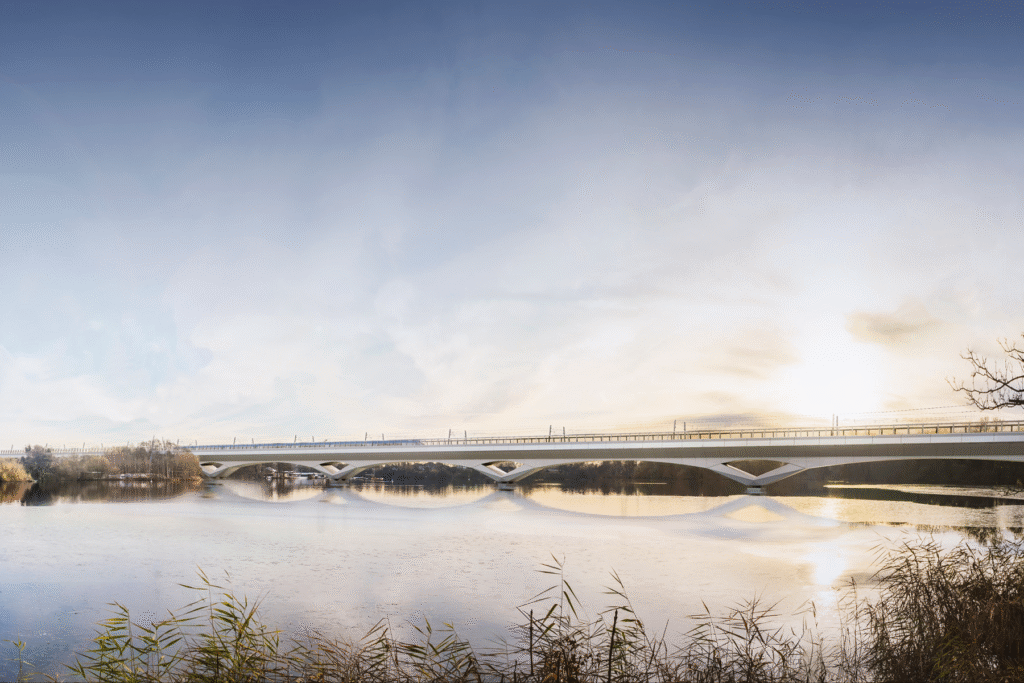
Menai Bridge Engineering Repairs: AeroTruss Platforms Keep Traffic Flowing
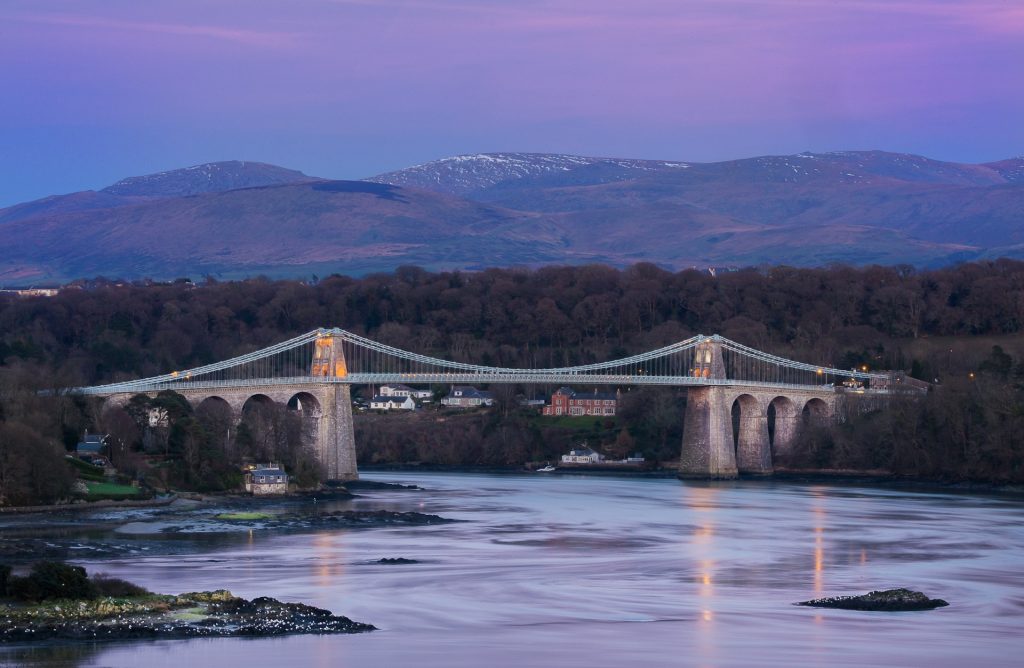
Custom AeroTruss platforms allow engineers to repair the 200-year-old Menai Suspension Bridge from below, avoiding lane closures on this vital Wales-Anglesey link.
Key points
- Spencer Bridge Engineering's AeroTruss platforms provide underdeck access to the Menai Suspension Bridge
- Engineers can inspect and repaint the 200-year-old ironwork without closing lanes to traffic
- Platforms accommodate the bridge's natural movement from wind, traffic, and temperature changes
- Phase 2 maintenance expected to complete April 2027
- A critical crossbeam issue discovered in January 2026 extended the programme timeline
Thomas Telford’s Menai Suspension Bridge opened in 1826. It was one of the world’s first modern suspension bridges, an engineering landmark that connected mainland Wales to the island of Anglesey across a tidal strait. Two centuries later, engineers face a problem Telford never anticipated: how to inspect, strip, and repaint the ironwork of a Grade I-listed bridge while keeping it open to the 8,000 vehicles that cross it daily?
The answer, as reported by New Civil Engineer, involves a custom-designed modular platform system called AeroTruss. Developed by Spencer Bridge Engineering, these lightweight aluminium platforms hang beneath the bridge deck, providing engineers with full access to the underside of the structure without occupying any road space above. It is a solution that sounds obvious only after someone has built it.
The Menai Bridge maintenance programme entered Phase 2 this year, with completion expected in April 2027. Previous approaches required lane closures and traffic management, disrupting communities on both sides of the strait. A 7.5-tonne weight restriction remains in place, but the revised programme has significantly reduced the need for traffic management compared to earlier plans.
Four AeroTruss platforms are now installed on the Menai Suspension Bridge. Two smaller units, every 18 metres by 3 metres, sit below the deck at each tower to provide access to the bearings. Two larger painting platforms work towards each other from the ends of the main span, facilitating grit blasting, steel inspection and repairs, and repainting.
The challenge is that suspension bridges move. Wind, traffic loads, and temperature changes cause the deck to sway, flex, and expand. Any access platform attached to the structure must accommodate that movement without imposing additional loads that could stress the 200-year-old ironwork. The AeroTruss system achieves this through articulated connections and lightweight construction that moves with the bridge rather than against it.
The maintenance itself is painstaking: removing layers of old paint and corrosion through grit blasting, inspecting the exposed iron for cracks or section loss, making repairs where needed, and applying new protective coatings. A critical crossbeam issue discovered in January 2026 extended the programme timeline, demonstrating that even routine maintenance on heritage structures can reveal unexpected engineering challenges.
Engineering deep dive
Maintaining heritage structures under load
The engineering principles at work in the Menai Bridge repairs span structural mechanics, materials science, and construction methodology. For students considering civil or structural engineering, this project illustrates how theoretical knowledge translates into real-world problem-solving.
A suspension bridge works by transferring deck loads through vertical hangers into the main cables, which carry the load in tension to the towers and anchorages. The cables follow a parabolic curve under uniform loading (students encounter this in A-level Mechanics when studying catenary and parabolic curves). Telford's original design used wrought iron chains rather than wire cables, a technology that was state-of-the-art in 1826 but presents specific maintenance challenges today.
Wrought iron corrodes differently from modern steel. It forms a layered corrosion product that can delaminate, causing section loss in unpredictable patterns. Inspection must be thorough and hands-on. Engineers cannot simply measure overall dimensions; they must assess each component for internal delamination, pitting, and fatigue cracking. This is why physical access platforms are essential rather than, for example, drone-based inspection alone.
The AeroTruss platforms themselves demonstrate structural engineering principles. They are essentially lightweight truss structures, in which members carry loads primarily in tension or compression rather than in bending. A truss is more efficient than a solid beam for spanning large distances because material is concentrated along the load paths. Students studying A-level Physics encounter similar concepts when analysing forces in pin-jointed frameworks.
The platforms must satisfy several constraints simultaneously. They must be light enough not to overload the historic structure (the bridge already has a 7.5-tonne weight restriction for traffic). They must span gaps of up to 18 metres between attachment points. They must accommodate the bridge's thermal movement, which can be substantial. Steel expands by approximately 12 micrometres per metre per degree Celsius, and a 170-metre main span can experience temperature variations of 30°C or more over the course of a year, resulting in movement of over 60 mm. The articulated joints in the AeroTruss connections allow this movement without inducing stress in either the platform or the bridge.
Grit blasting, the process used to remove old paint and corrosion, involves projecting abrasive particles at high velocity onto the surface. The choice of abrasive matters: it must be hard enough to remove coatings and corrosion, but must not damage the underlying wrought iron. Containment is also critical on a structure above a tidal strait, an environmentally sensitive marine environment. The enclosed platforms contain the blast debris and old paint, preventing contamination of the waters below.
The protective coating system applied after cleaning must perform for decades in a marine environment, exposed to salt spray, UV exposure, temperature cycling, and the constant vibration of traffic. Modern bridge coating systems typically involve multiple layers: a zinc-rich primer for cathodic protection, an epoxy intermediate coat for barrier protection, and a polyurethane topcoat for UV resistance and aesthetics. The chemistry is well-understood,d but the application must be meticulous. Any defect in the coating system becomes a point of accelerated corrosion.
Heritage engineering adds another dimension. The Menai Bridge is Grade I listed, meaning any work must preserve its historic character. Engineers cannot simply replace components with modern materials without approval. Every intervention must be justified, reversible where possible, and sympathetic to the original design intent. This is engineering with constraints that go beyond pure structural adequacy.
Links to the curriculum: A level, GCSE
The Menai Bridge will celebrate its 200th anniversary next year with fresh paint and a clean bill of structural health. The AeroTruss system has demonstrated that heritage maintenance and minimal public disruption are not mutually exclusive. It requires more engineering thought, not less, but the result is a 200-year-old structure that continues to serve its original purpose while revealing almost nothing of the work happening beneath its deck.
Credit via newcivilengineer.com
Share
Related stories
All Construction & Infrastructure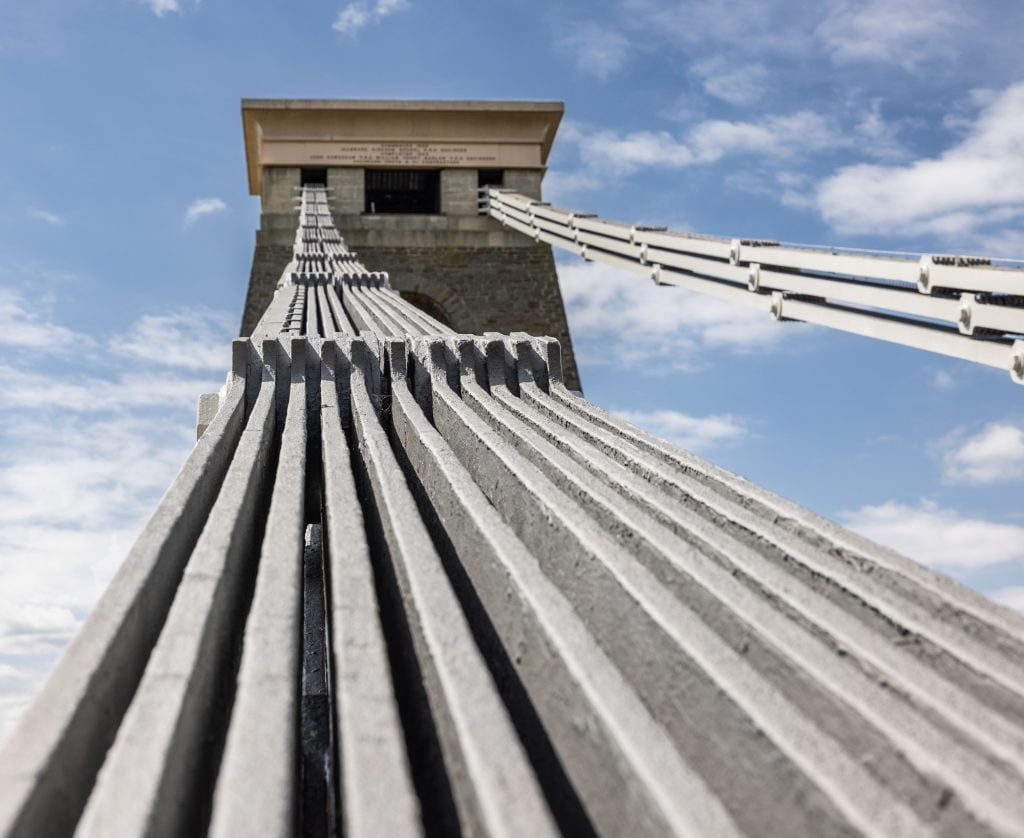
Construction & Infrastructure
Clifton Suspension Bridge Refurbishment: How Engineers Repainted 4,000 Chain Links

Construction & InfrastructureInnovation
Green Hydrogen Construction: Tilbury Hub to Replace 12 Million Litres of Diesel
Construction & Infrastructure