Automotive & Transport
Abu Dhabi's Autonomous Racing League demonstrates breakthrough AI technology as driverless cars lap within 1.5 seconds of human drivers at Yas Marina circuit, showcasing advanced sensor fusion and real-time processing capabilities
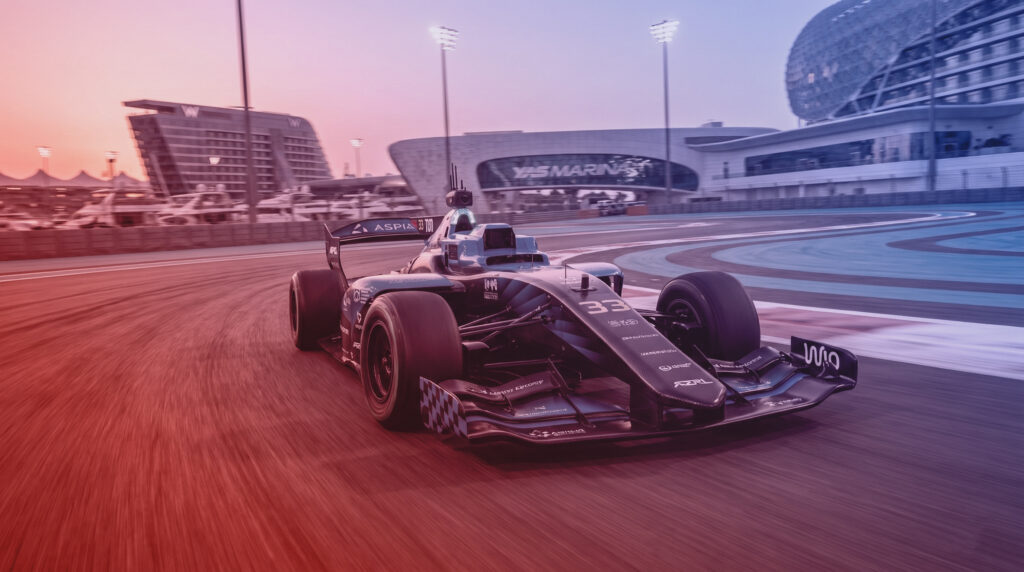
The Abu Dhabi Autonomous Racing League (A2RL) made tremendous strides in autonomous vehicle technology in it's November 2025 race held at Yas Marina Circuit.
For the first time, driverless cars completed laps at least 1.5 seconds faster than those of professional human drivers. This is an extraordinary improvement over the first race held by A2RL eighteen months earlier, when driverless cars trailed behind human drivers by ten seconds per lap.
The A2RL is indicative of the larger engineering issues encountered by autonomous systems. Unlike testing autonomous systems on public roads at relatively slow speeds, racing tests their ability to rapidly process data and make decisions at speeds above 250 km/h. The engineering teams must find ways to integrate sensor fusion, real-time processing, and predictive modelling to ensure that autonomous systems do not exceed the limits of even the most skilled human drivers.
Competitive pressure has accelerated the technological development of the A2RL. Initially, the April 2024 race revealed several fundamental differences between rules-based artificial intelligence and human-based intuitive decision-making. The vehicles had difficulty navigating the course, often turned incorrectly, and lost orientation to the track when GPS signals were interrupted. The failure of these early attempts revealed the limitations of conventional autonomous approaches based on predetermined rules and mapping.
To overcome these limitations, the engineers employed sophisticated sensor arrays comprising seven Sony IMX728 cameras, four ZF Prowave radar units, and three Seyond Falcon Kinetic FK1 lidar systems. This multi-sensor approach generated approximately 500 GB of data per lap. It required advanced data processing capabilities, housed in a ruggedised industrial computer equipped with an Nvidia RTX 6000 Ada graphics card. The total weight of the autonomous stack was approximately 65 kg, which was the same as that of a typical racing driver.
[Panel]
Autonomous Racing Technology Basics
The autonomous systems in racing cars use fundamentally different principles than those of navigation systems in consumer vehicles. Sensor fusion is the primary principle behind these autonomous systems; it merges multiple data sources to develop a comprehensive environmental model. Lidar sensors emit laser pulses and measure distance with millimetre accuracy to create highly detailed three-dimensional maps of the racecourse and adjacent vehicles. The point cloud data from the lidar sensors is updated thousands of times per second, allowing the system to detect slight variations in competitor positions or track conditions.
Visual information from camera systems is essential for detecting track boundaries, debris, and small visual cues that laser-based systems may miss. The seven cameras placed around each vehicle provide the AI with a complete visual representation of its surroundings. Computer vision algorithms process the images in real time to identify objects, estimate distances and predict the movement of adjacent vehicles.
Radar systems add a layer of perception and are helpful in difficult visibility conditions that may hinder optical systems. The four radar units continuously monitor the surroundings, measure the relative velocities of adjacent objects using Doppler-shift analysis, and provide the AI with a wealth of data to support overtaking manoeuvres. The AI’s ability to predict competitors’ positions and future movements in seconds is critical for successful overtaking manoeuvres.
Processing multiple data streams requires specialised hardware architectures. The Nvidia RTX 6000 ADA graphics card uses tens of thousands of parallel processing elements. Engineers utilise the massive number of parallel processing elements to run multiple AI models concurrently: a model focused on path planning, another on predicting competitors’ behaviour, and a final one on optimising vehicle dynamics.
Path planning involves solving complex optimisation problems in milliseconds. Thousands of possible paths are calculated and evaluated against criteria such as speed, safety, and the efficiency of the racing line. Unlike highway driving, where maintaining lane position is sufficient, racing requires constant optimisation of the vehicle’s path through turns, accounting for numerous factors, including tyre temperature, available grip, and aerodynamic effects. Model-predictive control algorithms are employed to simulate multiple future scenarios and select actions that optimise lap time while maintaining adequate safety margins.
The decision to retain internal combustion engines rather than convert to electric powertrains reflects the project team’s engineering considerations. The 4 Piston Racing K20C1 turbocharged engine produces 500 horsepower via well-established mechanical systems, allowing engineers to focus on autonomous control without managing the additional variables presented by electric powertrains.
[Panel]
One of the most significant innovation for the 2025 race included the implementation of a comprehensive set of tools to simulate the Yas Marina circuit. The teams had access to virtual testing environments that accurately represented the Yas Marina circuit, allowing them to complete thousands of virtual laps before arriving at the actual circuit. The simulation-based approach enabled engineers to refine algorithms, test edge cases, and optimise performance parameters without the expense and risk of physical testing.
The simulation environment extends beyond the track’s geometric characteristics. It includes realistic physics models of tyre behaviour, aerodynamics and vehicle dynamics. Engineers can adjust parameters such as track temperature, wind conditions, and tyre wear to prepare their AI systems for different racing scenarios. This simulation-based approach identified subtle interactions between the control algorithms and the vehicle physics that may not have been discovered through limited physical testing.
At the actual race, the autonomous systems demonstrated sophisticated tactical awareness. The TUM winning team successfully executed complex overtaking manoeuvres and strategic decisions regarding when to deploy additional power through the push-to-pass system. These abilities were the result of machine learning algorithms trained on large amounts of racing data, learning patterns and strategies that even the most experienced human drivers may not consciously recognise.
The dramatic collision that decided the race surprisingly validated advances in autonomous technology. When a retiring vehicle unexpectedly remained on the track at a significantly lower speed than usual, the leading autonomous vehicles responded immediately. One vehicle attempted an evasive manoeuvre, while the other found an opening on the inside line, responses that reflect human racing instincts developed over years of experience. Although the evasive manoeuvre caused damage and forced the vehicle out of the race, the incident demonstrated that autonomous systems can respond to unexpected, dynamic events not present in their training data.
The technologies developed for A2RL provide value beyond the circuit. Real-time sensor fusion and decision-making algorithms developed for racing can improve safety systems in consumer vehicles by enabling vehicles to respond to unexpected obstacles or hazardous road conditions faster than humans can. The ability of these systems to process 500 GB of data per lap and react in milliseconds can provide insights for autonomous systems operating in complex urban environments.
If autonomous racing technology continues to advance at its current rate, engineers may be able to develop autonomous racing systems that match human performance in just a few development cycles. Achieving human-level performance will likely require addressing the remaining challenges in intuitive decision-making and developing AI systems that can replicate human creative problem-solving to identify opportunities to pass or take advantage of competitors’ weaknesses. The processing capabilities required to accomplish this will present significant engineering challenges since existing systems are near the limit of what is currently available.
The carbon-fibre chassis and bodywork construction methods used can be applied to the design of consumer vehicles. The carbon sandwich structure with aluminium honeycomb core provides an excellent strength-to-weight ratio and the necessary stiffness for precise control at high speeds. The manufacturing techniques utilised in these racing vehicles to achieve this level of performance can be adapted to produce lighter and more fuel-efficient consumer vehicles.
The strategy of investing in A2RL as part of its economic diversification represents a model for technology development through competitive platforms. By utilising a competitive racing format to develop autonomous vehicle technology, the UAE can generate public interest in autonomous vehicle development while driving innovation through competition. This competitive format enables engineers to develop practical solutions to engineering challenges under extreme conditions and to identify breakthroughs that benefit everyday transportation.
As these autonomous systems continue to evolve, the engineering community will need to address fundamental questions related to the human-machine interface, safety validation, and performance optimisation. The success of the autonomous systems at Yas Marina circuit suggests that autonomous vehicles will eventually be capable of performing at the level of human performance in even the most challenging driving environments. However, achieving this objective will require further improvements in sensor technology, processing capabilities, and algorithmic complexity.
Credit via eandt.theiet.org
Automotive & Transport
Automotive & Transport
Automotive & Transport
Aerospace, Defence & Marine