Energy & EnvironmentInnovation
The UK government has set out Fusion Futures, a programme of up to £650 million to 2027 that will fund new fusion research facilities and train over 2,200 people in the next five years.

The UK government has announced a major new £650 million research programme to accelerate the development of fusion energy technology and training for specialists in this burgeoning field.[1][2]
Dubbed Fusion Futures,[3] the programme takes total government investment in fusion to over £1.4 billion since 2021.[4] The substantial funding will facilitate the construction of cutting-edge facilities, the growth of critical technologies, and expanded collaboration between academia and industry.
Fusion energy has long tantalised the scientific community with its potential as a limitless, low-carbon energy source. The process involves fusing atomic nuclei to release enormous amounts of energy, the same reaction that powers stars. While operational fusion power stations remain decades away, recent progress has provided hope that this technology could one day significantly decarbonise the world’s electricity system.
The Fusion Futures programme focuses investment on several key areas to accelerate real-world progress:
Support for the Spherical Tokamak for Energy Production (STEP) prototype plant – The plant will be built at West Burton in Nottinghamshire,[5] and the package includes up to £11 million to support the STEP programme.[6] With the ambitious goal of demonstrating net electricity generation from fusion by 2040,[7] STEP will be a pivotal facility for testing and validating fusion performance at the scale required for a power plant. A concept design is due by 2024, with construction planned for the early 2030s.[8][9]
Expansion of fusion technology facilities at the UK Atomic Energy Agency – Additional infrastructure will allow faster development of critical innovations needed to enable fusion energy, including robotics, advanced materials, remote handling, and processes for breeding tritium fuel.[10]
Growth of the UK’s private fusion industry – By strengthening collaboration between companies and research institutions, the UK aims to solidify its position as a global leader in fusion technology. The funding will drive public-private partnerships and attract venture capital.
Providing fusion skills training: The programme includes up to £55 million to train over 2,200 people through apprenticeships, master’s courses, PhDs and fellowships related to fusion science and technology.[11][12] This will build a pipeline of talented individuals that can propel ongoing fusion research.
While fusion remains a highly complex scientific and engineering challenge, the Fusion Futures programme represents a confidence boost for the field’s ongoing efforts. By marshalling substantial financial resources and coordinated support, the UK government aims to drive tangible progress in fusion technology while growing its specialised workforce.
Fusion energy aims to replicate the process by which stars produce energy – fusing light atomic nuclei to form heavier nuclei, releasing massive amounts of power. Earth’s primary fusion fuel sources are two isotopes, hydrogen-deuterium and tritium. When these fuse, the result is helium and a neutron.[13][14] This reaction requires incredibly high temperatures and pressures to overcome the strong electrostatic repulsion between positively charged nuclei.
The promise of fusion comes from these light element fuels being abundant, and fusion reactions release exponentially more energy than fission reactions. The challenge is confining the unstable fusion plasma at temperatures over 100 million degrees Celsius[15][16] and overcoming various instabilities. While small-scale fusion reactions have been achieved in experimental settings, creating a net energy gain from a sustained response remains a monumental engineering challenge.
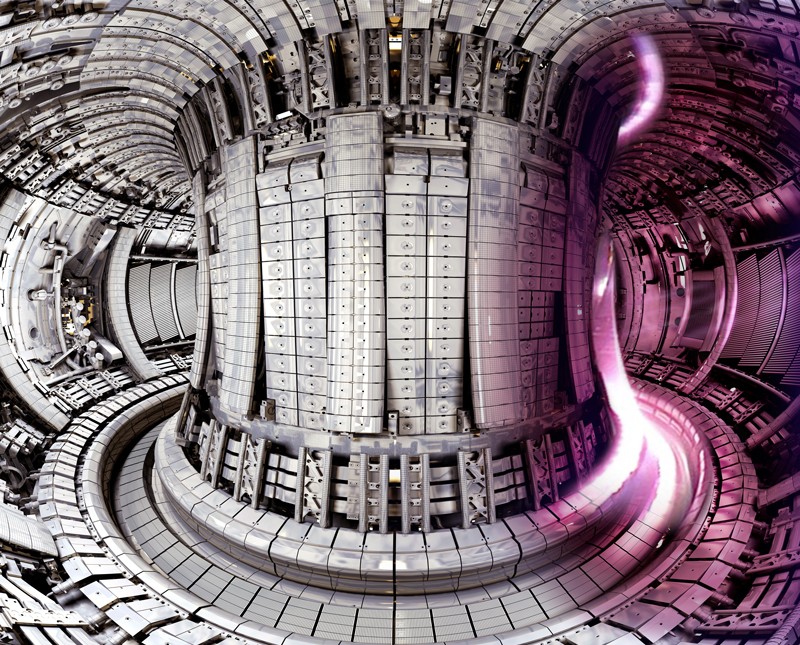
Currently, leading fusion experiments use donut-shaped devices called tokamaks, which use powerful magnetic fields to contain the reactive plasma. The STEP prototype under development builds on the spherical tokamak design, which provides more efficient magnetic confinement in a more compact device relative to early tokamak designs.
With decades of research already invested in fusion science, experts hope this new infusion of resources from the UK government can provide the boost needed to produce meaningful breakthroughs in the coming years. More progress is still required in plasma control systems, materials science, and fuel cycles.
The UK government has said “the potential of fusion is enormous”,[17] offering sustainable, safe, low-carbon electricity if it can be harnessed. This carbon-free power, derived from seawater, could play a significant role in the country’s legally binding commitment to achieve net zero emissions by 2050.[18]
With many renewable energy sources like wind and solar facing significant limitations around intermittency and storage, fusion could provide constant baseline energy without generating direct carbon emissions. It could complement and support an overall decarbonised energy system if successfully implemented.
Of course, significant work remains to demonstrate that fusion can work reliably at commercial scales and within viable economic constraints. But the possibility is tantalising to both scientists and climate policymakers alike. The Fusion Futures programme aims to meaningfully advance the readiness of fusion technology, bringing it closer to becoming a practical carbon-free energy solution one day.
While more research, development, and investment lie ahead, announcing such substantial funding indicates that political leaders view fusion as steadily moving towards that goal. The possibilities for a fusion-powered future remain bright with the right resources and focus. The UK has committed to leading in making it a reality.
Credit via gov.uk
Thousands of new training places created as part of £650 million fusion package
Nuclear Minister Andrew Bowie set out details of the new £650 million Fusion Futures Programme
Checked 25 November 2026
Government announces up to £650 million for UK alternatives to Euratom R&T
To deliver this package the government plans to invest up to £650 million until 2027, subject to business case approvals.
Checked 25 November 2026
Towards fusion energy 2023: the next stage of the UK’s fusion energy strategy
The Fusion Futures programme represents up to £650 million of new investment, subject to business case approval, between now and 2027 on top of the existing fusion programmes.
Checked 25 November 2026
Thousands of new training places created as part of £650 million fusion package
the £650 million spending outlined today taking the total government investment in fusion to over £1.4 billion since 2021
Checked 25 November 2026
West Burton selected as home of STEP fusion plant
The UK Government has confirmed the West Burton power station site in North Nottinghamshire will be home to the ground-breaking STEP prototype fusion energy plant.
Checked 25 November 2026
Thousands of new training places created as part of £650 million fusion package
to further support the STEP programme and upskill UK industry to help deliver it
Checked 25 November 2026
Towards fusion energy 2023: the next stage of the UK’s fusion energy strategy
the STEP Programme will design, develop and build, by 2040, a prototype fusion power plant capable of delivering net energy
Checked 25 November 2026
Site of UK’s first fusion energy plant selected
£220 million of funding for the first phase of STEP, which will see the UK Atomic Energy Authority produce a concept design by 2024.
Checked 25 November 2026
We are working towards getting permissions and consents in place for construction to start in the early 2030s.
Checked 25 November 2026
Thousands of new training places created as part of £650 million fusion package
up to £200 million for a Fuel Cycle Testing Facility, to develop technology in breeding fuel for fusion power plants
Checked 25 November 2026
Thousands of new training places created as part of £650 million fusion package
up to £55 million for a Fusion Skills Programme, to train over 2,200 people over the next 5 years by working with business and universities to expand fusion training programmes
Checked 25 November 2026
Towards fusion energy 2023: the next stage of the UK’s fusion energy strategy
universities to increase the number of fusion postgraduate and PhDs and international partners to increase post-doctoral opportunities
Checked 25 November 2026
Towards fusion energy 2023: the next stage of the UK’s fusion energy strategy
This creates a helium nucleus and a highly energetic free neutron, whose energy can be harnessed to produce heat and electricity.
Checked 25 November 2026
to around 150 million degrees centigrade, 10 times hotter than the core of the Sun
Checked 25 November 2026
Towards fusion energy 2023: the next stage of the UK’s fusion energy strategy
The potential of fusion is enormous and now is the time to commit and invest in this historic opportunity to lead the global mission in fusion.
Checked 25 November 2026
UK becomes first major economy to pass net zero emissions law
The target will require the UK to bring all greenhouse gas emissions to net zero by 2050
Checked 25 November 2026
Energy & EnvironmentInnovation

Automotive & Transport

Energy & EnvironmentBreakthroughs