Aerospace, Defence & Marine
Heavy-lift cargo drones carried 2,030 solar panels onto the roof of Bentley's new Paint Shop in Crewe, because the roof could not take full pallets. Here is how it worked, the physics of small loads, and the jobs behind it.
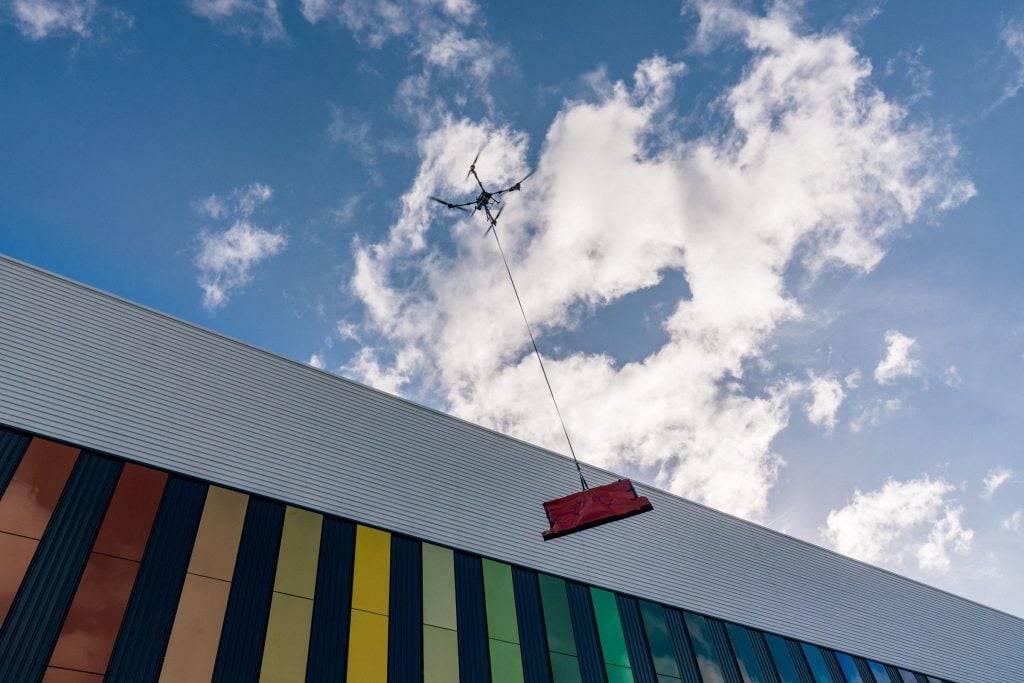
If you looked up at Bentley’s new Paint Shop in Crewe this autumn, you might have seen a solar panel flying by. Instead of hanging from a crane, it was carried in a red bag under a drone, moving past the building’s striped wall up to the roof.
On 23 November, Bentley Motors announced that this was one of the first UK rooftop solar installations using drones.[1] Push Power, together with Finlight, installed a 2.8 MW solar array across four Paint Shop roofs with 515-watt panels.[2] Heavy-lift cargo drones moved 2,030 of these panels, each about 30 kg, to the roof, bringing the site’s total to over 35,000 panels.[3] Construction Enquirer reported the total lifted load as 55 tonnes.[4] No matter how you count it, that’s a lot of glass and aluminium to move onto a roof.
The reason comes down to the roof. The panels were delivered in pallets of 36, each weighing nearly a tonne. The roof couldn’t support the weight of a full pallet, so they couldn’t set them down. Using a crane, the pallet would have to stay suspended while installers unloaded each 27.3 kg panel by hand.[5]
So the team changed their approach. Rather than making a few large, heavy deliveries, they made hundreds of smaller ones. The drone flew back and forth between the ground loading area and the roof, carrying two panels each time.[6] AutoSpray Systems handled the flying, with lifts reaching over 20 metres high.[7][8]
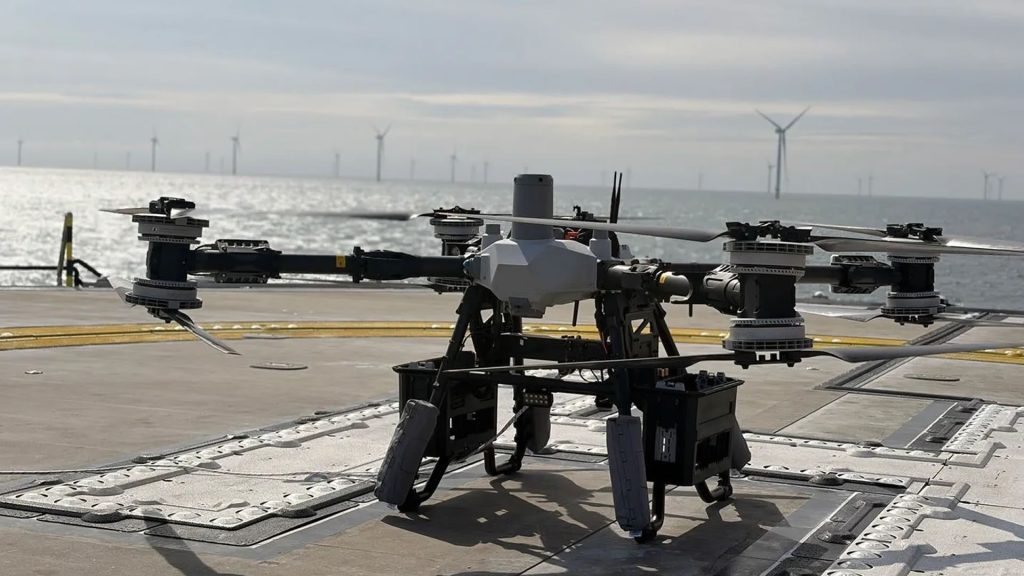
They used an XAG P150 Max, a drone originally made for farms. With a sling module, XAG says it can lift up to 80 kilograms, which is more than enough for two panels.[9] Bentley reports that the drones placed about one panel per minute, so the rooftop lifting was done in just over a week.[10] This method cut installation time by more than half compared to the usual way and meant they didn’t need fuel-powered telehandlers to move panels to the roof.[11][12]
Andrew Sproson, co-founder and chief operating officer of AutoSpray Systems, said: “What makes this project particularly interesting is that the drone wasn’t simply replacing a crane.”[13] The building’s loading restrictions, he explained, “presented a genuine logistical challenge, and the drone provided a practical solution by delivering panels in manageable quantities directly to the installation team.”[14]
Andy Khan, managing director of Push Power, called it “a faster, safer, cleaner and more efficient way to position rooftop PV panels”.[15]
This solar array is part of a bigger effort at the Crewe factory. LRQA has independently confirmed that Bentley’s UK operations will be carbon neutral for 2025 under ISO 14068-1.[16] Bentley also says its Scope 1 and 2 emissions dropped by 89 percent from 2018 to 2025.[17]
Engineering deep dive
Start with the problem. A pallet of 36 panels weighs close to 1,000 kg. Its weight is W = mg = 1,000 × 9.81 ≈ 9,800 N, about the weight of a small car, all arriving on one patch of roof.
Take a pallet footprint of 2.3 m by 1.2 m (an assumption, roughly the size of one panel). The area is 2.3 × 1.2 = 2.76 m², so the average pressure is:
p = F / A = 9,800 / 2.76 ≈ 3,600 Pa, or 3.6 kPa
Now the drone's load: two panels of 27.3 kg, so 54.6 kg. Its weight is 54.6 × 9.81 ≈ 540 N. Spread over the same footprint that is about 195 Pa, roughly 18 times less. Installers can then lay each panel on the frame where it belongs, so the load is shared across the roof instead of piling up in one place.
How much work did the drones do? Lifting one 30 kg panel 20 metres takes:
E = mgh = 30 × 9.81 × 20 ≈ 5,900 J
For all 2,030 panels that is about 12 MJ. Divide by 3,600,000 J per kWh and you get roughly 3.3 kWh. At full sun the 2.8 MW array would make 3.3 kWh in 3.3 ÷ 2,800 hours, which is about 4 seconds. In practice a drone burns far more energy than this, because it has to keep pushing air downwards just to hover, but it shows how little energy the lifting itself needs.
A check on the numbers. 2,030 panels at one a minute is 2,030 minutes, or about 34 hours of flying, which fits "just over a week" of shifts. Also, 2.8 MW divided by 515 W per panel is about 5,400 panels, so the sums suggest the drones lifted a share of the array rather than all of it. The release does not say how the rest went up.
Pressure, weight and energy are core A-level Physics. Our guide to how studying Physics A-level prepares you for engineering shows where these ideas lead.
Links to the curriculum: A level, GCSE
Cargo drones won’t be replacing cranes anytime soon. Weather, battery life, and the weight of materials like steel beams all limit what drones can do, and every flight over a work site needs careful planning. Still, for light, repeated loads on roofs that can’t handle much weight, this project shows that drones can be a useful tool in construction.
Behind this are drone pilots who plan and fly every lift, solar installers and electrical engineers who wire the array into the factory, and structural engineers who work out how much load a roof can safely carry. Our guide to getting started in electrical engineering explains the subjects and routes into that side of the job, and many installers and technicians begin with an apprenticeship, as our beginner’s guide to finding an engineering apprenticeship shows. If you are still choosing, our explainer on the main types of engineering shows where each of these roles fits.
Credit via bentleymedia.com
Amongst the first UK drone-lifted rooftop solar installation
Checked 24 November 2026
Delivered by Push Power Limited in partnership with Finlight, the 2.8 MW rooftop installation covers four rooftops and comprises 515-watt JA Solar panels.
Checked 24 November 2026
A total of 2,030 panels were lifted to roof level, bringing the site total lto over 35,000, using XAG P150 Max cargo drones, with each panel weighing approximately 30 kg.
Checked 24 November 2026
Heavy-lift drones deliver 55 tonnes of solar panels to live site
More than 2,000 solar panels weighing a total of 55 tonnes have been lifted directly onto the roof of a live construction site by heavy-lift commercial cargo drones.
Checked 24 November 2026
Heavy-lift drones deliver 55 tonnes of solar panels to live site
Under traditional crane lifting, a pallet would have had to remain suspended while installation crews manually unloaded each 27.3 kg panel.
Checked 24 November 2026
Heavy-lift drones deliver 55 tonnes of solar panels to live site
Instead, the drone operated a high-frequency, just-in-time shuttle between a controlled ground loading zone and a designated rooftop receiving area transferring two panels per flight.
Checked 24 November 2026
Heavy-lift drones deliver 55 tonnes of solar panels to live site
The flight operations were managed by AutoSpray Systems.
Checked 24 November 2026
Push Power Ltd pioneers use of cargo drones to install Solar PV Rooftop Array at Bentley Motors
at a height of more than 20 meters
Checked 24 November 2026
XAG’s New P150 Max Agricultural Drone Sets a Higher Bar for Autonomous Operation
When fitted with the RevoSling Module, the P150 Max becomes a transport platform capable of carrying up to 80 kilograms of farm inputs, tools, or produce across rough or flooded ground.
Checked 24 November 2026
The drones positioned approximately one panel per minute, enabling the rooftop lifting activity to be completed in just over one week.
Checked 24 November 2026
The use of cargo drones more than halved the installation time compared with the conventional approach, allowing a direct decant to each installation position.
Checked 24 November 2026
removed the need for fuel-powered telehandlers to move panels to roof level, reducing construction-vehicle emissions during this stage of the project.
Checked 24 November 2026
Heavy-lift drones deliver 55 tonnes of solar panels to live site
What makes this project particularly interesting is that the drone wasn't simply replacing a crane.
Checked 24 November 2026
Heavy-lift drones deliver 55 tonnes of solar panels to live site
The building's structural loading restrictions presented a genuine logistical challenge, and the drone provided a practical solution by delivering panels in manageable quantities directly to the installation team.
Checked 24 November 2026
Devising this new technique of using cargo drones as a faster, safer, cleaner and more efficient way to position rooftop PV panels, we were eager to implement this at the Bentley Motors site, and we're very satisfied with the results.
Checked 24 November 2026
Bentley's UK operations have been independently verified by LRQA in accordance with ISO 14068-1:2023 Climate Change Management – Transition to Net Zero – Part 1: Carbon Neutrality for the 2025 calendar year.
Checked 24 November 2026
Bentley reduced its directly comparable Scope 1 and Scope 2 emissions from 17,482 tonnes CO₂e in 2018 to 1,907 tonnes in 2025, an absolute reduction of 89 per cent.
Checked 24 November 2026
Aerospace, Defence & Marine

Aerospace, Defence & Marine
Energy & EnvironmentBreakthroughs

Construction & Infrastructure