Aerospace, Defence & Marine
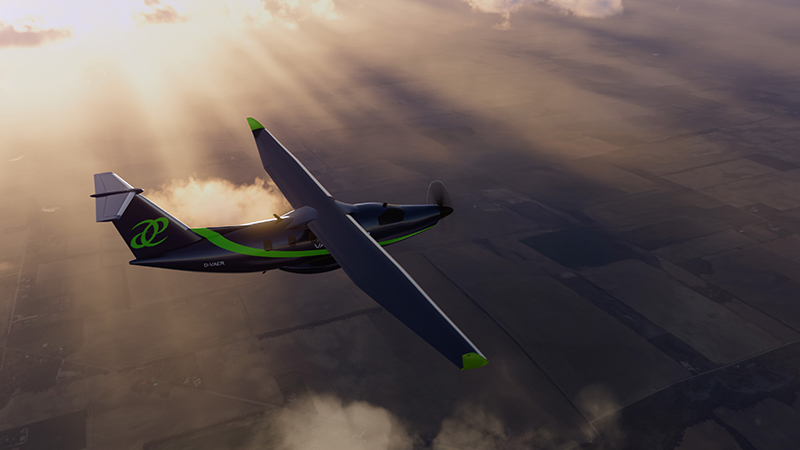
Munich-based Vaeridion has secured Belgian operator ASL Group as the launch customer for its nine-seat electric Microliner, while simultaneously acquiring Lilium’s former battery manufacturing facility at Oberpfaffenhofen airport. The dual announcements at the Paris Air Show signal acceleration in the company’s push toward first flight in late 2027 and type certification before 2030.
The Microliner employs an unconventional propulsion architecture, featuring multiple electric motors that drive a single propeller through a standard gearbox. This configuration differs from the distributed propulsion systems seen on most electric aircraft prototypes, where motors power individual propellers along the wing.
Chief technology officer Markus Kochs-Kämper explained the safety advantages at the Paris Air Show. “If we lose one engine, we have no asymmetry, we have no yaw moment. That means the pilot will hardly realise,” he said. The aircraft would experience a 20- to 40-per cent power reduction but maintain a sufficient climb rate. “This is the first time when an engine failure becomes a minor event.”
The design philosophy extends to component sourcing, with Vaeridion using off-the-shelf parts where possible to accelerate certification. The company aims for its first flight in December 2027 to utilise a certifiable design that meets European Union Aviation Safety Agency (EASA) standards, potentially shortening the path to commercial deployment.
Battery placement follows conventional aircraft fuel storage principles, with cells housed in the wings rather than the fuselage. “If you have the batteries in the belly or in the fuselage, and you have a gear-up landing, you have crash-worthiness issues,” Kochs-Kämper noted. The configuration utilises cylindrical cells, combined with a custom battery management system and high-temperature packaging developed by an R&D head with experience in the space sector.
ASL Group’s order for 10 aircraft positions them as the first commercial operator, initially targeting business travellers before expanding to leisure flights and scheduled services. Chief commercial officer Taco Stouten highlighted regulatory advantages: “If you look at the airport regulations, all the slots and all the restrictions… it is based on those two factors-how much noise do you make as an aircraft, and how much do you pollute? Well, we pollute zero and our noise is-for an aircraft this size-eight times lower.”
The partnership network extends to component suppliers. Evolito will provide high-performance electric motors, while MT-Propeller Entwicklung supplies its seven-blade “Silent 7” composite propeller system. The Netherlands Aerospace Centre (NLR) signed a memorandum of understanding to support flight testing, systems validation and regulatory compliance.
The acquisition of Lilium’s battery facility includes both the building and key industrialisation assets from the defunct company’s insolvency administrator. Vaeridion states the facility will be operational from 2026, supporting initial flight-test campaigns. Combined with assets previously purchased from Rolls-Royce Electrical, the company has established research, development, and low-rate initial production capabilities that cover the entire propulsion system.
Engineering deep dive
The Microliner's propulsion system represents a distinct approach to electric aircraft redundancy. Unlike distributed electric propulsion (DEP) systems that use multiple motors with individual propellers, Vaeridion's configuration channels power from multiple motors through a standard reduction gearbox to drive a single propeller.
This architecture exploits fundamental characteristics of electric motors. Electric motors deliver maximum torque from zero rpm, unlike turbine engines, which require a period of time to reach full speed. Multiple motors can share load through mechanical coupling, with torque contribution from each motor controlled electronically. If one motor fails, the remaining units can increase output within milliseconds, maintaining total shaft power with minimal transient effects.
The single-propeller configuration eliminates asymmetric thrust concerns inherent in distributed systems. In conventional twin-engine aircraft or DEP configurations, motor failure creates yaw moments requiring immediate pilot correction. The magnitude depends on the distance of the failed motor from the aircraft's centerline. Vaeridion's centralised thrust vector remains aligned with the longitudinal axis regardless of individual motor status.
Mechanical complexity shifts from aerodynamic surfaces to the gearbox. The reduction unit must handle variable input configurations while maintaining the integrity of the output shaft. Planetary gear systems offer natural load-sharing capabilities, with multiple sun gears driven by individual motors feeding a standard ring gear. Clutch mechanisms can isolate failed motors to prevent drag losses.
Wing-mounted battery placement addresses multiple engineering constraints. Structural considerations favour distributing mass along the span, reducing wing root bending moments compared to fuselage-mounted configurations. The wing structure provides natural cooling surfaces, with airflow over wing skins assisting thermal management.
Cylindrical cells offer advantages in fault propagation resistance. Unlike pouch or prismatic cells, cylindrical formats include internal pressure relief mechanisms. Cell-to-cell thermal barriers prevent cascading failures, which are critical for maintaining aviation safety standards. The space sector heritage mentioned suggests the adoption of screening protocols and quality control measures from satellite battery systems.
High-temperature packaging indicates active thermal management, which exceeds passive cooling. Phase change materials or liquid cooling circuits maintain optimal cell temperatures during high discharge rates. Battery management systems must balance individual cell voltages while monitoring temperature gradients across the pack.
Using off-the-shelf components accelerates certification through similarity credit. EASA's Special Condition for Electric/Hybrid Propulsion Systems (SC-E-19) requires demonstration of continued safe flight after single failures. The multi-motor architecture inherently satisfies this requirement without complex flight control augmentation.
Noise reduction stems from propeller tip speed and blade passage frequency. The seven-blade configuration reduces blade loading, allowing for lower rotational speeds while maintaining equivalent thrust. Electric motors eliminate the noise associated with combustion and mechanical transmission harmonics typically found in turboprops. The claimed eight-fold noise reduction positions the aircraft below current airport restriction thresholds.
The 400-kilometre range, with an 80-kilometre diversion and 30-minute loiter reserve, reflects conservative energy management. Current lithium-ion technology achieves 250-300 watt-hours per kilogram at the pack level. For a nine-seat aircraft requiring approximately 500 kilowatts of cruise power, the stated range implies a battery pack mass of around 1,500 kilograms, which is consistent with the structural limits for this aircraft category.
If the certification timeline holds, Vaeridion would enter service alongside several competing electric aircraft programs. The nine-seat capacity targets a specific market segment between four-seat trainers and 19-seat commuters. ASL Group's executive aviation focus suggests initial operations will avoid direct competition with scheduled carriers.
European airports increasingly restrict operations based on emissions and noise metrics. Electric aircraft could access slots that are unavailable to conventional turboprops, particularly during nighttime hours or at urban airports. The regulatory framework continues to evolve, with the EASA developing specific certification standards for electric propulsion systems.
The company's market advisory committee comprises operators, lessors, and service providers, including Aero-Dienst, Cirium, Copenhagen Air Taxi, CPH Helicopters, IBA, KLM Royal Dutch Airlines, MBA, Monte, and TrueNoord, alongside launch customer ASL Group. This stakeholder engagement suggests a focus on operational requirements beyond pure technical development.
The 2026 battery facility activation precedes the first flight by approximately 18 months, allowing cell procurement, pack assembly and testing cycles. The Oberpfaffenhofen location provides proximity to Munich's aerospace cluster while utilising existing aviation infrastructure.
Achieving type certification by 2030 requires demonstrating reliability levels comparable to those of conventional aircraft. Electric propulsion systems lack the operational history of turbine engines, necessitating extensive ground testing and accelerated life cycling. Battery degradation models must account for aviation duty cycles, including rapid charge-discharge events and temperature extremes.
If development proceeds as planned, the Microliner could validate electric propulsion for commercial aviation in the sub-10-seat category. Success would depend on achieving promised operational costs, maintenance intervals and dispatch reliability. The multi-motor single-propeller architecture offers a pragmatic compromise between redundancy requirements and system complexity, potentially accelerating the certification pathway compared to more radical configurations.
Links to the curriculum: A level, GCSE
If the certification timeline holds, Vaeridion would enter service alongside several competing electric aircraft programs. The nine-seat capacity targets a specific market segment between four-seat trainers and 19-seat commuters. ASL Group’s executive aviation focus suggests initial operations will avoid direct competition with scheduled carriers.
European airports increasingly restrict operations based on emissions and noise metrics. Electric aircraft could access slots that are unavailable to conventional turboprops, particularly during nighttime hours or at urban airports. The regulatory framework continues to evolve, with the EASA developing specific certification standards for electric propulsion systems.
The company’s market advisory committee comprises operators, lessors, and service providers, including Aero-Dienst, Cirium, Copenhagen Air Taxi, CPH Helicopters, IBA, KLM Royal Dutch Airlines, MBA, Monte, and TrueNoord, alongside launch customer ASL Group. This stakeholder engagement suggests a focus on operational requirements beyond pure technical development.
The 2026 battery facility activation precedes the first flight by approximately 18 months, allowing cell procurement, pack assembly and testing cycles. The Oberpfaffenhofen location provides proximity to Munich’s aerospace cluster while utilising existing aviation infrastructure.
Achieving type certification by 2030 requires demonstrating reliability levels comparable to those of conventional aircraft. Electric propulsion systems lack the operational history of turbine engines, necessitating extensive ground testing and accelerated life cycling. Battery degradation models must account for aviation duty cycles, including rapid charge-discharge events and temperature extremes.
If development proceeds as planned, the Microliner could validate electric propulsion for commercial aviation in the sub-10-seat category. Success would depend on achieving promised operational costs, maintenance intervals and dispatch reliability. The multi-motor single-propeller architecture offers a pragmatic compromise between redundancy requirements and system complexity, potentially accelerating the certification pathway compared to more radical configurations.
Credit via imeche.org
Aerospace, Defence & Marine
Aerospace, Defence & MarineBreakthroughs
Automotive & Transport
Aerospace, Defence & Marine