Energy & EnvironmentInnovation
Rolls-Royce SMR selects Škoda JS and Doosan Enerbility to manufacture reactor pressure vessels for Britain's first small modular reactors at Wylfa, Wales.
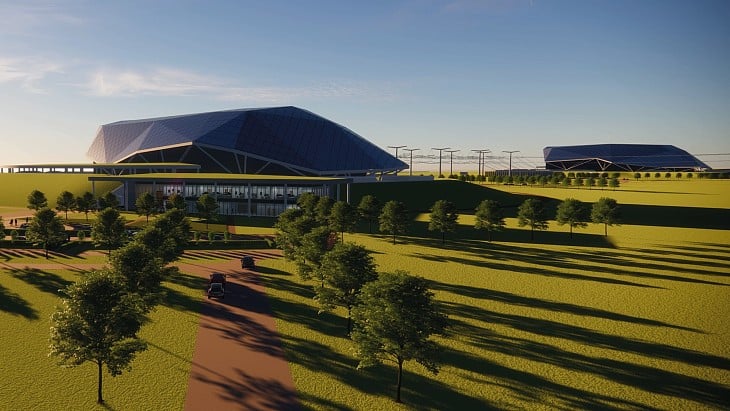
On 28 May 2026, Rolls-Royce SMR announced that it had selected two companies to manufacture the reactor pressure vessels for Britain’s first small modular reactors: Škoda JS of the Czech Republic and Doosan Enerbility of South Korea.
It sounds like unexciting news. It is actually the moment a theoretical nuclear programme became a manufacturing programme. Reactor pressure vessels are the single most critical component in a nuclear power station. As reported by World Nuclear News, the selection of suppliers signals that design finalisation, manufacturing readiness, and delivery timelines are now real commitments rather than aspirations.
The Rolls-Royce small modular reactor is a 470-megawatt pressurised water reactor designed to be built in factory conditions. 90% of the SMR, which measures approximately 16 metres by 4 metres, will be manufactured off-site as prefabricated, pre-tested modules. On-site work is limited primarily to assembly. The first three units will be built at Wylfa on the coast of Anglesey in North Wales, with power delivery to the grid targeted for the mid-2030s.

Ruth Todd, Rolls-Royce SMR’s Operations and Supply Chain Director, described the dual-supplier approach as essential for reducing project risk and ensuring delivery certainty. Both Škoda JS and Doosan Enerbility have long records of delivering reactor pressure vessels for nuclear plants already operating worldwide. Doosan manufactures these components at its Changwon, South Korea, facility, which holds certifications from multiple international nuclear regulators.
The broader context is significant. The UK Government signed a landmark contract with Rolls-Royce SMR through Great British Energy, Nuclear, in April 2026, enabling immediate design and delivery work. The first project is expected to support around 3,000 jobs at peak construction, with thousands more across the supply chain. ČEZ, the Czech nuclear operator that owns Škoda JS, holds a 20 per cent stake in Rolls-Royce SMR and plans to deploy the same reactor design at its Temelín site.
For the UK, this represents an attempt to rebuild nuclear manufacturing capability that has largely eroded since the last generation of power stations was built in the 1990s. The modular approach, in which reactors are manufactured in controlled factory environments rather than constructed on-site from scratch, is designed to avoid the cost overruns and delays that have plagued recent large-scale nuclear projects such as Hinkley Point C.
Engineering deep dive
The Rolls-Royce SMR uses the same fundamental physics as conventional pressurised water reactors, which A-level Physics students encounter when studying nuclear fission. Uranium-235 atoms absorb neutrons and split into lighter elements, releasing energy (approximately 200 MeV per fission event) and additional neutrons that sustain the chain reaction. The energy heats pressurised water in the primary circuit, which transfers heat through steam generators to a secondary circuit where steam drives turbines connected to electrical generators.
What makes the SMR different is not the nuclear physics but the engineering philosophy. Conventional nuclear plants produce 1,000 to 1,600 megawatts and are enormous bespoke construction projects. Each one is essentially a prototype, designed and built on-site over a decade or more. The Rolls-Royce SMR produces 470 MW and is designed for serial manufacture. The distinction matters because manufacturing is fundamentally different from construction.
In a factory environment, quality control is more consistent. Workers perform the same operations repeatedly, developing expertise. Environmental conditions (temperature, humidity, cleanliness) are controlled. Testing can be completed before modules leave the factory, catching defects early when they are cheap to fix, rather than late when they require expensive on-site rework. This is the same principle that makes cars reliable: a car built by robots in a factory to a fixed design is more consistent than one hand-built in a field.
The reactor pressure vessel is the centrepiece of this approach, and the most demanding component to manufacture. It is a thick-walled steel cylinder designed to contain the reactor core and primary coolant at pressures of around 155 bar and temperatures of around 320°C, with a minimum operational life of 60 years. The steel must resist neutron embrittlement (in which prolonged neutron bombardment changes the metal's crystalline structure, reducing its ductility), thermal fatigue (from temperature cycling during load changes), and corrosion due to the primary coolant chemistry.
Manufacturing a reactor pressure vessel involves forging large steel sections from ingots, machining them to precise tolerances, welding them together, and subjecting every weld to exhaustive nondestructive testing (ultrasonic, radiographic, and dye-penetrating). The welds are the critical points. A single defect in a pressure vessel weld could, in theory, lead to a loss-of-coolant accident. The qualification process for welders, welding procedures, and inspection methods is among the most rigorous in any engineering discipline.
Students studying materials science will recognise the challenge. The steel must maintain adequate fracture toughness throughout its 60-year life despite neutron irradiation. Reactor pressure vessel steels are carefully specified compositions (typically low-alloy steels with controlled levels of copper, nickel, phosphorus, and sulphur) developed over decades for this application. Surveillance specimens are placed inside the reactor vessel and periodically removed for destructive testing to track how material properties change with accumulated neutron fluence.
The modular construction approach has specific engineering implications. Each module must interface precisely with adjacent modules. Dimensional tolerances must be tight enough for assembly on-site without extensive fitting. Transport constraints limit module size and weight; modules must fit on standard roads, rails, or barges. The 16-by-4-metre overall dimensions of the Rolls-Royce SMR are not arbitrary; they represent the largest practical size for factory manufacture and road transport in the UK.
The choice of Wylfa as the first site is also engineering-driven. The location on the Anglesey coast provides access to seawater cooling (though the SMR can also use air cooling), an existing grid connection from the decommissioned Magnox station, and established nuclear site licensing. - thecoastal location also simplifithe es transport of heavy modules by barge.
Links to the curriculum: A level, GCSE
The mid-2030s target for first power is ambitious by nuclear industry standards but plausible if the factory-build approach delivers its promised schedule compression. Three identical reactors at one site will test whether modular nuclear manufacturing can avoid the one-off delays that have defined the industry for decades. The answer matters not just for the UK but for any country seeking reliable zero-carbon baseload power.
Credit via world-nuclear-news.org
Energy & EnvironmentInnovation

Energy & Environment