STEP Fusion Reactor: The UK's £2.5 Billion Bet on Star Power
The UK’s STEP fusion reactor programme has received £2.5 billion in funding. Here’s how the spherical tokamak at West Burton aims to deliver prototype fusion power by 2040.
Key points
The UK committed £2.5bn to fusion energy with £1.3bn for STEP at West Burton. The reactor aims for 100 MW by 2040 using deuterium-tritium fusion at over 100 million degrees.
On the site of a decommissioned coal power station in West Burton, Nottinghamshire, engineers are preparing to build something that has never existed: a working prototype fusion power plant. The STEP fusion reactor, short for Spherical Tokamak for Energy Production, sits at the centre of a new £2.5 billion government strategy published in March 2026. If the engineering works, STEP will generate around 100 megawatts of electricity by 2040, enough to power a small city, using the same process that fuels the sun.
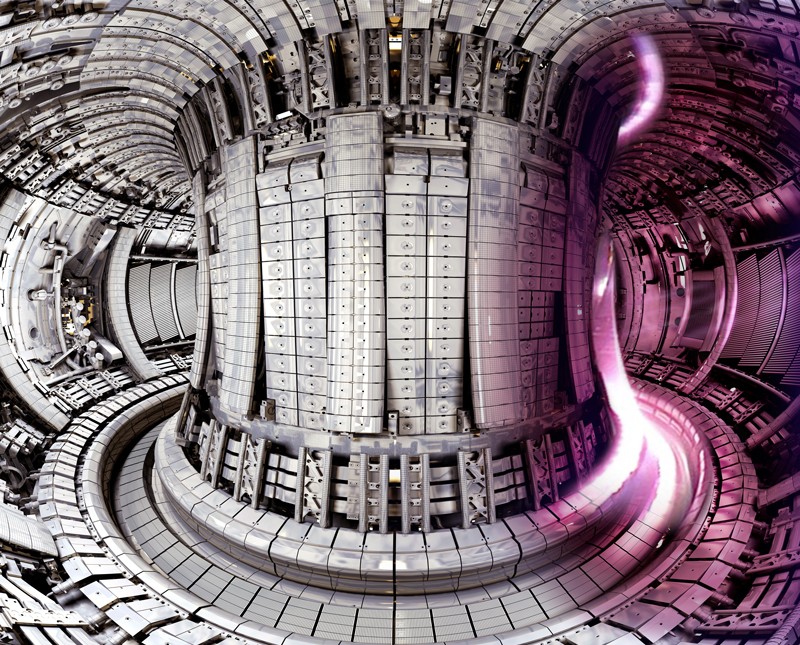
Fusion is not fission. Where conventional nuclear plants split heavy atoms like uranium, fusion forces light atoms together. Specifically, STEP will fuse isotopes of hydrogen, deuterium and tritium, at temperatures exceeding 100 million degrees Celsius, roughly ten times hotter than the core of the sun. At those temperatures, matter exists as plasma, a state where electrons are stripped from their atoms. Containing that plasma is the central engineering problem, and as the UK government’s fusion strategy outlines, STEP’s answer is a spherical tokamak, a doughnut-shaped magnetic cage that holds the superheated fuel away from the reactor walls.
What makes the STEP fusion reactor different
STEP is not the world’s only fusion project. ITER, the multinational experiment in southern France, aims to demonstrate net energy gain using a conventional tokamak design. But STEP takes a different shape. A spherical tokamak is more compact, with a plasma cross-section that looks less like a ring doughnut and more like a cored apple. This geometry produces a stronger magnetic confinement for a given magnetic field strength, which means the machine can potentially be smaller and cheaper than a conventional tokamak of equivalent performance. The UK Atomic Energy Authority (UKAEA) has been developing this approach for decades on its MAST-Upgrade experiment at Culham in Oxfordshire.
The strategy commits £1.3 billion directly to STEP through 2029, with construction expected to begin in 2030. Alongside the reactor, the government is investing £180 million in LIBRTI, a first-of-its-kind facility for designing tritium breeding blankets, and £45 million in Sunrise, a 1.4-megawatt AI supercomputer dedicated to fusion simulation. Sunrise, expected to be operational by June 2026, will compress plasma simulations that currently take a week into a matter of hours.
From coal to fusion at West Burton
The choice of West Burton is deliberate. The coal station closed in 2022, and the site already has grid connections, cooling water access, and transport links. Repurposing it for fusion brings engineering jobs to a region that lost them when coal disappeared. The strategy promises thousands of new roles and a dedicated skills programme called FOSTER, targeting over 2,000 newly trained individuals for the fusion sector. By April 2026, UK Fusion Energy, the delivery body formerly known as UKIFS, will have selected a construction partner to be fully integrated into the STEP team by October.
Engineering deep dive
How a STEP Fusion Reactor Works
Start with the fuel. Deuterium is extracted from seawater, where it occurs naturally at about 1 atom in every 6,500 hydrogen atoms. Tritium is rarer. It does not occur in useful quantities in nature, so a fusion plant must breed its own. STEP's breeding blanket, the component lining the inside of the reactor vessel, contains lithium. When neutrons produced by the fusion reaction strike lithium atoms, they transmute into tritium and helium. This is nuclear transmutation, the same underlying process that alchemists dreamed about, except here it serves an engineering purpose: making the fuel cycle self-sustaining. The LIBRTI facility will test breeding blanket designs before they are installed in STEP.
The plasma is confined by powerful magnetic fields generated by superconducting magnets cooled to near absolute zero, about minus 269 degrees Celsius. The temperature contrast inside a tokamak is staggering: 100 million degrees at the plasma core, and colder than deep space at the magnets just metres away. High-temperature superconducting (HTS) magnets, made from materials like rare-earth barium copper oxide (REBCO), are a key enabling technology. They generate stronger fields than older niobium-tin magnets at higher operating temperatures, which simplifies the cooling system. If you are studying electromagnetism at A-level, the Lorentz force, F = qv × B, is what keeps the charged plasma particles spiralling along the magnetic field lines rather than crashing into the walls.
Heating the plasma to fusion temperatures requires multiple systems working in concert. Neutral beam injection fires high-energy atoms into the plasma, transferring kinetic energy through collisions. Radiofrequency heating uses microwave-like waves, generated by devices called gyrotrons, to transfer energy to ions or electrons at their resonant frequencies. Once the plasma reaches ignition conditions, the fusion reactions themselves contribute to the heating, a self-sustaining burn that is the ultimate goal.
The spherical tokamak geometry gives STEP a particular advantage. In a conventional tokamak, the plasma is shaped like a ring doughnut with a large central hole. In a spherical tokamak, the hole is much smaller, and the plasma is fatter relative to its radius. This compact shape increases the ratio of plasma pressure to magnetic pressure, a dimensionless quantity called beta. Higher beta means more fusion power for a given magnet strength, which translates into a smaller, potentially more economical machine. MAST-Upgrade at Culham has been investigating high-beta plasmas since its upgrade completion, and STEP's design builds directly on those results.
Materials engineering is arguably the hardest unsolved problem. The reactor's first wall, the surface directly facing the plasma, endures intense neutron bombardment, high heat fluxes, and electromagnetic forces. Neutrons gradually damage the crystal structure of metals through a process called displacement damage, measured in units of displacements per atom (dpa). Over years of operation, this makes materials brittle and swollen. The Materials Research Facility at Culham tests candidate materials by irradiating them and measuring changes in mechanical properties. STEP must demonstrate that its first-wall materials can last long enough between replacements to make the plant commercially viable.
Remote maintenance adds another engineering dimension. Human access to the reactor interior is impossible during operation and impractical even during shutdowns because of residual radioactivity. UKAEA's RACE programme develops robotic systems for remote handling, inspection, and repair. These robots must work in confined, radioactive spaces with millimetre precision. The skills involved, robotics, control systems, computer vision, bridge mechanical and electrical engineering with software development, making fusion one of the most interdisciplinary engineering challenges in existence.
Links to the curriculum: A level
Whether STEP delivers on its 2040 target remains an open question. Fusion has a long history of promises deferred. But the engineering is no longer theoretical. Real magnets, real materials, and real plasma experiments are producing data that feeds directly into the design. The transition from coal to fusion at West Burton would be a powerful symbol, and more than that, a proof that engineering can replace what it once built.
Credit via gov.uk
Share
Related stories
All Energy & Environment
Energy & EnvironmentInnovation
Swansea Tidal Lagoon: The Renewable Energy Project Rises Again
Energy & EnvironmentBreakthroughs
Autonomous Robot Paves the Way for Safe and Efficient Fusion Facility Maintenance
Energy & EnvironmentInnovation