Construction & InfrastructureInnovation
The HS2 tallest bridge launch sees the 4,200-tonne Curzon 2 arched truss pushed 93m over live Birmingham rail lines in a precision engineering feat.
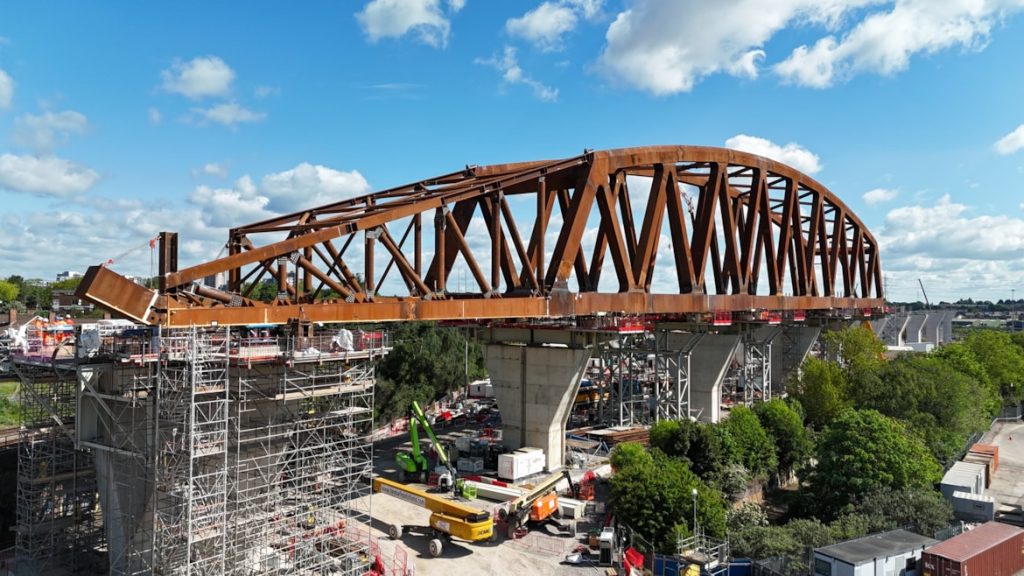
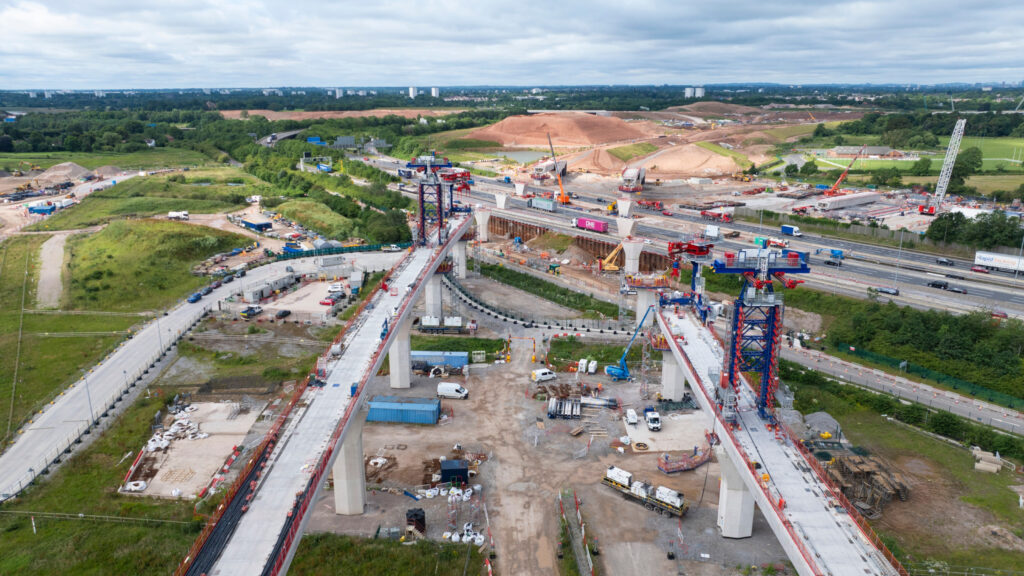
Somewhere in central Birmingham, a bridge taller than a ten-storey building is waiting to move. The Curzon 2 arched truss, the tallest structure on the entire HS2 network, has been assembled piece by piece over the past three years on a construction platform beside the Cross City railway line. This weekend, during a planned closure of the tracks between Birmingham New Street and Lichfield Trent Valley, it will be pushed 93 metres sideways across the operational railway. It weighs 4,200 tonnes. The HS2 tallest bridge launch is one of the most complex heavy-lift operations attempted on a British railway.
The numbers alone tell a story. The arched truss rises to over 40 metres at its peak and sits atop an existing Victorian-era railway viaduct that is itself 17 metres tall. Combined, the structures will carry HS2 trains across the existing rail corridor at a height that dominates the Birmingham skyline. The bridge was built by Balfour Beatty Vinci (BBV), the joint venture responsible for the central section of HS2, and involved around 250 engineers across design, fabrication, and assembly.
Curzon 2 is made from 670 individual steel sections, each fabricated off-site and transported to Birmingham for welding into triangular truss units. The steel is weathering steel, an alloy that forms a stable rust-coloured patina when exposed to the atmosphere. Unlike conventional painted steel, weathering steel does not need repainting over its lifetime, which reduces maintenance costs and the disruption of working at height above live railways. Over the coming months, the bridge’s surface will gradually darken from its current fabrication finish to a deep brown, a visual signal that the protective oxide layer is doing its job.
The triangular cross-section of the truss is not just an aesthetic choice. Triangular geometries distribute loads efficiently along three planes, giving the structure high torsional stiffness relative to its weight. For a bridge that must span a wide gap while carrying the dynamic loads of high-speed trains, torsional rigidity is as important as vertical strength. Trains passing at speed generate lateral forces and oscillations that a less rigid structure would transmit as vibration and noise to the surroundings.
The three-phase launch planned for the weekend of 29 to 31 May is itself a feat of temporary works engineering. The bridge will be moved on a system of hydraulic skid shoes running along greased tracks, inching forward at a pace measured in metres per hour. The operation must be completed within the weekend closure window. If something goes wrong and the bridge cannot be moved to its final position, the railway beneath must still reopen on Monday morning. That constraint shapes every aspect of the launch plan, from the capacity of the hydraulic systems to the contingency procedures for partial completion.
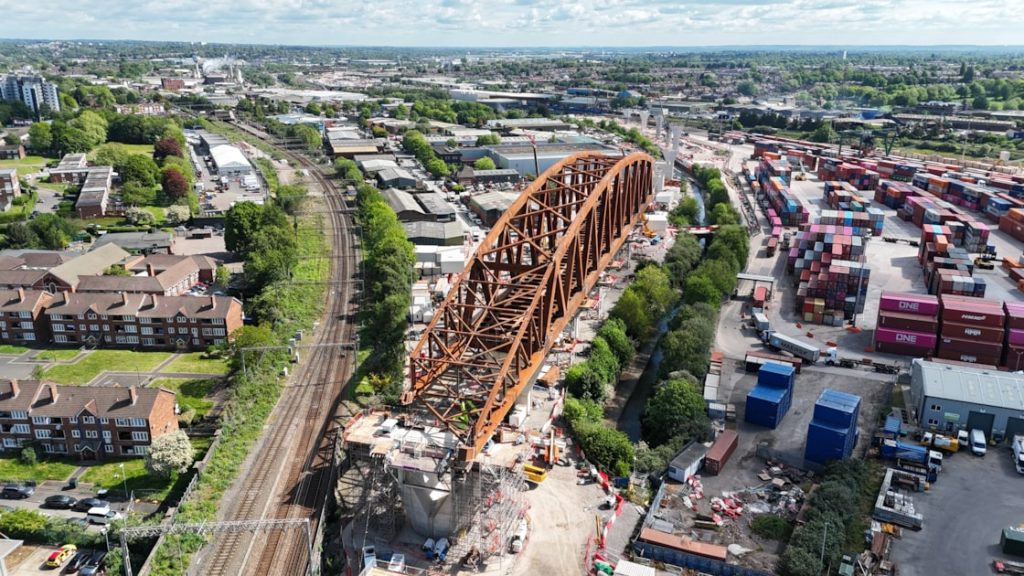
Curzon 2 is not an isolated structure. It is one of five interconnected viaducts that form the Curzon approaches, the final mile of HS2 track leading into Birmingham Curzon Street station. These viaducts thread through a dense urban environment, crossing roads, railways, canals, and utilities. Each one has been designed to fit a specific set of geometric and structural constraints dictated by what lies beneath and beside it.
The station itself, Curzon Street, will be HS2’s Birmingham terminus and the first major intercity rail station to be built in Britain since the Victorian era. The approaches are, in engineering terms, the hardest part. Running a railway through open countryside is relatively straightforward. Running one through the middle of a city, above existing transport corridors, without disrupting the services that millions of people depend on, is a problem that demands precision at every scale.
There is also an artistic dimension. The bridge will feature “Out of the Blue,” a light artwork by Liz West, integrated into the structure. Public art on infrastructure is not new, but designing an artwork that must withstand the vibration, temperature cycling, and environmental exposure of a railway bridge requires collaboration between artist and engineer from the earliest design stages. The installation will be visible to passengers on the Cross City line below, offering a view of HS2 from the perspective of the railway it crosses.
Engineering deep dive
Bridge launching is a technique used when a bridge cannot be built in its final position, typically because the gap it must span is occupied by something that cannot be interrupted. In the case of Curzon 2, that something is the Cross City line, one of the busiest commuter railways in the West Midlands. Building the bridge in place would require months of railway closure. Launching it sideways requires only a weekend.
The launch system uses hydraulic skid shoes, flat steel assemblies that sit on greased steel tracks and support the bridge's weight during the move. Hydraulic rams push or pull the skid shoes along the tracks in controlled increments. The friction coefficient of greased steel on steel is low enough that the force required to move the bridge is a fraction of its dead weight, but the system must be precisely aligned to prevent the bridge from drifting off course. Lateral guides and monitoring systems track the bridge's position in three dimensions throughout the launch.
Temporary works are the unsung discipline of civil engineering. The launch tracks, temporary supports, hydraulic systems, and monitoring equipment are all structures in their own right, designed to carry the full weight of the bridge under dynamic conditions. They must be installed without disrupting the railway, tested before the launch weekend, and removed afterwards without leaving any trace on the permanent works. The design of temporary works for a 4,200-tonne bridge launch is a project within a project.
Weathering steel has specific engineering properties that influenced the design. Its yield strength is comparable to that of conventional structural steel grades (typically 345 to 480 MPa, depending on the specification), but its corrosion behaviour is fundamentally different. Under normal atmospheric conditions, the initial corrosion products on weathering steel form a dense, adherent oxide layer that slows further corrosion to a negligible rate. The key requirement is that the steel undergo wet-dry cycles to form this protective patina. In permanently wet conditions or in environments with high chloride levels, weathering steel can corrode as fast as ordinary carbon steel. Birmingham's climate provides suitable conditions for patina formation.
The triangular truss configuration distributes loads along three chord members connected by diagonal web members. Under vertical loading from train weight, the top chord is in compression,a nd the bottom chords are in tension. Under lateral loading from wind or train dynamics, the inclined faces of the triangle resist the horizontal forces through a combination of axial loads in the web members and bending in the chords. This gives the section high stiffness in all directions without the weight penalty of a box girder or the maintenance demands of a cable-stayed design.
Fatigue is a primary design consideration for railway bridges. High-speed trains generate millions of load cycles over a bridge's design life, and every welded connection is a potential site for fatigue crack initiation. The 670 steel sections were welded using controlled procedures that specify preheat temperatures, interpass temperatures, and post-weld treatments designed to minimise residual stresses. Every critical weld was inspected using ultrasonic or radiographic testing to detect internal defects before the bridge left the assembly platform.
By Monday morning, if all goes to plan, the Curzon 2 arched truss will be sitting in its permanent position above the Cross City line, and commuter trains will be running beneath it as though nothing had happened. The 250 engineers who made it possible will have moved on to the next problem. There are four more viaducts to finish, a station to build, and a railway to open. The bridge is just one piece, but at 40 metres tall and 4,200 tonnes, it is a conspicuous one.
Credit via newcivilengineer.com
Construction & InfrastructureInnovation
Construction & InfrastructureInnovation
Construction & InfrastructureInnovation
Construction & Infrastructure