Construction & Infrastructure
Network Rail has renewed 4.6km of rail, 3,509 sleepers and 6,400 tonnes of ballast on Derbyshire's Derwent Valley Line in a single nine-day closure. Here is how a track-laying train does it, with the maths, and the rail jobs behind it.
For nine days this month, no passenger trains ran between Derby and Matlock. Instead, the line along the River Derwent belonged to the engineers, and to a long blue machine that lays a brand new railway as it rolls along.
On Monday 23 November, Network Rail announced that a £3 million track renewal of Derbyshire’s Derwent Valley Line was complete[1]. Services restarted that morning after teams renewed track at three places, Matlock Bath, Cromford and near Whatstandwell station, during a nine-day closure between Derby and Matlock[2]. The closure began on Saturday 14 November, as Railway-News reported ahead of the work[3].
The numbers are big for a short stretch of line. Engineers installed 4.6km of new rail, 3,509 new sleepers and 6,400 tonnes of ballast, replacing parts that had reached the end of their working life[4]. Network Rail says the new track will make the line more resilient and cut the need for future maintenance[5].
Eight engineering trains worked on the job, including a New Track Construction train, which lays new rails and sleepers as it travels[6]. Think of it as a factory on rails. On an earlier job, Network Rail explained that the machine moves new sleepers from wagons at the back onto a conveyor, which carries them to the front of the train where they are placed on the track bed[7]. The sleepers are then lined up at the right spacing automatically, and the new rail is fed through rollers and clamps and clipped onto them[8].
Each part has a clear job. Sleepers hold the two rails the correct distance apart and pass the weight of passing trains down into the ballast[9]. Ballast is the layer of stones beneath the track, and maintenance teams use tamping machines to pack it under the sleepers so the track keeps its shape[10]. Get the ballast wrong and the rails sink unevenly, which means rough rides and speed restrictions.
Why shut the line for nine days in a row? Eric Larocque, Network Rail’s operations director, said: “We know closing the railway for nine days caused disruption, but it allowed our teams to complete a substantial amount of essential work safely and efficiently-avoiding what would have otherwise involved eight weekend closures.”[11]
Every weekend closure means setting up the site, bringing in trains, then packing it all away and testing the line before Monday morning. One long closure only does that once, leaving far more hours for actual track laying. “Our teams have replaced thousands of sleepers and laid several kilometres of new rail, improving the resilience of the railway and reducing the need for future maintenance,” Larocque added[12].
Engineering deep dive
Engineers always sanity-check figures. Let's see if 4.6km of rail and 3,509 sleepers agree.
Step 1: track from rail. Every track has two rails. If 4.6km is the total length of new rail (Network Rail doesn't say exactly how it was measured, so this is our assumption), the length of track is 4.6 ÷ 2 = 2.3km.
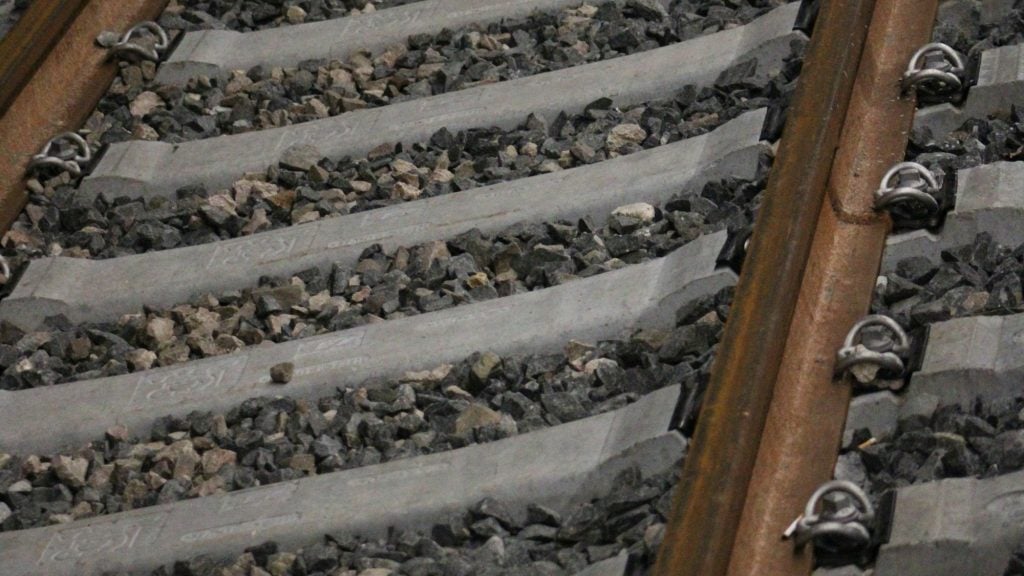
Step 2: track from sleepers. A UK railway standard recommends sleeper centres of 700mm on straight track and gentle curves[13]. Take that spacing as an assumption for this line. Then 3,509 sleepers cover about 3,509 × 0.7 = 2,456m, or roughly 2.5km.
The two answers, 2.3km and 2.5km, are within about 7% of each other. Tighter curves use closer sleepers, so the real figure probably sits between them. That is a good sign the numbers hang together.
Step 3: ballast per metre. Spread 6,400 tonnes along about 2,400m of track:
6,400,000 kg ÷ 2,400 m ≈ 2,700 kg per metre
That is more than two tonnes of stone under every metre, roughly the mass of a large car. Its weight on each metre is 2,700 × 9.81 ≈ 26,000 N.
Step 4: how long does laying take? Network Rail has said its New Track Construction machine can lay up to 180 metres of track per hour[14]. At that rate, 2,400m takes 2,400 ÷ 180 ≈ 13 hours of laying. That is far less than nine days, which shows how much of a closure goes on digging out old ballast, bringing in new stone, welding rails and tamping and testing everything. By comparison, Network Rail's high output teams can renew rails and sleepers over 1.2km in a single night on straight track[15].
Ratios, unit conversions and estimates like these are the bread and butter of A-level Maths. See how studying Maths A-level prepares you for engineering.
Links to the curriculum: A level, GCSE
Renewals like this are never really finished. Britain’s railway has thousands of kilometres of track, and every sleeper and rail eventually wears out. The challenge for engineers is doing more work in fewer, shorter closures, with faster machines and better planning, so passengers notice the smoother ride and not the disruption.
Behind this are track engineers who plan and design the renewal, engineering train operators who drive and run the track-laying machines, and site teams who weld, tamp and test the line before trains return. Network Rail’s Level 6 Rail and Rail Systems Engineer degree apprenticeship lets you specialise in track, signalling or civil engineering[16], and asks for five GCSEs at grade 4 or above, including Maths and English, plus three A Levels at BBB including Maths and a physical science[17]. Our guide to engineering degrees versus degree apprenticeships helps you compare the routes, and our beginner’s guide to finding an engineering apprenticeship shows where to look.
Credit via networkrailmediacentre.co.uk
£3m Derwent Valley Line upgrade completed to deliver smoother, more reliable journeys
A £3 million railway upgrade of Derbyshire's Derwent Valley Line has been completed, helping to deliver smoother and more reliable journeys for passengers and freight.
Checked 24 November 2026
£3m Derwent Valley Line upgrade completed to deliver smoother, more reliable journeys
Services resumed this morning (Monday 23 November) after Network Rail renewed track at three locations – Matlock Bath, Cromford and near Whatstandwell station – during a nine-day closure of the line between Derby and Matlock.
Checked 24 November 2026
UK: Passengers Urged to Plan Journeys Ahead of Work Along Derwent Valley Line
Network Rail has reminded passengers that there will be no trains between Derby and Matlock for nine days from Saturday 14 November as work begins to renew over 4.5km of track along the Derwent Valley Line.
Checked 24 November 2026
£3m Derwent Valley Line upgrade completed to deliver smoother, more reliable journeys
The major programme of work saw engineers install 4.6km of new rail, 3,509 new sleepers and 6,400 tonnes of ballast, replacing equipment which had reached the end of its working life.
Checked 24 November 2026
£3m Derwent Valley Line upgrade completed to deliver smoother, more reliable journeys
The improvements will make the railway more resilient, reducing the need for future maintenance and helping to minimise the risk of delays caused by track faults.
Checked 24 November 2026
£3m Derwent Valley Line upgrade completed to deliver smoother, more reliable journeys
Eight engineering trains were used during the work, including a specialist New Track Construction train, which lays new rails and sleepers as it travels.
Checked 24 November 2026
Making tracks at Norton Bridge
It works by transporting new sleepers from trailing wagons and places them onto the conveyor system which moves them to the head of the train before they are placed on to the track bed.
Checked 24 November 2026
Making tracks at Norton Bridge
The sleepers are then aligned to the correct spacing automatically and new rail is run through a series of rollers/clamps and clipped onto them.
Checked 24 November 2026
MOD UK Railways – Permanent way design and maintenance standards – issue 5
Sleepers perform the task of holding the rails the correct distance apart (gauge), and distributing to the ballast the load imposed on the rails by the rolling stock.
Checked 24 November 2026
using tamper and ballast regulators to redistribute ballast – the stones beneath the track that give support – and compact it beneath the sleeper so that it maintains the track geometry
Checked 24 November 2026
£3m Derwent Valley Line upgrade completed to deliver smoother, more reliable journeys
We know closing the railway for nine days caused disruption, but it allowed our teams to complete a substantial amount of essential work safely and efficiently – avoiding what would have otherwise involved eight weekend closures.
Checked 24 November 2026
£3m Derwent Valley Line upgrade completed to deliver smoother, more reliable journeys
Our teams have replaced thousands of sleepers and laid several kilometres of new rail, improving the resilience of the railway and reducing the need for future maintenance.
Checked 24 November 2026
MOD UK Railways – Permanent way design and maintenance standards – issue 5
Straight and curves >600m radius - 700mm (26/standard 18.288m length)
Checked 24 November 2026
Making tracks at Norton Bridge
The High Output New Track Construction (NTC) machine, which has laid the new railway, can lay up to 180 metres of track per hour and is up to 50 per cent quicker than conventional track laying methods.
Checked 24 November 2026
Each night, HO teams replace up to a mile (1.6km) of ballast, and renew rails and sleepers over ¾ of a mile (1.2km), on the plain-line (straight) track.
Checked 24 November 2026
Level 6 Rail & Rail Systems Engineer – Network Rail Early Careers
Depending on your pathway, you will specialise in Track, Signalling or Civil engineering and contribute to work that supports the safety, reliability and future performance of the network.
Checked 24 November 2026
Level 6 Rail & Rail Systems Engineer – Network Rail Early Careers
You will need five GCSEs at a minimum of grade 4, including Maths and English, and three A Levels at a minimum of BBB, including Maths and a Physical Science, or relevant equivalent qualifications.
Checked 24 November 2026
Construction & Infrastructure
Automotive & Transport
Construction & Infrastructure
Automotive & Transport