ChemicalsBreakthroughs
Engineers at Oxford, UCL and UNAM filmed raindrop-sized drops hitting water covered in plastic particles, and found the splash and a thin upward jet can both fling microplastics into the air.
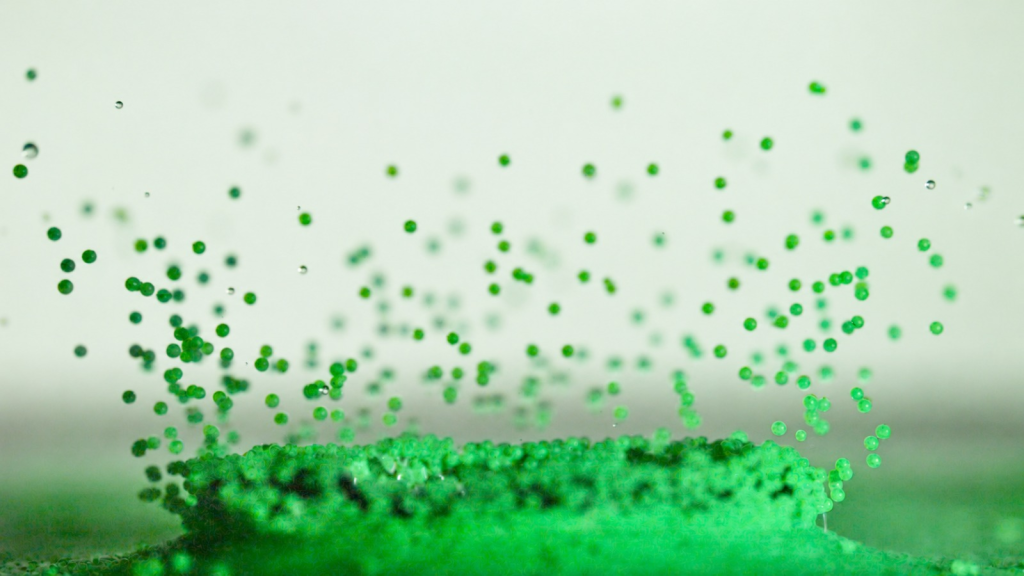
Rain on the sea seems calm, but when you watch it in slow motion with a high-speed camera, each drop looks like a tiny explosion. A drop hits the water, forms a crater, a ring of spray appears, and a thin column of water shoots up from the center. Engineers from the University of Oxford, University College London (UCL), and the National Autonomous University of Mexico (UNAM) used these slow-motion images to see if rainfall could help spread plastic pollution.[1]
The researchers used high-speed cameras to watch water droplets hit a surface covered with tiny plastic particles. They published their findings in the Journal of Colloid and Interface Science.[2] They discovered that microplastics can get into the air in two ways: from the first splash and from a thin jet of water that shoots up when the crater left by the drop closes.[3] This upward jet is called a Worthington jet. In their preprint, the team explains that it forms when the cavity made by the drop closes and pushes momentum upward along the center.[4] In some tests, a single droplet that was thrown up carried about 100 microplastic particles.[5]
The most surprising finding was how important the surface of each particle was. “What struck me most was how changing just the surface properties of the particles could completely change what happened to them when a drop hit the water,” said lead author Muhammad Hamza Iqbal, a PhD researcher at UCL[6].
The preprint talks about rafts made of fluorescent polyethylene, plain polyethylene, and glass particles, with some treated to be very water-repellent.[7] These super water-repellent particles acted differently. Some formed tiny droplets covered in a plastic shell, called liquid marbles, which do not easily mix back into the water. This means the plastic can stay spread out for longer.
This research comes from Professor Alfonso Arturo Castrejón-Pita’s Fluid Dynamics Laboratory at Oxford, which studies drops and liquid jets.[8] “Microplastics are now everywhere and understanding how they spread is hugely important if we are to track them and perhaps eventually contain them,” he said[9].
The researchers are clear about what their study shows and what it does not. Their experiments were done in controlled lab conditions, so more work is needed to see how important this process is in the ocean. Real rain falls at different speeds, real waves stir the water, and real plastic is much messier than the clean lab particles. Still, the study gives a clear view of the mechanism, which is the first step before measuring it in nature.
There is an interesting connection for people who like making things. The same physics of drops and jets is important for inkjet and 3D printing, which are also studied in the lab.[10] If you understand how a drop acts when it hits a surface, you can use that knowledge to print circuits or track pollutants. If you are unsure which type of engineering is right for you, our guide to engineering disciplines is a good place to begin.
Engineering deep dive
Fluid engineers describe drop impacts with dimensionless numbers, ratios that compare one force with another. Two matter here.
The Froude number compares inertia with gravity: Fr = U² ÷ (gD), where U is the impact speed, g is 9.81 m/s² and D is the drop diameter. In the preprint the drop is 2.55 mm across[11], and one run is described by a Froude number of 471[12]. Rearranging gives the speed:
U² = Fr × g × D = 471 × 9.81 × 0.00255 ≈ 11.8 m²/s², so U ≈ 3.4 m/s
Now the mass. A drop is a sphere, so its volume is (π ÷ 6) × D³ = 0.524 × 0.00255 × 0.00255 × 0.00255 ≈ 8.7 × 10⁻⁹ m³. Water has a density of 1,000 kg/m³, so the drop weighs about 8.7 × 10⁻⁶ kg, or 8.7 milligrams.
Kinetic energy = ½mv² = 0.5 × 8.7 × 10⁻⁶ × 11.8 ≈ 5 × 10⁻⁵ J
That is about the energy needed to lift a 1 g paperclip by 5 mm. Tiny, yet it sits right in the range the preprint gives for real millimetre-sized raindrops hitting the ocean, between 10⁻⁵ and 10⁻⁴ J[13].
The Weber number, We = ρU²D ÷ σ, compares inertia with surface tension σ, the "skin" that holds a drop together. Big We means the drop smashes; small We means it bounces or merges. On clean water the crown splash only starts at around We ≈ 193[14]. On rafts of the smallest water-repellent particles, splashing starts at much lower values, around We ≈ 65 to 101[15].
Because We depends on U², the speed needed scales with the square root. √(65 ÷ 193) ≈ 0.58 and √(101 ÷ 193) ≈ 0.72. So on a water-repellent plastic raft, a drop needs only about 58% to 72% of the speed it would need to splash clean water. Rearranging equations, kinetic energy and density are all A-level Physics, and our guide to how a Physics A-level prepares you for engineering shows where they lead.
Links to the curriculum: A level, GCSE
The big question is about scale. No one knows yet how much plastic rain lifts off the oceans each year or how far those particles travel in the air. To answer this, scientists will need to take measurements at sea and use models that combine lab physics with real wind, waves, and weather.
Fluid dynamics engineers design experiments like these and build the high-speed camera setups to film them. Environmental engineers track where pollution goes after it leaves the water. Many fluid dynamics experts begin with a mechanical engineering degree, and our guide to mechanical engineering careers, degrees, and vocational qualifications explains the different paths, including apprenticeships.
Image: University of Oxford Department of Engineering Science
Credit via eng.ox.ac.uk
Could raindrops be launching microplastics from the ocean into the air?
Researchers from the University of Oxford, University College London (UCL), and the National Autonomous University of Mexico (UNAM) have been investigating whether something as ordinary as rainfall could play a part.
Checked 3 November 2026
Could raindrops be launching microplastics from the ocean into the air?
the team used high-speed cameras to observe what happens when water droplets strike a surface covered with microscopic plastic particles.
Checked 3 November 2026
Could raindrops be launching microplastics from the ocean into the air?
They found that microplastics can be thrown into the air in two ways: through the initial splash, and through a thin jet of water that shoots upwards as the crater left by the drop collapses.
Checked 3 November 2026
a Worthington jet formed when the transient cavity created by the impacting drop collapses and focuses momentum upward along the symmetry axis
Checked 3 November 2026
Could raindrops be launching microplastics from the ocean into the air?
In some experiments, a single ejected droplet carried around 100 microplastic particles.
Checked 3 November 2026
Could raindrops be launching microplastics from the ocean into the air?
Muhammad Hamza Iqbal, lead author of the study and PhD researcher at UCL, said: "What struck me most was how changing just the surface properties of the particles could completely change what happened to them when a drop hit the water."
Checked 3 November 2026
fluorescent polyethylene, polyethylene (FPE and PE) and glass
Checked 3 November 2026
In Oxford, he established the Fluid Dynamics Laboratory for (mainly) the study of drops and liquid jets.
Checked 3 November 2026
Could raindrops be launching microplastics from the ocean into the air?
Microplastics are now everywhere and understanding how they spread is hugely important if we are to track them and perhaps eventually contain them.
Checked 3 November 2026
InkJet and additive manufacturing (3D Printing)
Checked 3 November 2026
In brief, a 2.55 mm water droplet is generated from a syringe pump and released onto a quiescent pool
Checked 3 November 2026
Fr = 471
Checked 3 November 2026
Millimetric raindrops strike the ocean surface with kinetic energies on the order of 10^-5 - 10^-4 J
Checked 3 November 2026
We ≈ 193
Checked 3 November 2026
We ≈ 101-65
Checked 3 November 2026
ChemicalsBreakthroughs

Energy & Environment
Energy & Environment
Construction & Infrastructure